
- Morgan Stanley files an S-1 for trusts tracking Bitcoin (BTC) and Solana (SOL).
- The Solana trust will stake SOL, reflecting staking rewards in its NAV.
- SOL price rises 2.44%, breaking a key Fibonacci resistance level.
Morgan Stanley has officially submitted a Form S-1 filing with the U.S. Securities and Exchange Commission (SEC) to create spot trusts for Bitcoin and Solana.
The filing underscores the bank’s growing interest in the cryptocurrency sector and aligns with Morgan Stanley’s strategy to provide clients with diversified access to digital assets.
The proposed Solana Trust would give investors indirect exposure to Solana (SOL) without requiring direct ownership of the cryptocurrency.
Morgan Stanley’s institutional move into Solana
The S-1 describes plans to structure the Solana Trust as a Delaware statutory trust.
Shares of the trust are expected to track SOL’s market performance via a specified price reference index.
The trust will custody a portion of its Solana holdings with regulated third-party custodians.
Through a staking mechanism, rewards earned from staking SOL will be reflected in the fund’s net asset value (NAV).
Morgan Stanley’s filing signals growing regulatory comfort with Solana-based financial products and follows the adoption path seen with bank-backed Bitcoin ETFs, which attracted significant inflows upon launch.
The trust will be managed passively, meaning it will hold Solana without active trading or leverage.
Custody arrangements will involve regulated third parties to safeguard investor assets.
The S-1 remains preliminary; sales of trust shares will only be permitted once the SEC declares the registration effective.
For investors seeking Solana exposure through traditional brokerage accounts, this trust could provide a new, regulated avenue.
Implications for the crypto market
Institutional adoption of this kind tends to reduce sell pressure on staked assets and can support price stability.
Currently, more than 563 million SOL are staked across the network, contributing to supply discipline.
Morgan Stanley’s Bitcoin product will be named the Morgan Stanley Bitcoin Trust.
Like the Solana Trust, the Bitcoin Trust will hold Bitcoin outright, without using derivatives or leverage, and will calculate its NAV daily based on a price reference index sourced from major spot exchanges.
The fund will follow a passive strategy and will not engage in active trading of Bitcoin in response to market conditions.
Notably, Morgan Stanley’s filing comes after Bitwise reported a $16.8 million inflow into a Solana ETF earlier this week, reflecting rising institutional interest in SOL.
The move also aligns with a broader altcoin rotation as Bitcoin dominance softens and investors search for higher-beta opportunities.
Regulators’ responses will be monitored closely, particularly in the context of other pending decisions such as the VanEck Solana ETF timeline.
Market participants view this development as a positive signal for Solana’s long-term growth and liquidity.
Solana price reaction
Solana’s price has responded to these developments with a notable uptick.
Over the last 24 hours, Solana (SOL) rose 2.44% to $138.77, outperforming Bitcoin (BTC) and closely following Ethereum (ETH).
Altcoin trading volume also jumped 43% to $5.1 billion, marking the strongest activity since December 2025.
Technical indicators show SOL has reclaimed the 23.6% Fibonacci retracement level at $138.45 and cleared the 7-day simple moving average at $130.50.
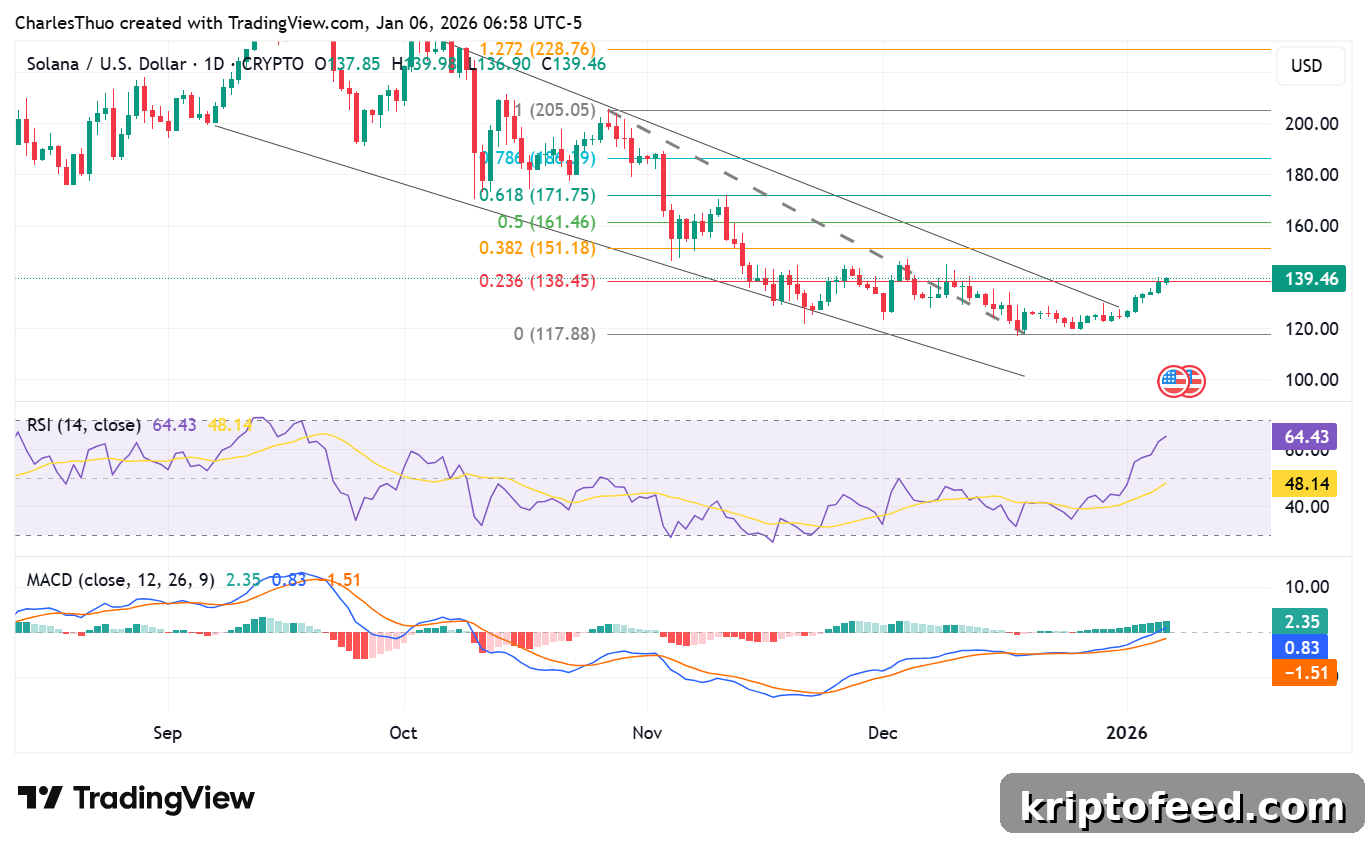
The MACD histogram has turned positive, confirming bullish momentum, and the 14-day RSI is positive though approaching overbought territory.
Immediate resistance sits near $151.18, with support around $117.88, consistent with Fibonacci levels.
The market is likely to watch whether SOL holds above the $138.45 support level to confirm continued upside momentum.
However, an upcoming options expiry on January 7 adds a layer of short-term volatility, with roughly $145 million in SOL contracts expected to expire.