
- Bitcoin approaches a record-setting $124,000 after a strong September and an “Uptober” rally.
- Institutional ETF inflows and corporate purchases are fueling the upward momentum.
- Analysts predict $160,000–$200,000 if demand continues into Q4.
Bitcoin (BTC) has entered the final quarter of 2025 with the kind of momentum traders hoped for, breaking the $120,000 barrier and reigniting talk of new all-time highs.
The rally follows an unexpectedly strong September and is already being called the beginning of a historic “Uptober.”
BTC now hovers just a few percentage points below its August high of $124,128, and analysts and on-chain observers say conditions could support a push toward $200,000 before year-end if buying persists.
Seasonal strength takes hold
September closed above $114,000—about a 5% monthly gain—overcoming typical seasonal weakness and setting the stage for October’s breakout.
Historically, when September finishes in the green, the fourth quarter has produced outsized returns; in years such as 2015, 2016, 2023 and 2024, the average Q4 gains exceeded 50%.
That pattern, combined with average October gains of 21.8% and November gains of 10.8%, has reinforced “Uptober” as more than just a crypto trader’s slogan.
This month alone, Bitcoin has rallied nearly 10% in a single week, extending a roughly 27% gain year-to-date.
The proximity to its all-time high adds to the sense that new records are within reach if demand continues.
Institutions ramp up BTC demand
Institutional activity is setting the tone behind the price action.
U.S. spot Bitcoin ETFs have drawn billions in inflows since early September, including more than $600 million on back-to-back days and $2.25 billion over the most recent week.
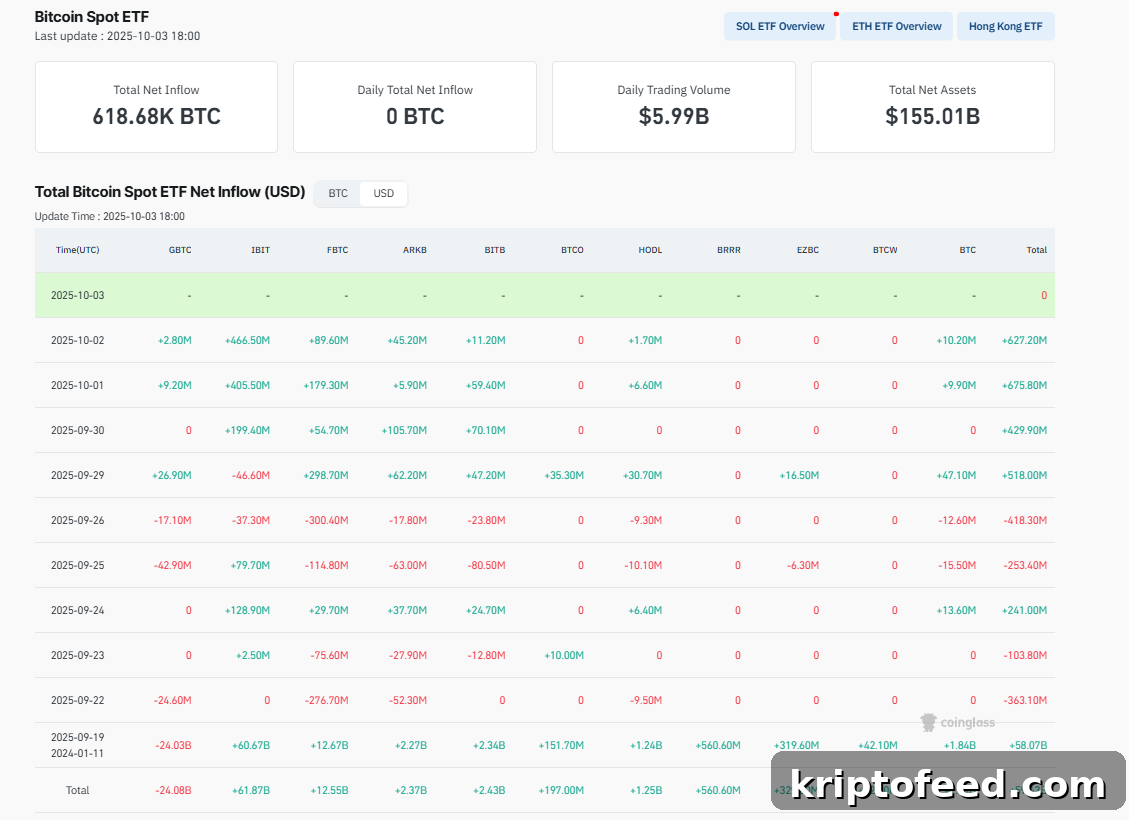
BlackRock’s IBIT ETF has become a focal point of this demand, with open interest in its options topping $38 billion and even surpassing Deribit, historically the largest derivatives venue.
Corporate buyers are also reinforcing the uptrend. Strategy, formerly MicroStrategy, now controls roughly 3.2% of Bitcoin’s total supply after adding more than 11,000 coins in recent weeks.
Steady accumulation reduces exchange supply and signals confidence from long-term holders.
That sustained buying pressure creates upward momentum that markets find difficult to ignore.
Technical breakout reinforces momentum
The technical picture supports the move. Bitcoin decisively broke above $119,500, a resistance level that had capped prices through the end of September.
Indicators such as MACD and RSI are flashing bullish signals while price remains above short-term moving averages.
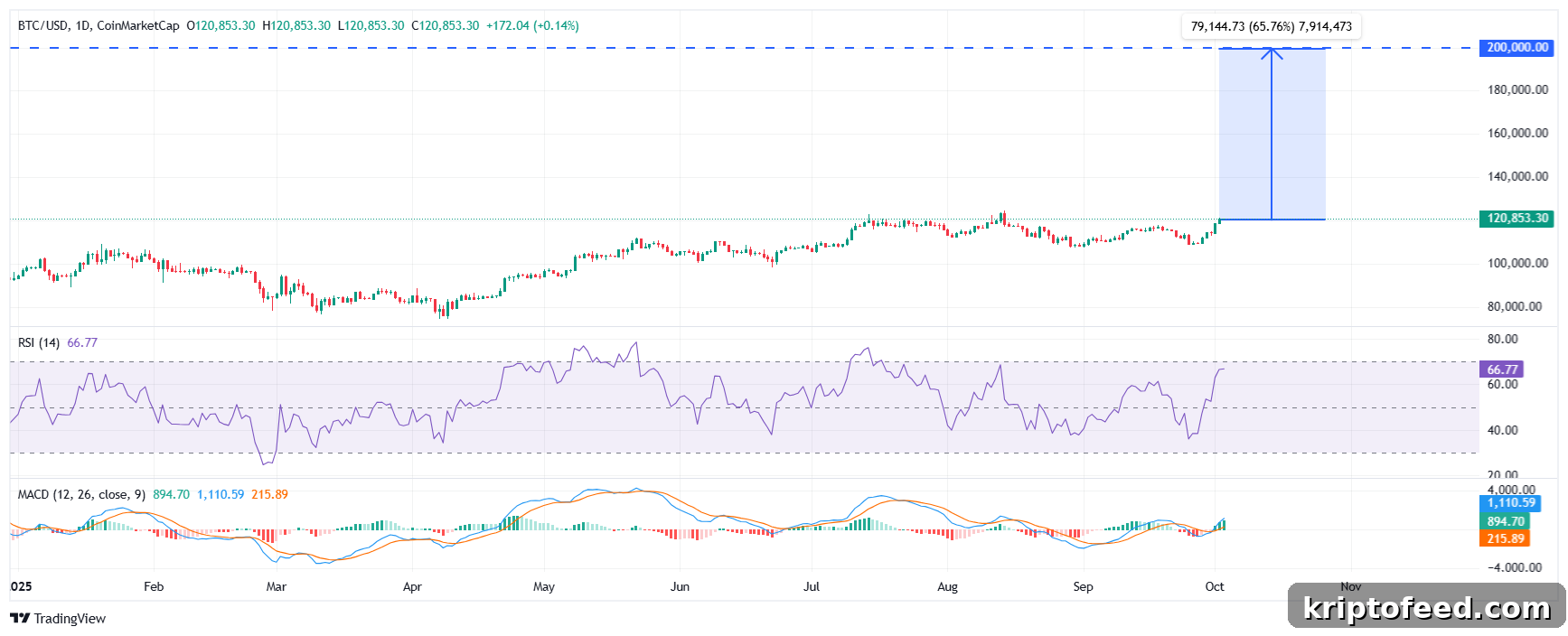
Eyes are now on $124,600 as the next test, with Fibonacci extensions pointing to near-term targets between $128,000 and $130,000.
Beyond that, the broader narrative becomes more ambitious. JPMorgan’s recent analysis likens Bitcoin to gold and suggests a theoretical fair value of $165,000 if adoption trends converge.
Citi has published a 12-month target of $181,000, and Standard Chartered has gone further, forecasting that institutional flows could lift Bitcoin to $200,000 by year-end.
CryptoQuant’s bull point index sits around 40–50, comparable to levels before major breakouts in 2020 and 2024, and the firm believes Bitcoin could reach $160,000–$200,000 this quarter if demand holds.
The U.S. government shutdown has also shaken confidence in traditional markets and pushed investors toward hard assets like Bitcoin and gold.
$200,000 in sight
The combination of seasonal strength, institutional inflows, technical momentum and macro uncertainty has created a set of conditions Bitcoin has rarely faced.
With the asset trading just shy of its all-time high and liquidity continuing to flow in, analysts argue that $200,000 is no longer an extreme outlier but a realistic scenario if buying pressure persists through the quarter.
The key question remains whether Bitcoin can sustain closes above $120,000 and decisively break past $124,000.
If it can, “Uptober” could prove to be the spark that drives the world’s largest cryptocurrency into its most explosive rally yet.