
- Celestia’s TIA token rebounded to $1 on October 14, 2025, after plunging to $0.27 on October 10.
- Technical indicators, however, still point to lingering weakness amid recent bearish momentum.
- Short-term forecasts suggest immediate resistance near $1.20 as bulls attempt to reinforce the recovery from recent lows.
Celestia (TIA) has climbed back above $1 as buyers show resilience in a turbulent crypto market. As the native token of the modular blockchain seeks further gains, what does the near-term outlook look like?
The market recovery follows a steep crash that pushed TIA to fresh lows below $0.30 on October 10, 2025. A number of altcoins, including Bittensor, have posted notable rebounds since that rout.
Celestia price plunged below $0.30
TIA experienced a sharp decline amid a broader sell-off that hit Bitcoin and many altcoins last week, falling to a new all-time low of $0.27. The drop reflected a mix of structural vulnerabilities and market-wide negative sentiment that disrupted the upbeat momentum many traders had been banking on in early October.
Bitcoin’s slide below $105,000 on October 11 intensified selling pressure across the market and drove TIA through key support levels at $1.35 and $1.00 before it found a floor around $0.27. The crash erased billions in market value, but buyers later pushed the token back up toward $0.93.
On Monday, TIA briefly rose to $1.26 before pulling back amid renewed macroeconomic jitters, including concerns tied to US-China trade relations that weighed on risk assets. Even so, the token has looked to maintain footing above the $1 mark.
TIA price outlook
The near-term trajectory for TIA is cautiously optimistic, supported by technical signs of rebound and the project team’s ongoing strategic messaging. The Celestia team has likened the network’s potential role in providing modular infrastructure to the way Amazon Web Services shaped web2, emphasizing that the protocol is still early but positioning itself as a key provider of blockspace demand.
Technically, the daily Relative Strength Index (RSI) sits around 39, having recovered from oversold territory below 30. That improvement suggests selling exhaustion and increases the likelihood of a mean reversion—an effect that has historically preceded notable bounces for TIA, such as the rise from $1.35 to $2.28 in July 2025.
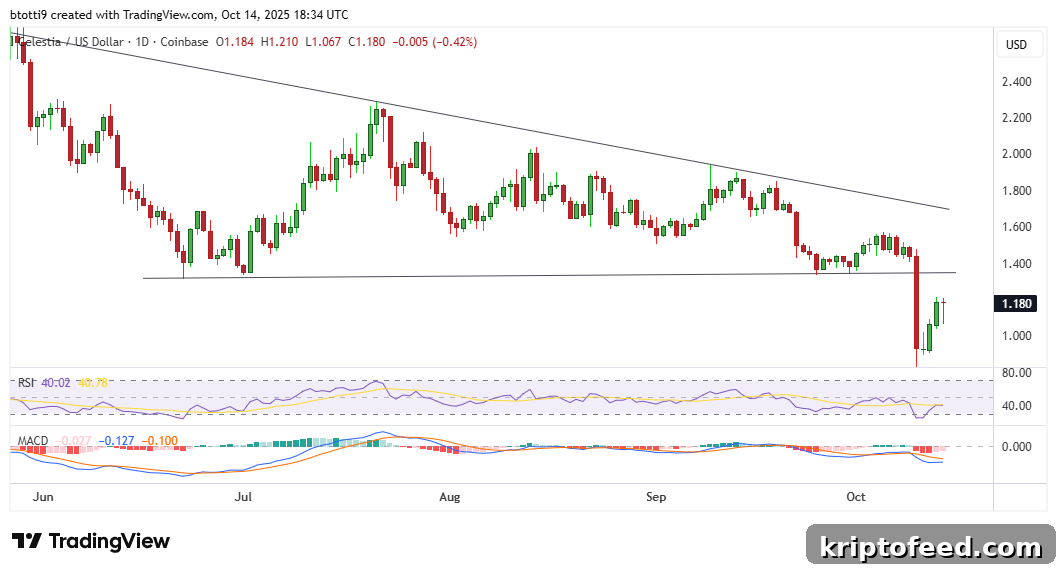
The Moving Average Convergence Divergence (MACD) still reflects bearish momentum, but the histogram is narrowing, which could signal a weakening of downward pressure. A developing bullish divergence also points to accumulating buy-side pressure that may support further recovery attempts.
Short-term projections have placed potential ranges between roughly $2.27 and $3.40 if buying momentum strengthens. Before those levels can be targeted, bulls need to decisively clear the immediate supply zone near $1.20. Additional resistance lies at about $1.54 and $1.90.
In more bullish scenarios, Celestia could aim for mid-to-high single-digit targets over the coming months, with some optimistic projections reaching the $10–$14 area. The all-time high above $20 recorded in February 2024 remains a possible long-term target within the current cycle, though it would require sustained market-wide recovery and strong network fundamentals.
Conversely, failure to hold the $1 support level could open the door for bears to push TIA back below $0.90, testing lower support zones and potentially prolonging the consolidation or downtrend.