- Users were unable to access accounts or execute trades for more than two hours
- Other affected platforms included Snapchat, Reddit, Hulu, Xbox and Fortnite
- Crypto traders expressed frustration as reliability concerns resurfaced
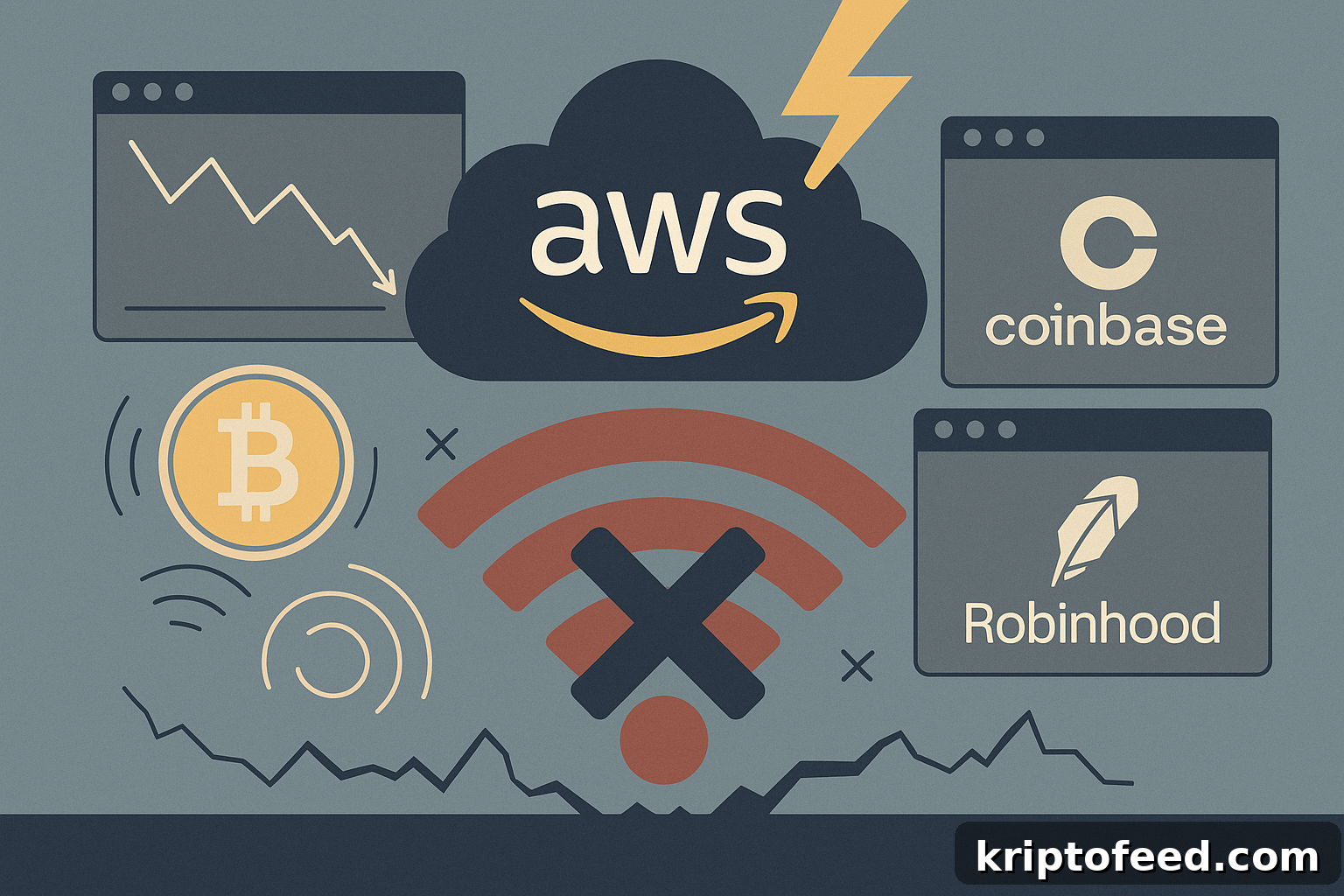
A major internet disruption on Monday briefly halted parts of the digital economy after an Amazon Web Services (AWS) outage disabled platforms including Coinbase and Robinhood.
The roughly two-hour outage interrupted trading activity, streaming services and gaming networks, reminding users how heavily the world depends on cloud infrastructure.
The outage, which began early Monday, affected users across regions, leaving many locked out of accounts or unable to complete transactions.
AWS failure halts major crypto exchanges
Coinbase, one of the world’s largest cryptocurrency exchanges, was among the first to report issues.
Users attempting to log in or place trades encountered error messages and timeouts.
The exchange later confirmed the problems were caused by the ongoing AWS outage and reassured customers that funds remained secure.
Coinbase’s social post on X stated, “We are aware many users are unable to access Coinbase due to an AWS outage. Our team is working to resolve this and we will provide updates here. All funds are secure.”
The exchange resumed full operation after more than two hours, but traders voiced displeasure online—some alleging losses or hinting at potential legal action over interrupted trades.
Robinhood, another major trading platform, also confirmed technical issues tied to AWS.
“AWS (one of our third-party providers) is experiencing an outage,” the platform said on X, assuring customers their teams were working on fixes.
For investors trading fast-moving digital assets, even short outages can mean missed opportunities and price slippage, reigniting debate over the industry’s dependence on centralized cloud providers.
Wide internet disruption highlights cloud dependence
The AWS failure did not stop at crypto platforms.
Numerous well-known online services—including Snapchat, Reddit, Hulu, Grammarly, Xbox Network, Fortnite and Electronic Arts—also experienced slowdowns or temporary access issues.
The outage underscored how deeply Amazon’s infrastructure is embedded in global online operations, from financial transactions to entertainment and gaming.
While cloud computing offers flexibility and scalability, it concentrates risk when a major provider suffers downtime.
AWS remains the backbone for thousands of businesses, making the impact of such outages immediate and widespread.
Monday’s event raised fresh questions about redundancy and disaster planning across industries that rely on third-party hosting.
Repeated outages raise reliability concerns
The recurrence of outages magnified broader concerns within the crypto community about platform reliability during volatile market conditions.
Retail investors depend on continuous access to execute time-sensitive trades, and any downtime can erode confidence in trading venues.
Industry observers noted that as digital asset adoption grows, exchanges must invest more in resilient infrastructure and transparent communication.
AWS faces scrutiny as dependency grows
Amazon Web Services has long been the world’s largest cloud provider, hosting many of the internet’s most popular platforms.
However, intermittent outages expose single points of failure that ripple beyond crypto to affect many aspects of online life.
Each event fuels concern that too many global businesses rely on a single company for critical online operations.
AWS has not provided a detailed root cause for Monday’s disruption, but confirmed service recovery later in the day.
The incident has renewed discussion about cloud diversification, prompting companies to reassess hybrid or multi-cloud strategies to reduce future risk.
As the digital economy continues to expand, outages like this serve as reminders of the fragility beneath otherwise seamless services.
Even brief disruptions can reverberate across finance, communications and entertainment—illustrating how interconnected and centralized large portions of the internet have become.