
- The Mantra (OM) token has slipped below $0.40, with the RSI at 17.18, signaling oversold conditions.
- 300 million OM tokens are set to be burned to reduce supply, yet a sustained price recovery remains elusive.
- The Mantra team is planning governance reforms to rebuild trust, although volatility persists.
The native token of the Mantra protocol, OM, has fallen below $0.40, sparking speculation about a potential rebound as its Relative Strength Index (RSI) drops to an oversold reading of 17.18.
This steep decline follows a dramatic crash in April 2025 that wiped out billions in market value and shook investor confidence.
With technical indicators sending strong bearish signals and the MANTRA team implementing token burns and governance changes, the central question remains: can OM recover, or is further downside likely?
A catastrophic OM token crash and lingering effects
On April 13, 2025 the OM token plunged from $6.30 to $0.37 within hours.
The collapse slashed the project’s market capitalization from roughly $6 billion to under $700 million.
That sudden drop, blamed on forced liquidations during low-liquidity weekend trading, triggered rumors about exchange involvement, which the team promptly denied.
CEO John Mullin released on-chain data to refute claims of insider selling and confirmed that team-held tokens remained locked.
In response to the crisis, MANTRA leadership took decisive steps to stem selling pressure.
On April 29, 2025, CEO John Mullin burned 150 million staked OM tokens from the team allocation.
An additional 150 million tokens from ecosystem partners are slated for destruction, totaling 300 million OM—about 16.5% of the circulating supply.
This substantial reduction is intended to tighten supply and help restore investor confidence.
So far, the market has not reacted positively, as OM remains below key technical thresholds and skepticism persists.
Beyond token burns, the MANTRA team is pursuing structural changes to rebuild trust.
Plans to decentralize validators and strengthen governance aim to boost the protocol’s resilience and transparency.
While these initiatives are promising, they take time to implement and may not immediately influence price action.
Despite these measures, investor confidence remains fragile and OM is struggling to regain footing.
Market participants remain cautious as volatility continues to dominate the short-term outlook for OM.
The success of the reforms underway will be pivotal in determining whether MANTRA can reclaim its former standing or continues to falter.
Technical indicators show OM in oversold territory
From a technical standpoint, MANTRA’s price sits well below its 20-day EMA of $0.51 and its 50-day EMA of $0.74, underscoring a pronounced downtrend.
However, the daily Relative Strength Index (RSI) sits around 17.01, one of the lowest levels since the April crash, indicating extreme oversold conditions.
Historically, RSI readings below 20 have often preceded relief rallies as buyers step in to take advantage of perceived undervaluation.
Additionally, the MACD has produced a crossover and the histogram has moved toward the zero line, a bullish technical development.
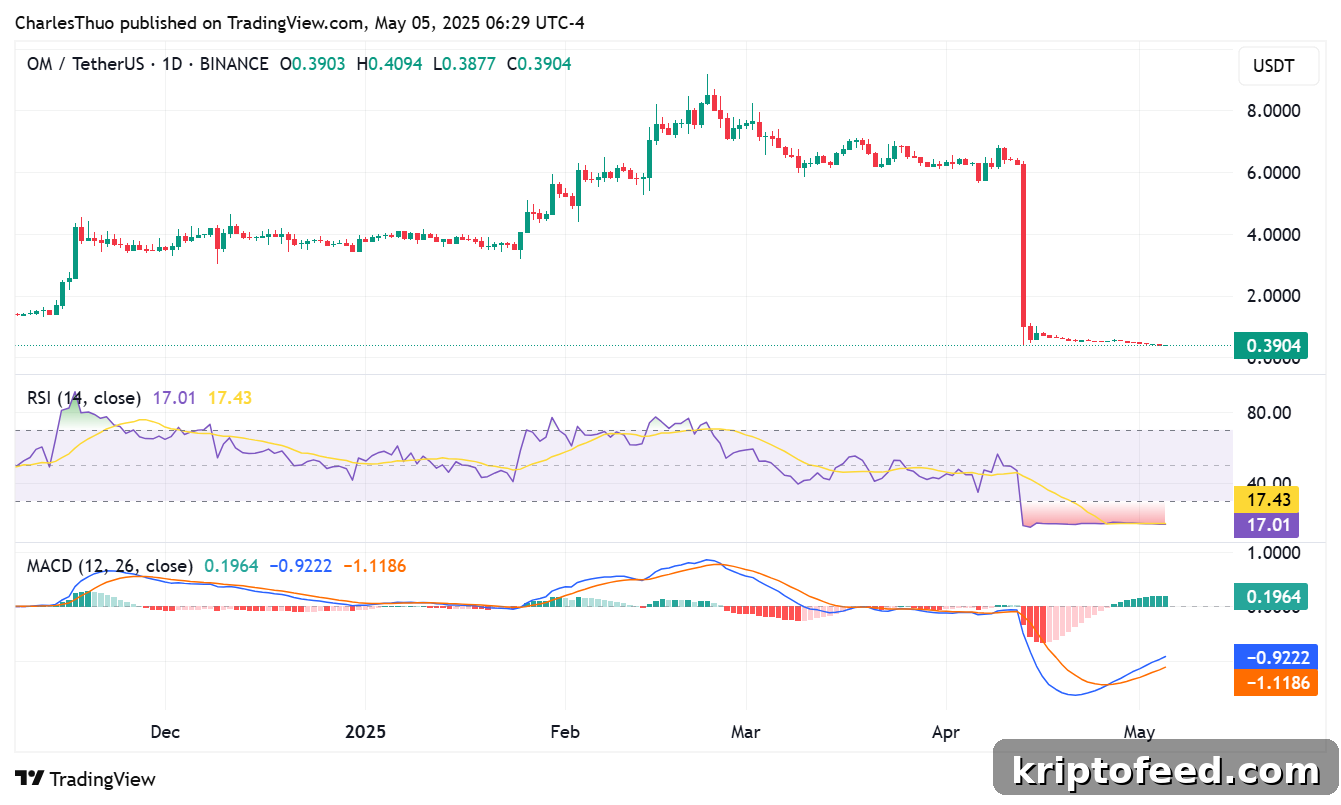 Mantra price chart by TradingView
If buying momentum materializes, OM could target resistance near $0.42, with a break above $0.54 offering a stronger bullish confirmation.
Failure to hold support at $0.37 risks a slide toward $0.30, which could trigger further panic selling.
Can the Mantra price stage a comeback?
The convergence of an oversold RSI, significant token burns, and planned protocol upgrades creates a mixed outlook for MANTRA.
While technical indicators leave open the possibility of a bounce, a sustainable recovery depends on renewed investor confidence.
The $0.42–$0.54 range will be critical for bulls, while a drop below $0.37 would likely deepen bearish sentiment.
As MANTRA navigates this turbulent period, its ability to deliver promised reforms and stabilize price action will shape its future trajectory.
For now, traders are watching closely, balancing the potential for recovery against the risk of further declines.