
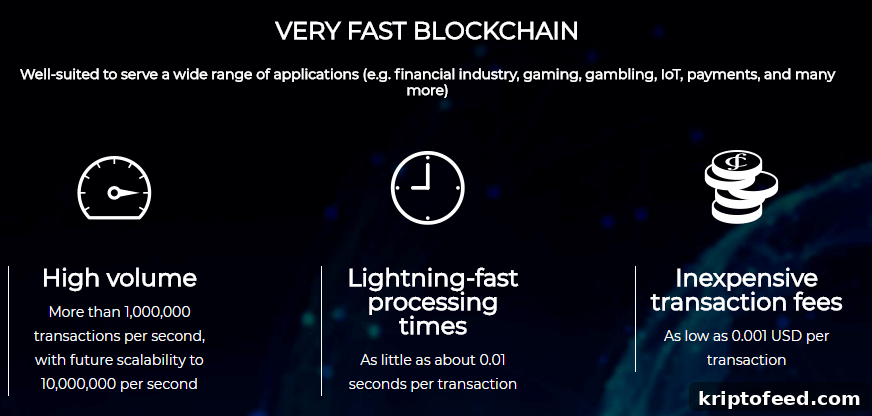
The CREDITS blockchain platform achieved an impressive peak of 488,403 transactions per second during Alpha testing.
This result was reached after recalibrating several core components of the platform, optimizing the data storage mechanism, and refining the API.
The Testing Process
The primary goal of the test was to determine the platform’s maximum sustainable load, evaluate its resilience under heavy transaction throughput, and identify any weaknesses to address. Tests were performed on Microsoft Hyper-V for x64-based systems with the following hardware profile:
- Intel® Xeon® E5–2630 processor
- 15 MB cache
- 30 GHz reported configuration (aggregate/virtualized environment)
- 20 GT/s Intel® QPI
- Turbo Boost to 2.80 GHz
- 8 GB RAM
The virtual setup required 29 nodes and one signaling server. Node processing speeds ranged between 2.2 and 2.8 GHz. Transaction load was simulated by bots; each server executed Client_6300.bat and TransactionSender.exe to generate continuous transaction streams.
Technical Approach
Using multi-threading and asynchronous, node-driven processing, the system consistently demonstrated throughput in a broad band from hundreds up to hundreds of thousands of transactions per second. The test model accounted for transaction attributes such as account balance checks, address length, currency fields, and presence of digital signatures where applicable.
To isolate raw throughput limits, EDS (which added 64 bytes per transaction and increased processing overhead) was excluded. For node validation, a simplified Byzantine Fault Tolerance (BFT) variant was used rather than full DPoS. Transaction validation during the stress runs was performed without full account balance verification. The test also omitted transaction fees and smart contract execution to focus on pure transaction processing throughput.
Issues Identified and Remedies

Several limiting factors were observed. Hardware capability, data transmission techniques, processing stack choices, and heterogeneous network bandwidths significantly impacted observed throughput. These environmental constraints and technology interactions limited optimization potential.
Network-dependent transaction generation introduced bottlenecks because packet transmission relied on network connector cues. One mitigation option would be removing that protocol layer, but doing so risks data loss during calibration. UDP packet size restrictions (65,535 bytes) also constrained batch transmission sizes and required careful handling to avoid fragmentation and loss. The team balanced these constraints by adjusting transmission batching to respect protocol limits and reduce retransmissions.
Data loss occurred under high concurrent transaction bursts. To address this, the team implemented turn-based and rate-limited processing to smooth peak loads. Constant streaming of transactions caused channel congestion; this was mitigated by redesigning the data storage architecture and revising the API to better handle concurrent writes and reads, reducing contention and improving throughput.
Conclusions from the Results
Testing revealed several practical insights:
- Low-grade or undersized hardware significantly limits transaction recording and processing capacity.
- Network load and testing environment characteristics materially affect measured speeds, so production estimates must account for realistic networking and storage conditions.
- Large-scale deployments require robust big-data storage frameworks and careful API design to avoid bottlenecks under sustained load.
By removing certain protocol overheads, optimizing data transfer batching, and altering storage and API architecture, the system recovered lost performance while minimizing data loss. These changes enabled more stable high-throughput operation under test conditions.
The Bottom Line
The Alpha testing demonstrates that the CREDITS platform has substantial throughput potential. Results are significant for both the blockchain community and the project itself, indicating that the platform’s load-processing capabilities can be scaled to match expected production demands.
During these tests the system handled speeds approaching 500,000 transactions per second. Given that the hardware used was modest, the results suggest headroom for further improvements. With additional code-level optimizations and hardware scaling, the CREDITS team projects the possibility of handling millions of transactions in fractions of a second, and achieving per-transaction processing times on the order of microseconds in optimized environments.