- The core organizations have proposed a 70 million ADA token budget.
- The goal is to fund key ecosystem integrations through 2026.
- Despite short-term weakness, ADA could still stage a surprising breakout.
The primary organizations behind Cardano have tabled a new budget proposal to allocate 70 million ADA tokens from treasury funds to accelerate delayed ecosystem upgrades and integrations.
Announced on November 27, the proposal outlines a strategic plan to introduce infrastructure needed for institutional access, cross-chain connectivity, and stablecoin support.
BREAKING NEWS:
CARDANO SEEKS ₳70,000,000 FOR CRITICAL ECOSYSTEM UPGRADES 😱😱😱
A new Cardano Critical Integrations Budget has just been submitted requesting a massive ₳70 MILLION from the Treasury to supercharge the ecosystem with vital infrastructure.
According to the… pic.twitter.com/SDtzVXIWu0
— Mintern (@MinswapIntern) November 28, 2025
The initiative, called the “Cardano Critical Integrations Budget,” has received backing from major ecosystem organizations including the Cardano Foundation, EMURGO, Input Output, the Midnight Foundation, and Intersect. It represents a coordinated approach to equip the ADA network with the components required for future growth.
An official Intersect blog highlights the need for a shared, accountable effort across the ecosystem:
Cardano requires a set of core infrastructure layers to enable stablecoins, attract deeper liquidity, support institutional participation, and expand the potential of DeFi, RWA, and DePIN. These integrations cannot be achieved in isolation. They require a shared commitment across the ecosystem to bring the right partners to Cardano in a structured and accountable way.
With these moves underway, traders remain focused on ADA’s price action. Could this coordinated effort provide the catalyst that pushes the altcoin toward projected highs?
Why this budget matters
Cardano’s teams are among the most active in the blockchain space, but the project’s next growth phase depends on mission-critical and partially developed components coming together.
That includes enterprise-grade custody and wallets, price oracles, advanced stablecoin infrastructure, and cross-chain bridges. Without these pieces, Cardano has struggled to unlock certain real-world utility.
Stablecoins, for example, are essential for DeFi liquidity and everyday on-chain transactions. Cross-chain support allows users to move tokens seamlessly across platforms. Institutional-grade custody and analytics are critical for risk management and regulatory compliance.
Realizing Cardano’s long-term potential requires coordinated effort. For that reason, core organizations have been negotiating with top-tier integration partners; those discussions have reportedly reached a mature stage, and the community is being urged to support the next steps.
ADA price outlook
After rising more than 6% over the past seven days, Cardano is trading around $0.4311. The token showed little change day-over-day, dipping only 0.08% compared with the prior session.
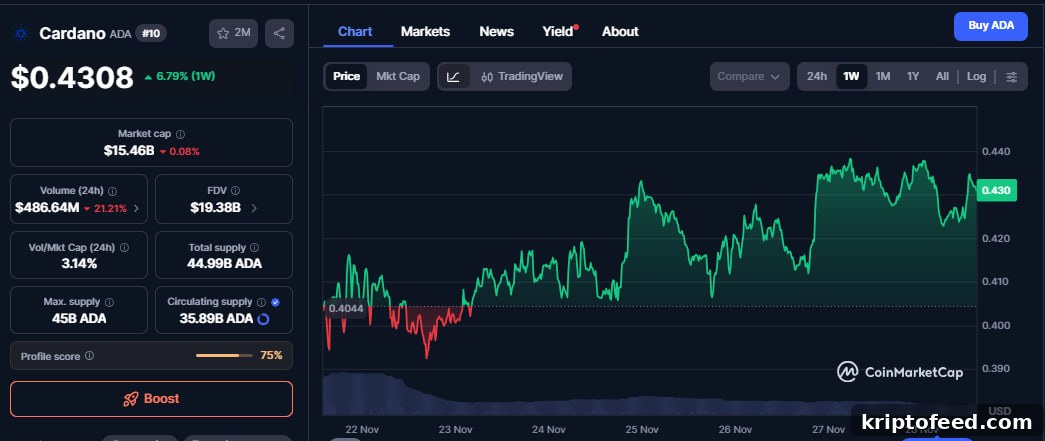
At the same time, 24-hour trading volume declined by roughly 20%, suggesting weaker short-term selling pressure.
If the 70 million ADA budget is approved and development activity accelerates, those efforts could trigger a large ADA breakout. However, buyers will need to overcome key resistance levels at $0.45 and $0.70 and reclaim the psychological $1.00 mark to turn the short-term outlook bullish.
A confirmed move above $1.50 would signal a solid reversal and open the path to higher targets. ADA could then surge toward $2.00 and possibly extend to $2.20 — gains of more than 400% from current prices if sustained.
Conversely, continued selling pressure could push ADA down toward the $0.25 support area, a decline of roughly 40%. A breakdown below that level would extinguish bullish momentum and could drag ADA toward historical support near $0.18.
Ultimately, the proposed budget is meant to address structural gaps in the Cardano ecosystem. If implemented effectively, it could materially improve utility, institutional adoption, and long-term price prospects; if it stalls or faces setbacks, ADA could remain range-bound or decline with broader market weakness.