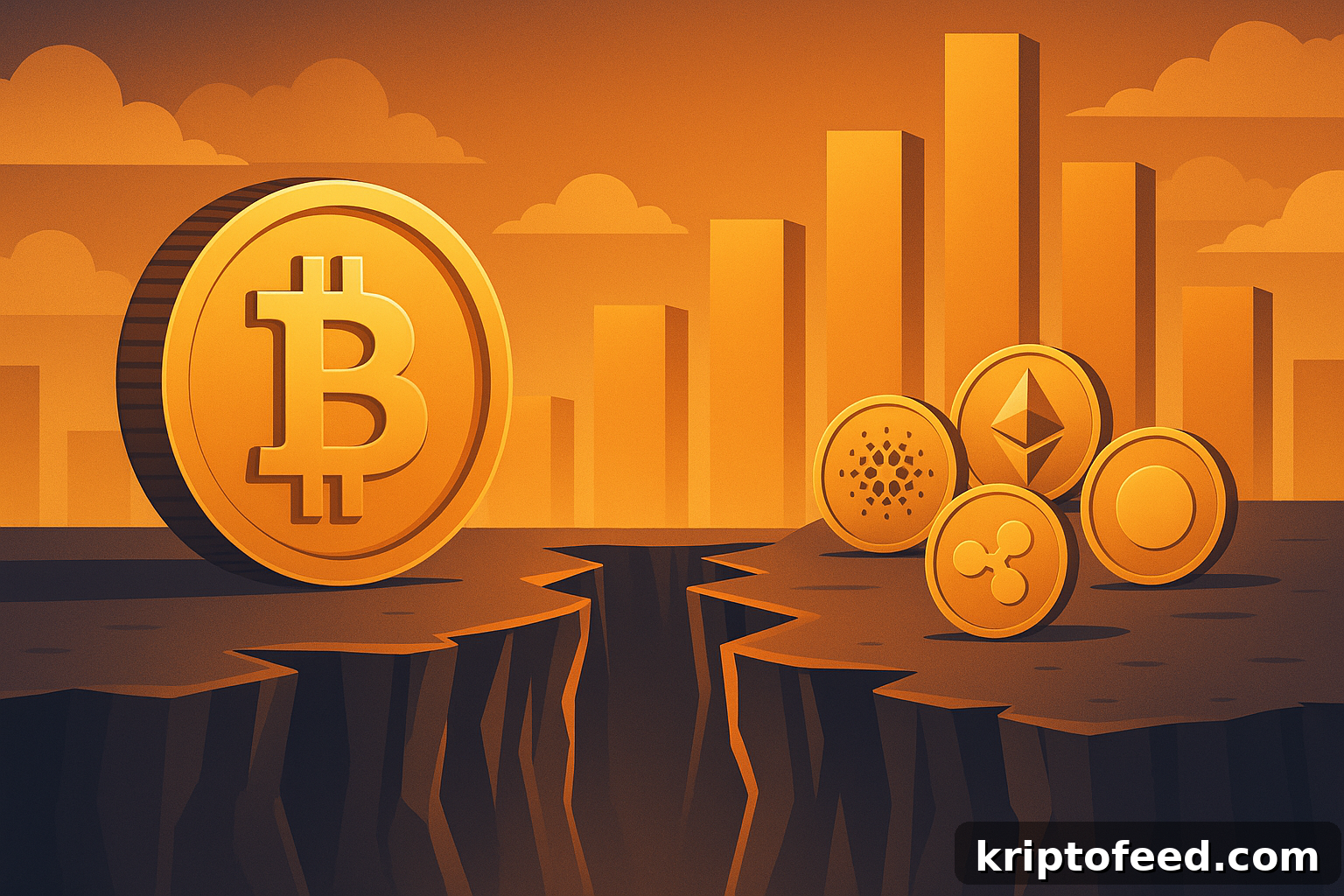
- A gap worth trillions of dollars now separates Bitcoin from other tokens.
- Data show that altcoin market capitalization could be roughly $800 billion higher.
- A trade-driven sell-off between the US and China wiped about $380 billion from cryptocurrency markets.
Rising Bitcoin dominance in institutional portfolios has created an almost trillion-dollar gap between the world’s largest cryptocurrency and its altcoin counterparts, according to new data published by 10x Research.
The report attributes this widening gap to a structural shift in investor behaviour, particularly among retail traders in South Korea, who have redirected funds away from altcoins and into crypto-linked public equities and exchange-traded vehicles that hold tokens.
Retail shift weakens altcoin liquidity
10x Research found that altcoin market capitalization could be about $800 billion higher if retail investors—especially in South Korea—had not moved capital into crypto-related stocks and other equity markets.
Altcoins, which often rely on retail liquidity to sustain upward momentum, have failed to attract sufficient new capital during this cycle.
Historically, South Korean traders were a major force behind altcoin rallies.
Local exchanges recorded altcoins accounting for more than 80% of total trading activity, a stark contrast with global platforms where Bitcoin and Ether typically dominate 50% or more of daily volume.
However, this year that pattern shifted abruptly, producing a liquidity shortfall for smaller digital assets.
Decline in South Korean trading activity
Between November 5 and November 28, 2024, the average daily trading volume on South Korean cryptocurrency exchanges reached $9.4 billion, surpassing $7 billion in trading on the Kospi during the same period, according to CCData and Korea Exchange data.
Since then, 10x Research has observed a sharp slowdown in crypto activity, suggesting retail participation has cooled significantly.
The report highlights that South Korea’s reduced appetite for riskier altcoins played a key role in their recent underperformance.
Retail investors who once fueled speculative runs in coins like XRP, Cardano and Solana have instead favored publicly listed blockchain companies and exchange-traded vehicles that provide indirect crypto exposure.
That shift has contributed to the broader weakness in altcoin prices.
Market losses deepen amid trade tensions
A broader market sell-off triggered by escalating trade tensions between the US and China worsened the situation.
The correction erased roughly $380 billion of total market value, with about $131 billion concentrated in altcoins, according to 10x Research.
While both Bitcoin and altcoins fell, smaller tokens bore the brunt of the declines as investors sought safety in more established, liquid assets.
Bitcoin’s appeal as a defensive asset within the crypto ecosystem strengthened, reinforcing its dominance during periods of market stress.
The sell-off underscores a changing market structure in which altcoins are increasingly viewed as speculative instruments, while Bitcoin’s institutional legitimacy gives it greater resilience during downturns.
As capital continues to concentrate around Bitcoin and select publicly listed plays, the broader altcoin market faces challenges in regaining lost momentum.