
Note: The following is a first-person account of the events that led to the survival of the original Ethereum chain after the hard fork activated in response to The DAO exploit.
Within hours of Ethereum’s hard fork to redirect funds away from the attacker who exploited The DAO, many in the blockchain community declared the intervention a success. Ethereum’s creator, Vitalik Buterin, celebrated publicly, and Coinbase CEO Brian Armstrong praised the hard fork as an effective upgrade mechanism for blockchains.
At the time, only a small number of people were determined to preserve what they considered the original Ethereum social contract: code that runs without external interference. One notable holdout was the self-described crypto-anarchist known as Wiz.
On July 21, Wiz messaged me to say he was impressed that the hard fork had worked. He also sent a screenshot from a block explorer showing he had become one of the top 25 Ethereum miners. I was surprised that the original chain seemed to decline so quickly; I had previously expected the fork to split the community into two viable chains.
“I guess what we learned is that you just need to get the top five pools onboard and you’re good,” said Wiz.
At that moment, roughly five mining pools controlled over 90 percent of Ethereum’s network hashrate.
 Wiz, who had served as managing director of WizSec, wondered aloud if Ethereum was effectively centralized among a small number of people. “I guess if I grew my pool by 5x, I could get into the top ten and at least have a voice,” he said. “But I’d still overwhelmingly be outvoted.”
I pointed out that exchanges had largely suppressed dissenting stakeholder voices by refusing to list the original chain’s coin. “There isn’t an easily found market price for ETHC right now because none of the centralized exchanges are allowing it to be traded,” I noted.
In the immediate aftermath of the fork, what would later become known as Ethereum Classic (ETC) was often referred to as ETHC. Initially, ETC only traded on decentralized platforms like Bitsquare (now Bisq) and in forum posts on bitcointalk.org.
A few hours later, Wiz sent another message:
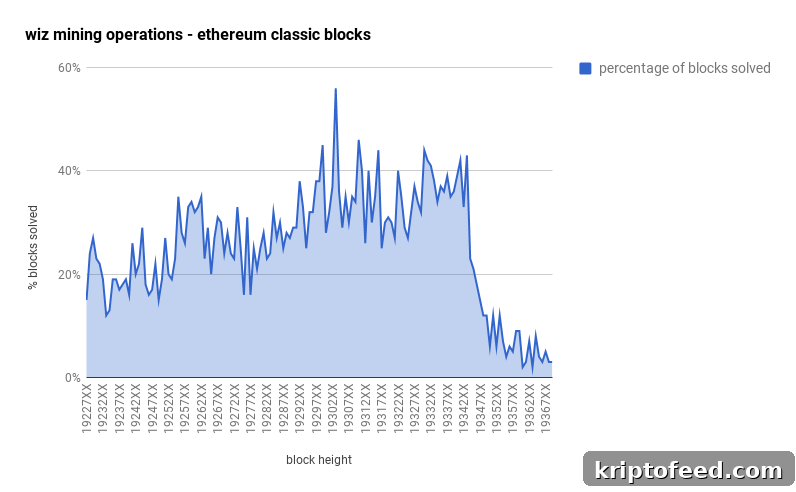
“Guess who now represents 20% of the hash power on Ethereum Classic?”
“I’m solving blocks like crazy right now,” he added.
 We spoke about the potential for an article about the original chain, but Bitcoin Magazine had already published an interview with the person coordinating the early Ethereum Classic effort.
“Let’s see if it gets any traction,” Wiz said. “If exchanges start trading it, this could potentially be a thing.”
The following day, Wiz reported that his share of the Ethereum Classic hashrate had risen to about 40 percent.
“I think I solved 31 blocks in a row or something crazy,” he added.
He was able to mine so many consecutive blocks because the other major mining pool supporting the original chain went offline momentarily, leaving Wiz to control the entire network for roughly ten minutes.
Over the day, Ethereum Classic’s overall hashrate fell, and Wiz considered returning to the forked Ethereum chain.
“At this point I’m like the only one mining the chain except for the [Ethereum Classic] founders,” he said.
Less than two hours after Poloniex listed Ethereum Classic, trading activity exploded. Following the exchange listing, Wiz still controlled about a third of ETC’s hashrate for a time, though he noted the network’s total hash power was slowly rising. By observing how often he was solving blocks relative to his own hashing power, he estimated the network’s hash rate at roughly 30 GH/s.
Wiz soon realized his speculative mining had turned into a substantial windfall.
“Hmm, I just realized I have more than $20K worth of ETC. Like, out of nowhere,” he said.
At ETC’s peak price, the value Wiz had mined approached roughly $90,000. Over the next hours and days his share of the network’s hashrate declined as more miners and speculators joined ETC. In the early hours after Poloniex listed the coin, Wiz reflected on what had happened to Ethereum:
“It’s now very clear what has happened to Ethereum. Originally, about 20% of the network opposed the DAO fork, but because of consensus rules, everyone was afraid and went along with the majority thinking the non-fork chain would be abandoned (and it was, for about 2–3 days). Now people realize both chains can peacefully coexist, and since they already have ETC, they immediately value it at about 20% of ETH’s worth.”
At the time this was written, Ethereum Classic traded at roughly 5 percent of the price and hashing power of the forked Ethereum chain.
“I am literally eating popcorn right now,” Wiz added later that night. “This is so fun to watch.”