
- Zcash price plunged 25% in 24 hours, wiping more than $3 billion off market capitalization amid heavy liquidations.
- A speculative reversal and profit-taking triggered the collapse.
- ZEC remains under pressure despite a record 4.96 million shielded coins in circulation.
Zcash price has dropped more than 25% in the past 24 hours, falling below the psychologically important $500 level.
During intense trading that saw daily volume surge roughly 150%, Zcash fell to lows of $476, erasing a significant portion of the gains from an explosive rally that earlier pushed ZEC to highs near $744.
Other privacy coins, including Dash, mirrored the sector leader’s movements.
Zcash price collapses 25% to under $500
On November 11, Zcash traded near $484.
At the time of writing, that was above the intraday low of $476 but still represented a roughly 25% drop from intraday peaks above $600.
This slide below $500 and the risk of further downside contrast sharply with the outlook just days earlier when Zcash surged to $744.
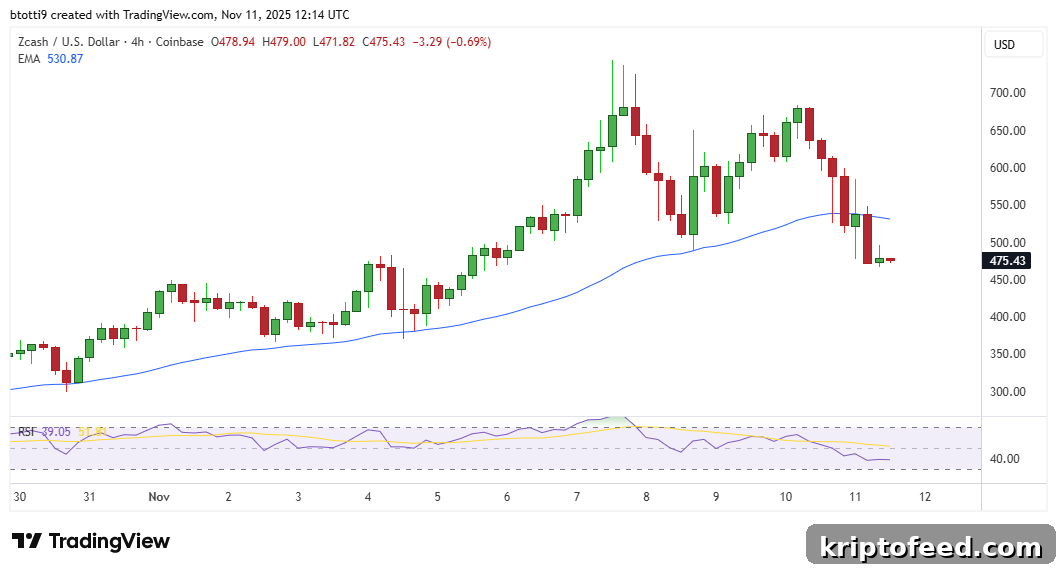 Zcash price chart by TradingView
Investors were drawn by the idea of ZEC reaching $1,000 and poured billions into the token.
That influx pushed trading volumes to unprecedented levels. The rally also reflected a broader altcoin frenzy, with Zcash briefly outperforming established names like Stellar and Bitcoin Cash in market-cap rankings.
However, profit-taking and frantic selling have pushed daily volume up about 156% to over $5.14 billion.
On-chain metrics also indicate some outflows of shielded ZEC. CoinMarketCap lists Zcash with a market capitalization of $7.89 billion, while network data shows shielded pool transactions have dropped from nearly 5 million to roughly 4.84 million.
Zcash price: what’s next?
On the price chart, a bearish double-top pattern has emerged on the four-hour timeframe.
Price trades below the 50-day exponential moving average, and the RSI sits around 39, suggesting there may be room for further downside.
Arthur Hayes, a prominent supporter of recent Zcash gains, summed up investor sentiment in a post on X, highlighting the dilemma between selling into the rally or holding for further upside.
At the heart of the volatility is a mix of speculative reversal, structural events and external pressures.
The Zcash rally — which ran from about $40 in early September to near $750 in early November — was driven by halving anticipation, capital rotation and a revived privacy narrative.
Profit-taking, including a whale deleveraging a $12 million position on November 9, intensified the sell-off.
Macro developments — expectations of U.S. stimulus, relief after a government shutdown, and renewed interest in staking and ETFs — have generally supported the crypto market, with Bitcoin briefly topping $105,000 and driving gains in larger tokens.
Still, ZEC’s sharp rally and sudden reversal have introduced a note of caution into broader market sentiment.
ZEC could regain momentum after its halving, especially if interest in privacy tokens strengthens again. Conversely, a decisive reversal in Bitcoin would likely prompt further outflows from the segment and deepen the correction.
In the near term, key bearish support lies in the $400 to $300 range. Bulls are attempting to stabilize around $470 at the time of writing, while the next major resistance — the EMA — sits near $530.94.
Traders and investors should watch volume, on-chain shielded activity, and broader market cues to gauge whether the pullback is a temporary correction or the start of a deeper downtrend.