
Key takeaways
- ZEC has fallen roughly 45% and is trading near $309 per coin.
- The vulnerability was patched within days, and current evidence suggests exploitation in the wild is unlikely.
Zcash plunged sharply after researchers revealed a critical vulnerability in the Orchard shielded transaction pool that could, in theory, have allowed the creation of counterfeit ZEC tokens. The disclosure prompted a rapid market reaction and a steep price decline.
The token’s price fell about 45% to around $309, with most of that drop occurring shortly after the security findings were made public.
Critical flaw found in Zcash Orchard shielded pool
Security researcher Taylor Hornby discovered the vulnerability while auditing Orchard under a review commissioned by Shielded Labs, an independent support organization for the Zcash ecosystem.
The issue resided in the Orchard circuit, the zero-knowledge proof system that protects private transactions within Zcash’s shielded pool. Specifically, the flaw allowed under-constrained inputs in elliptic curve computations, enabling invalid values to be accepted as valid proofs.
In a controlled test environment, researchers were able to create an undetectable counterfeit ZEC. The bug dated back to Orchard’s activation in May 2022 and was patched on June 1, soon after discovery.
Despite the severity of the bug, Shielded Labs reports no clear evidence that it was exploited in the wild. Several factors support this assessment: Orchard’s privacy design makes tracing shielded transactions difficult, the flaw went unnoticed for years despite cryptographic review, and there have been no confirmed anomalies in total supply.
Shielded Labs also noted, however, that absolute certainty is unattainable because shielded transactions are privacy-preserving by design, which can obscure signs of misuse.
ZEC dips by 45%. Will it recover soon?
On the 4-hour chart, ZEC/USD looks bearish after the sudden drop. The coin lost roughly 45% of its market value in the immediate aftermath of the disclosure.
Momentum indicators have shifted negative: the RSI sits near 33, suggesting oversold conditions, and the MACD lines are in negative territory, reinforcing the short-term bearish bias.
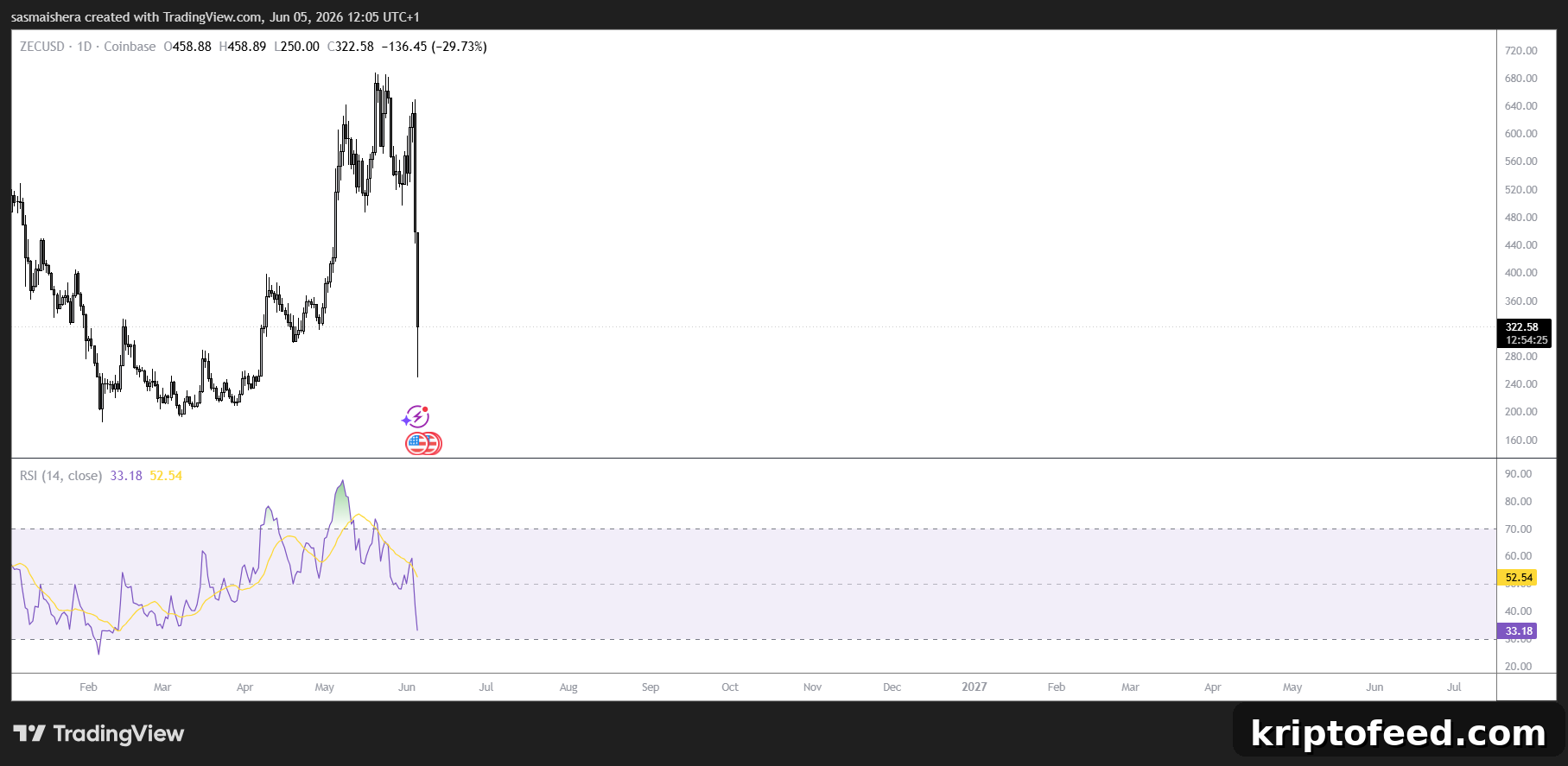
If selling pressure continues, ZEC could fall below Friday’s low near $245 and potentially test the psychological $200 level. That said, a recovery above $300 would imply the immediate selloff may be ending.
Should buyers regain control, the first meaningful resistance sits around $413, with a further resistance zone near $527. Traders should watch volume and confirmation from momentum indicators before assuming a durable reversal.