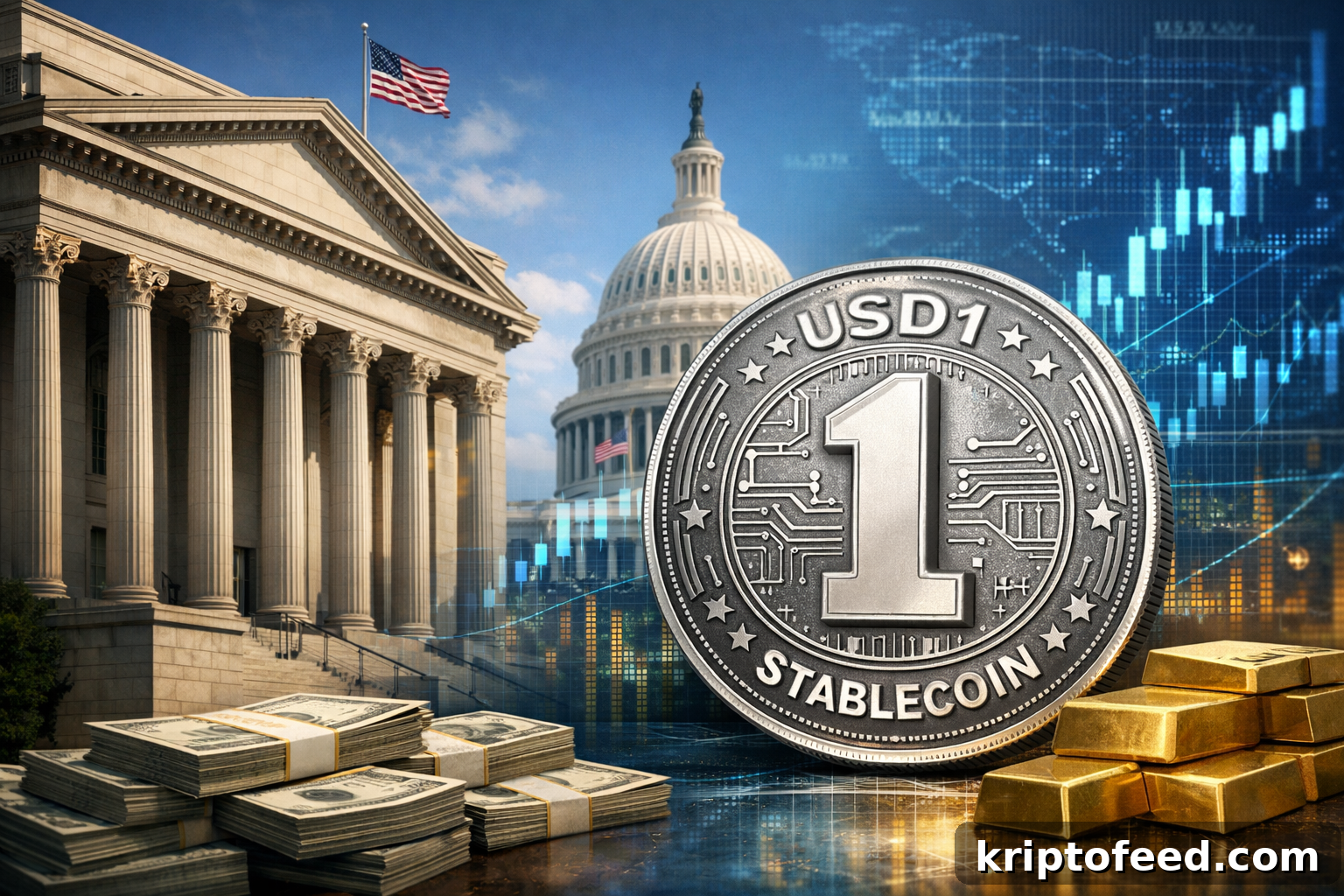
- The proposed trust bank would operate solely for stablecoin services under OCC supervision.
- USD1 reached more than $3.3 billion in circulation within a year of its launch.
- The stablecoin is fully backed by U.S. dollars and short-term U.S. Treasury assets.
World Liberty Financial, a cryptocurrency company associated with the Trump family, has filed for a national trust bank charter that would place its stablecoin issuance and custody operations under the traditional banking regulatory framework.
Circulation of the USD1 stablecoin quickly expanded to exceed $3.3 billion in the year following its launch.
Trust Bank Filing
According to documents filed with the Office of the Comptroller of the Currency (OCC), World Liberty Financial has applied to launch World Liberty Trust Company through its subsidiary WLTC Holdings LLC.
The proposal outlines a national trust bank created exclusively for activities related to stablecoins.
The trust bank would be authorized to issue, redeem, and hold USD1. It would not offer traditional lending or retail banking services.
Instead, it would operate within the OCC’s established trust bank framework, which requires strict asset segregation, independent reserve oversight, and regular examinations.
If approved, World Liberty Trust Company would fall under the same federal supervision applied to traditional trust institutions.
Stablecoin Services
World Liberty Trust Company plans to provide three primary services under U.S. regulatory supervision.
These services include minting and redeeming USD1, enabling conversions between U.S. dollars and the stablecoin, and custody of USD1 and other approved stablecoins.
Minting and redemption are planned to be fee-free at launch.
All services would comply with anti-money laundering rules, sanctions controls, and enhanced security measures.
The structure is also designed to align with the proposed GENIUS legislation, which seeks to establish clear federal standards for stablecoin issuers operating in the United States.
USD1 Growth
USD1 has grown rapidly since launch, reaching roughly $3.3 billion in circulation during its first year. This expansion places it among the fastest-growing stablecoins to date.
The token is fully backed by U.S. dollars and short-term U.S. Treasury assets held by regulated financial institutions.
The stablecoin already operates across multiple blockchains, including Ethereum, Solana, BNB Smart Chain, TRON, Aptos, and AB Core.
It is also listed on major exchanges, making it accessible to both retail and institutional users.
Regulatory Path
If the OCC grants approval, the trust bank would initially focus on institutional clients seeking regulated stablecoin issuance and custody services.
The review process is expected to be thorough, covering capital adequacy, compliance infrastructure, and risk management systems.
This filing follows earlier steps by U.S. regulators to engage with crypto firms.
In recent months, the OCC has granted conditional approvals to firms such as Fidelity Digital Assets, Ripple, Paxos, and Circle.
More recently, companies including Crypto.com and Coinbase have also submitted applications, reflecting a broader industry trend toward federally regulated crypto banking structures.