
- Bitcoin ETF outflows have been negative for 11 consecutive days, adding downward pressure to BTC.
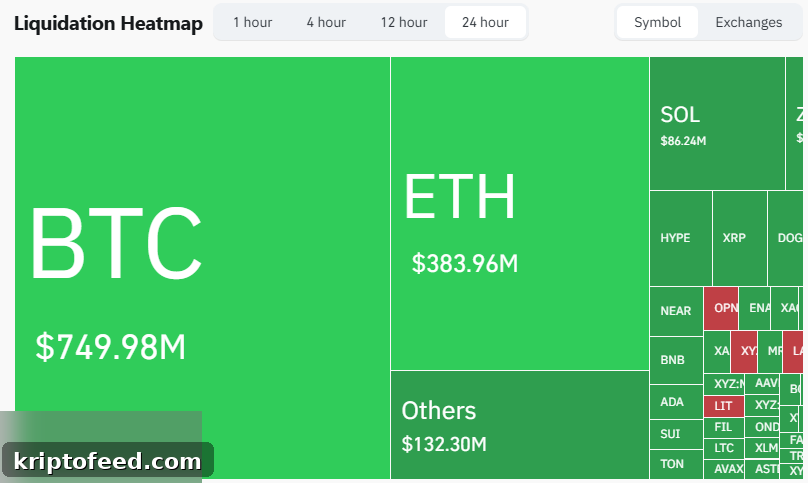
- Roughly $750 million in liquidations accelerated the recent decline in Bitcoin’s price.
- An RSI below 18 signals deeply oversold conditions, but the broader trend remains bearish.
Bitcoin (BTC) has come under sustained selling pressure, trading around $63,548 after a sharp multi-week decline that wiped out much of its recent recovery. The retreat reflects a mix of institutional selling, forced liquidations and a weakening market structure that continues to dominate near-term price action.
Although technical indicators point to deeply oversold conditions, the overall flow of capital suggests downside risk remains active. In this context, short-term relief rallies are possible, but a durable recovery has not yet emerged.
ETF outflows weigh on the Bitcoin price
A major driving force behind the recent weakness has been steady withdrawals from U.S. spot Bitcoin exchange-traded funds. Data shows 11 straight days of net outflows, including a single-day redemption of about $519 million on June 2. Over the ten-day period from May 25 to June 3, 2026, Bitcoin ETFs recorded more than $3 billion in outflows per market metrics.
This trend has removed a significant source of steady institutional demand. Analysts at major banks have stressed that ETF flows explain a meaningful portion of short-term return variation, meaning prices are now highly sensitive to institutional positioning. With flows negative for nearly two weeks, Bitcoin lacks a key demand pillar at a time when selling pressure is elevated.
During the prior recovery, ETFs were absorbing large amounts of available supply. The recent reversal means ETFs are no longer stabilizing price—on the contrary, net outflows are contributing to downside momentum. Without a sustained return of net inflows, maintaining price stability in the mid-$60,000s has proven difficult.
Liquidations and macro factors amplify the decline
Leveraged positions in the derivatives market added fuel to the sell-off. Market data shows roughly $749.98 million of leveraged long positions were liquidated within a 24-hour window during the recent drop. These forced closures accelerated the move lower rather than allowing for gradual adjustment.
Breaking below key technical zones triggered additional selling, creating a cascading effect in which falling prices lead to further liquidations. At the same time, macroeconomic conditions have reduced appetite for risk assets. Strong U.S. employment prints pushed expectations for Federal Reserve rate cuts further into the future, reinforcing a “higher-for-longer” interest rate backdrop and limiting liquidity into speculative markets such as crypto.
Geopolitical tensions and broader global risk concerns also encouraged defensive positioning across markets. In this environment, Bitcoin has been trading more like a high-risk asset correlated with broader risk-off moves rather than acting as an independent store of value.
Technical picture: oversold but no confirmed reversal
From a technical standpoint, Bitcoin is showing extreme oversold readings. The 14-day Relative Strength Index has fallen to roughly 17.7–18, a level that historically indicates selling exhaustion and often precedes short-term relief rallies. However, other indicators paint a more cautious view.
Bitcoin is trading below the major exponential moving averages—the 10-, 20-, 50-, 100- and 200-day EMAs—an alignment that signals a strong bearish trend across multiple timeframes. Until price reclaims these averages, the prevailing structure remains tilted to the downside.
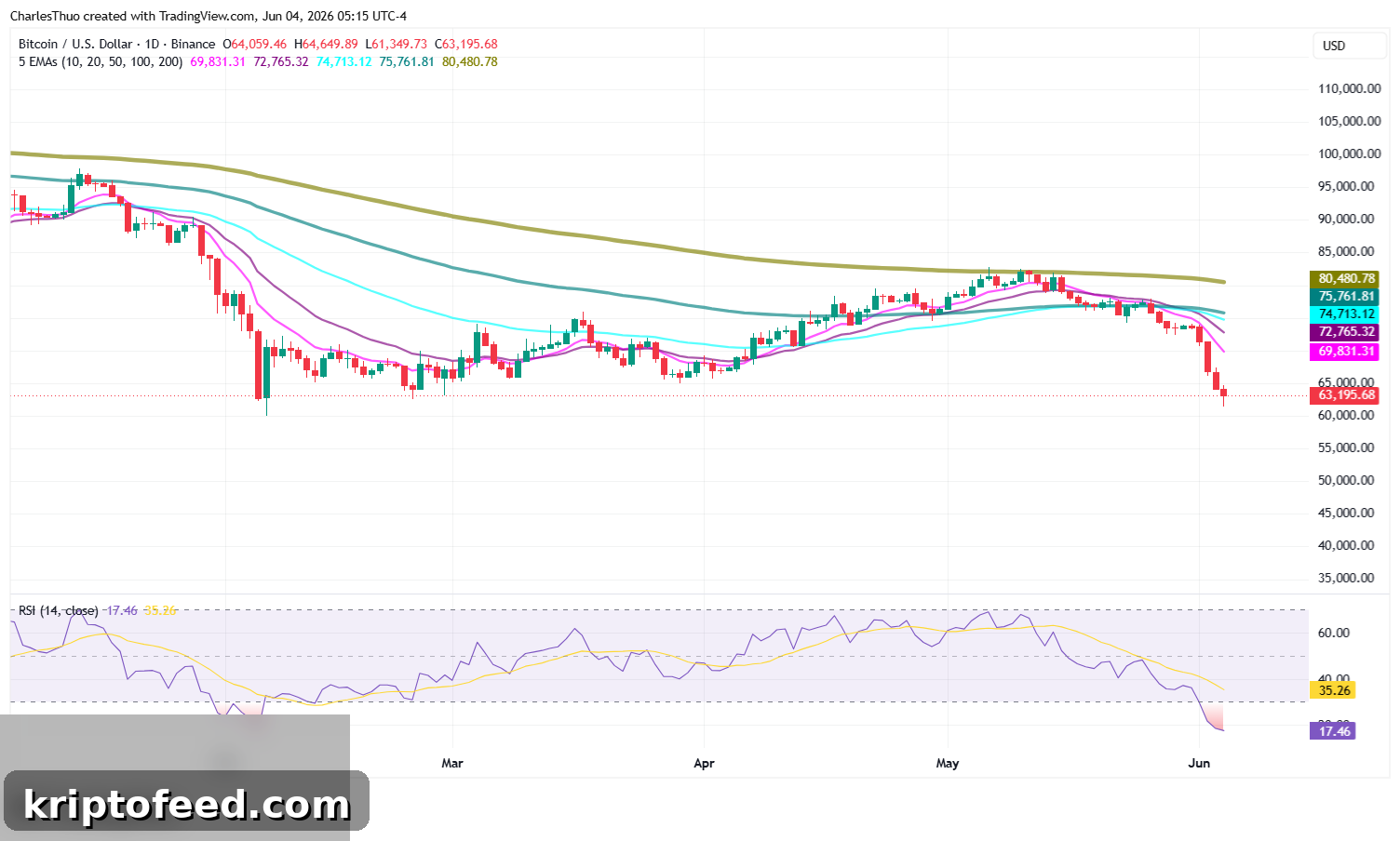
Short-term projections place immediate support near $62,964, with a broader structural floor around $60,000 that aligns with longer-term trend metrics. A breakdown below $62,964 would raise the probability of moves toward lower liquidity zones near $60,000 and potentially toward $55,000. On the upside, Bitcoin would need a decisive close above $69,124 to shift short-term momentum; reclaiming that level would point toward resistance near $71,589 and signal early signs of structural recovery.
For now, despite oversold conditions that could prompt a bounce, the prevailing trend is still dominated by downside momentum rather than clear reversal signals. Market participants should watch ETF flows, liquidation metrics and the key technical levels above and below current prices to gauge the next meaningful directional move.