- Short squeezes and $11 million in liquidations fueled Audiera (BEAT)’s rapid price spike.
- Weekly token burns and roughly $2.9 million in platform revenue added strong narrative support.
- $7.50 is key support; a break below risks a move toward $6 or lower.
Audiera (BEAT) has emerged as one of the most discussed tokens in the digital asset market after an explosive rally that took its price from under $1 earlier in the month to a recent high near $9.21 on MEXC.
Trading around $9.07 at the time of writing, the token gained more than 61% in a single day and has risen over 1,400% across the month. The speed and magnitude of this move place BEAT among the top-performing crypto assets over that period.
What is Audiera (BEAT)?
Audiera is a blockchain-based entertainment ecosystem focused on music creation, rhythm gaming, and AI-driven content tools. The platform aims to combine interactive gaming experiences with digital music production and on-chain ownership of assets such as NFTs.
The BEAT token serves as the ecosystem’s primary utility asset. It is used for in-game purchases, creator rewards, subscription access, governance voting via staking, and participation in platform reward programs. The project also deploys AI agents to assist with music generation and user interaction within the environment.
Why has BEAT surged more than 1,400% in a month?
The BEAT rally was not caused by a single catalyst. Instead, several factors converged—derivatives market dynamics, on-chain tokenomics, and ecosystem developments—to produce the sharp upside.
1. Large short squeeze in derivatives markets
A major driver was a sizable short squeeze. As BEAT’s price accelerated, over $11 million in short positions were liquidated across derivatives exchanges, generating forced buybacks that added upward pressure and accelerated the move.
During the same period, open interest rose by roughly 35.44% to about $303.5 million, indicating that leveraged positions were being added even as volatility climbed. That combination of rising open interest and cascading liquidations created a feedback loop in which buying pressure was amplified by the market’s leveraged structure.
2. Weekly token burns and revenue
Audiera operates a weekly burn mechanism that recently removed 770,545 BEAT from circulation, funded by nearly $2.9 million in weekly revenue. The ongoing reduction in circulating supply contributes to a deflationary narrative that can support price under certain demand conditions.
$BEAT Revenue & Burn Update 🔥
Jun 1 – Jun 8, 2026
🔥 770,545 $BEAT burned
📈 772,045 $BEAT weekly revenue (2,866,231 USDT)Total burned: 12,353,034 $BEAT
Over 12.35M $BEAT permanently removed from circulation.1 $BEAT = 3.712 USDT (Jun 8, 2026)
— Audiera🟣🎵 (@Audiera_web3) June 8, 2026
This burn schedule is intended to shrink supply over time and strengthen the platform’s demand-deflation narrative.
Audiera (BEAT) price outlook
The current market structure shows BEAT still heavily affected by leverage-driven flows and short-term momentum trading. The critical technical level to watch is $7.50, which previously acted as resistance and now functions as an important support zone.
While BEAT remains above $7.50, the token may consolidate within a wide range with elevated volatility. Maintaining stability above this level preserves the structure for potential attempts to reach the $9.40 region, where recent highs were established.
A confirmed breakout above $9.40–$9.50 would likely reopen price discovery, with historical momentum cycles suggesting potential extensions toward the $15 area. However, momentum indicators show extreme readings following the rally, and a cooldown or pullback is possible after such a rapid surge.
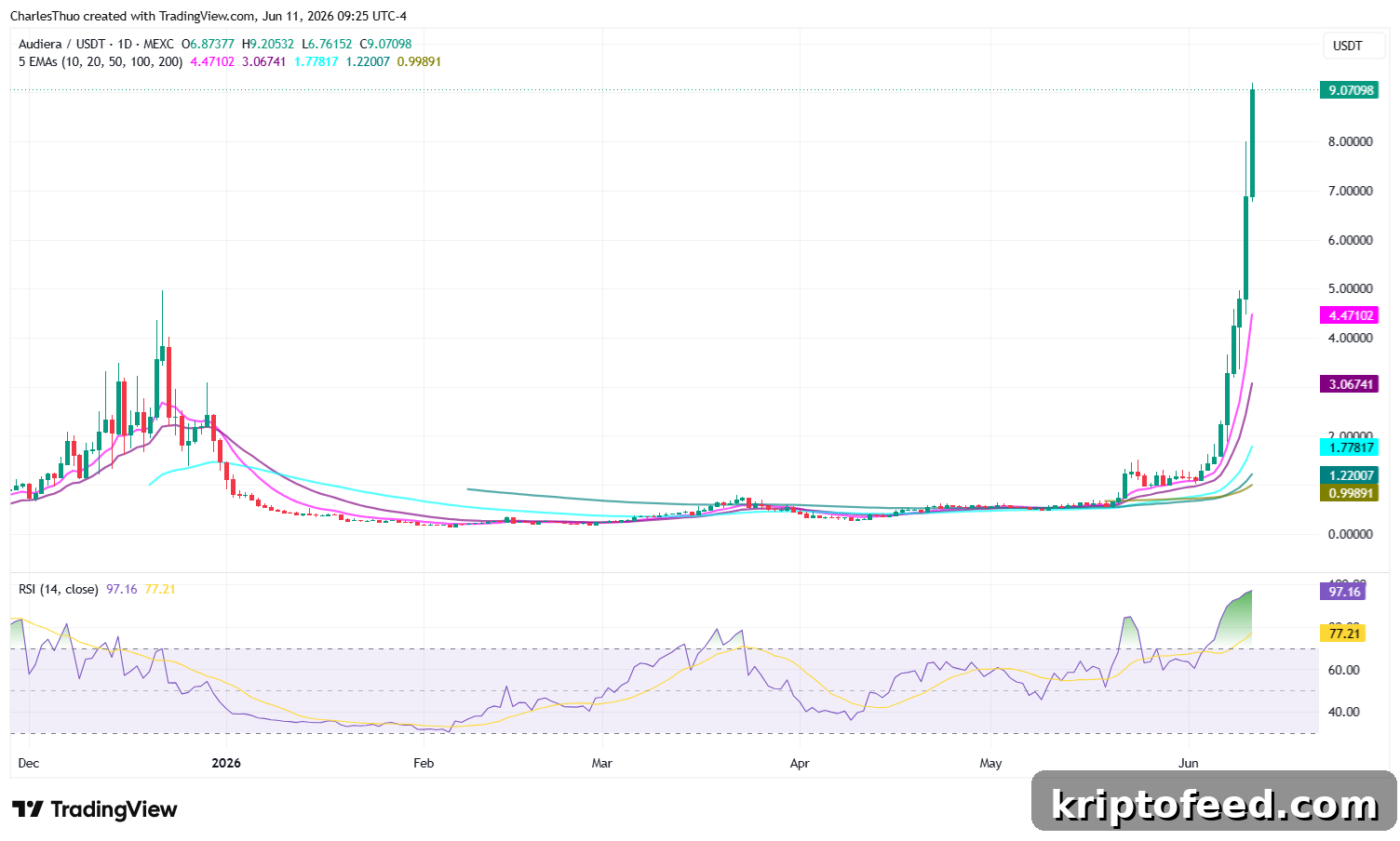
If a pullback breaches $7.50, forced liquidations could accelerate a decline toward the $6.00 region. In a deeper correction—particularly if open interest contracts sharply while price falls—downside extensions could reach roughly $3.70, reflecting an unwind of the earlier leveraged rally.
Traders should recognize the elevated risk profile given the role of leverage and short-term speculative flows in the move higher. Monitoring liquidity, open interest, and on-chain burn updates will be important for assessing near-term price stability.