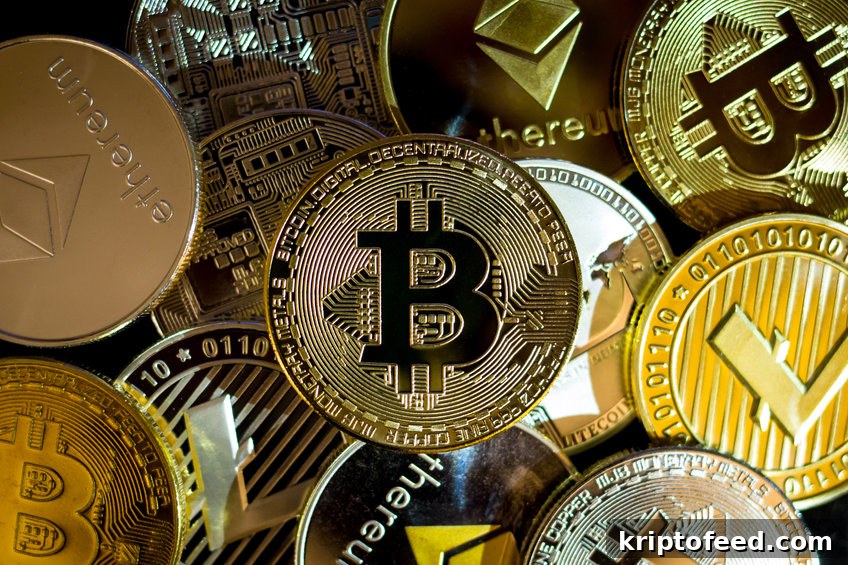
As we prepare for 2022, here are five coins to consider for your investment portfolio.
1. Ethereum – The Star of the Show
The Ethereum blockchain proudly describes itself as the world’s programmable blockchain, able to host a wide range of decentralized applications. Beyond functioning as a digital currency, Ethereum powers systems that aim to decentralize and disrupt industries such as finance, gaming and digital services. While it followed Bitcoin’s path as a pioneer, Ethereum differentiated itself by becoming the foundation for the majority of decentralized finance (DeFi), games and apps in the crypto space. Its decentralized architecture helps maintain a secure network.
The network runs on its native currency, Ether (ETH), which is issued with each block and rewarded to miners or validators. There is no fixed hard cap on ETH supply; emission is currently planned to grow by roughly 4.5% per year, with two ETH historically created per block (though upgrades and fee-burning mechanisms have altered issuance dynamics). Every protocol and application on the network uses ether for gas fees, so increased usage of the blockchain drives demand for ETH and can push its value higher. At the time of writing, ETH remains the second-largest cryptocurrency by market capitalization.
2. Bitcoin – Expected to Reach 100K+
Since its launch in 2009, Bitcoin has experienced several major price cycles and reached an all-time high of $69,045 on November 10, 2021. Many analysts and investors expect Bitcoin (BTC) to reach $100,000 in 2022, although that outcome depends on multiple factors. Bitcoin’s price is driven by market demand relative to its limited supply. As demand rises and available supply tightens, the price typically appreciates. Production costs, macroeconomic conditions, regulatory developments and institutional adoption also influence price movements.
Bitcoin has increasingly been viewed as a store of value by institutions, investors and some governments. Growing adoption for payments, custodial holdings and as an inflation hedge can support long-term price appreciation. Futures markets, derivatives and speculative activity also affect volatility and price direction. While regulatory changes can push prices up or down, the trend of wider adoption suggests sustained interest. Bitcoin currently commands the largest market capitalization among cryptocurrencies and remains available on all major exchanges.
3. BNB – Continued Growth of Binance Smart Chain
Binance Coin (BNB) is the native token of the Binance ecosystem and powers many services across Binance’s exchange and Binance Smart Chain (BSC). Launched in 2017 via an initial coin offering (ICO), BNB initially traded for cents and has since grown substantially in utility and market value. The total supply is capped at 200 million BNB, and Binance periodically conducts token burns — using a share of trading revenue to buy back and permanently destroy BNB — until 50% of the circulating supply is burned. This mechanism reduces supply over time, creating scarcity that can support price appreciation.
BNB benefits from the growth of BSC, which hosts a wide variety of DeFi projects, DEXs and decentralized applications. As the BSC ecosystem expands, demand for BNB for transaction fees, staking and other use cases can rise. BNB is non-inflationary in practice due to the planned burn schedule, and it consistently ranks among the top cryptocurrencies by market capitalization. It is traded on Binance and many other exchanges.
4. Solana – A Rapidly Growing Ecosystem, Long-Term Challenger to Ethereum
Solana is an open-source blockchain designed to scale transaction throughput while preserving decentralization. Launched by Anatoly Yakovenko in 2017, the Solana network can validate tens of thousands of transactions per second at extremely low cost per transaction, using a proof-of-stake consensus combined with innovative timestamping and processing techniques. Token holders can stake SOL to become validators, earn rewards and participate in network security.
Because Solana supports smart contracts and many of the same use cases as Ethereum — from DeFi and DEXs to games and NFTs — it is often cited as a major long-term competitor. Solana’s high throughput, low fees and distinctive consensus design have attracted projects and users looking for faster, cheaper transactions. The network’s native token, SOL, pays for transaction fees, supports staking and can be used in governance. A substantial portion of the planned supply is already circulating, and SOL consistently ranks among the top cryptocurrencies by market cap and exchange listings.
5. Terra – Popular with Strong Use Cases, Approaching Mainstream Recognition
Terra is a layer-1 blockchain focused on programmable money and the creation of algorithmic stablecoins pegged to fiat currencies or other assets. As an open-source protocol, Terra enables the minting, trade and exchange of stablecoins that can power payments, DeFi applications and cross-border transactions.
The Terra ecosystem has gained traction as a provider of DeFi services and stablecoin-based payment solutions. Its native token, LUNA, plays a central role in maintaining peg stability, paying transaction fees, absorbing volatility and supporting governance. LUNA holders can stake tokens, participate in governance votes and propose ecosystem changes. Terra’s tokenomics and growing suite of use cases have helped it secure a notable position among top cryptocurrencies and make it available on multiple major exchanges.
Remember that the cryptocurrency market is highly volatile and carries significant risk. Only invest funds you can afford to lose, diversify your portfolio and consider seeking professional financial advice before making investment decisions.