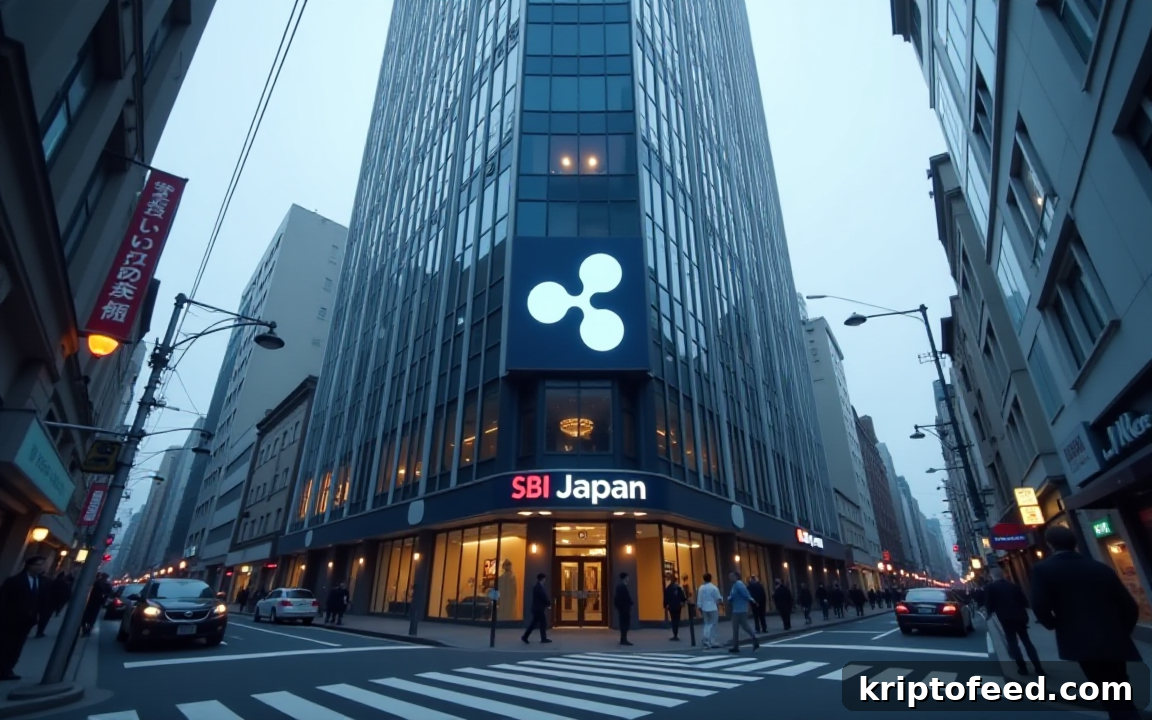
- They signed a memorandum of understanding to distribute the stablecoin in Japan through SBI VC Trade.
- RLUSD is a licensed asset backed by US dollar deposits, reliable reserves, and government securities.
- The stablecoin is scheduled to debut in Japan in early 2026.
Blockchain company Ripple revealed a significant development with its long-standing partner, SBI Holdings, one of Japan’s leading financial services conglomerates.
The two firms signed a memorandum of understanding to launch and distribute Ripple USD (RLUSD) in the Japanese market.
Access to RLUSD in Japan will be provided through SBI’s licensed cryptocurrency exchange, SBI VC Trade Co.
The official press release indicates that RLUSD is expected to launch in Japan in early 2026.
The $300B stablecoin market is set to grow into the trillions.
Together with @sbivc_official, we’re bringing $RLUSD to Japan in early 2026, offering users and institutions a trusted, regulated and fully-backed stablecoin built for enterprise use cases. https://t.co/htcrMiQkTe
— Ripple (@Ripple) August 22, 2025
This move marks an important step toward expanding financial options for institutions, retailers, and businesses that rely on regulated digital currencies.
Commenting on the integration, SBI VC Trade CEO Tomohiko Kondo said:
Introducing RLUSD will not only broaden stablecoin options in the Japanese market but also represents a significant advance in the reliability and convenience of stablecoins in Japan, and is an important step toward accelerating the convergence of finance and digital technology.
The next phase of stablecoin growth
Stablecoins performed strongly in 2025, a trend that accelerated after the United States approved the long-awaited GENIUS Act.
These asset-backed digital tokens now boast a combined market capitalization approaching $300 billion, and analysts forecast continued growth that could reach into the trillions.
While early adoption was driven by traders seeking price stability, the second wave appears to be powered by institutional demand and real-world utility.
Coinbase’s listing of World Liberty Financial’s USD1 stablecoin, which launched in March 2025 and experienced rapid growth, is a notable example of this trend.
RLUSD fits into this evolving landscape by targeting payments for public services and institutional transactions.
Its regulatory-first strategy has increased industry appeal—Ripple publishes third-party auditor attestations monthly to ensure transparency.
Ripple USD emphasizes robust stability, backed by short-term government securities, US dollar deposits, and other cash equivalents.
Compliance and transparency position RLUSD ahead of many existing stablecoins.
Jack McDonald, Ripple’s Vice President for stablecoins, stressed that the partnership with SBI focuses on building a compliant, trusted financial future. He added:
This distribution in Japan with SBI VC Trade is the culmination of that work. RLUSD is designed to be a true industry standard, offering a reliable and efficient bridge between traditional and decentralized finance. We believe this partnership will not only enhance stablecoin utility in Japan but also set a new benchmark for the broader market.
Outlook for RLUSD
Ripple’s stablecoin currently carries a market capitalization of more than $666 million, with a daily trading volume near $70 million, signaling strong user activity.
RLUSD recently gained notable endorsement when Bullish confirmed settling a portion of its successful $1.15 billion IPO proceeds using the stablecoin.
Congrats to @Bullish on a successful IPO! 👏
A portion of the IPO proceeds were settled in $RLUSD, minted on the XRP Ledger. This is the first public listing to bring the settlement process onchain and sets a precedent for how stablecoins can shape future listings. https://t.co/AD4AkpPnLD
— Ripple (@Ripple) August 19, 2025
Now, RLUSD is preparing for its Japanese launch in early 2026. A successful rollout could strengthen institutional, corporate, and regulatory confidence in stablecoins across Asia.