
- The company has begun testing RLUSD on leading Ethereum L2 platforms.
- The launch reflects growing demand for regulated stablecoins.
- RLUSD will go live on L2s pending approval from New York regulators.
The cryptocurrency industry is gradually moving toward a landscape where no single platform dominates.
Rather than remaining tied to one blockchain, users, institutions, and developers increasingly want cross-chain transfers driven by demand and opportunity.
Stablecoins remain central to this evolution, serving as an on-ramp for new participants navigating the on-chain economy.
Ripple appears to recognize this reality.
In an announcement dated December 15, the blockchain company confirmed it has begun testing its stablecoin RLUSD across multiple Ethereum Layer-2 platforms.
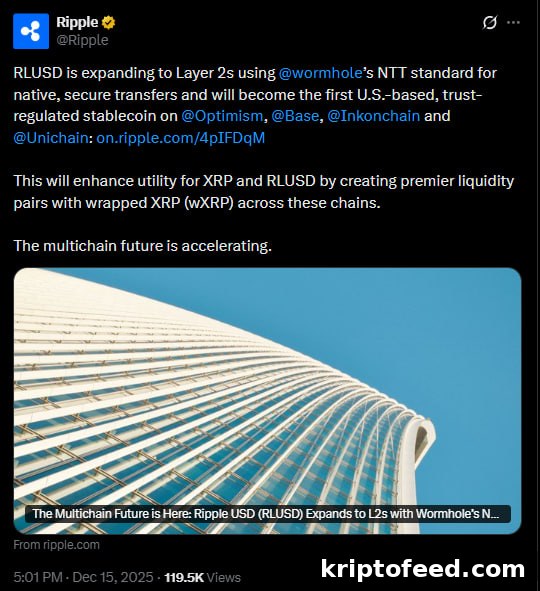
The experiment marks an important step toward the asset’s public debut, which is planned for 2026 pending regulatory approval.
The current testing phase will run across Base, Unichain and Ink, using Wormhole’s interoperable infrastructure to streamline movements between networks.
Jack McDonald, Ripple’s Senior Vice President for Stablecoins, described stablecoins as a gateway to decentralized finance and institutional adoption.
He said:
RLUSD is designed from the ground up to be the trusted, liquid medium users need to enter, interact with, and exit the broader digital asset economy seamlessly. By introducing RLUSD—the first US trust-regulated stablecoin on these L2 networks—we are not only expanding usability; we are setting the standard where compliance and on-chain efficiency meet.
Why Layer-2 Platforms Matter
Layer-2 networks have become some of the busiest corridors in the crypto space.
These blockchains are faster, cheaper, and more practical for everyday use than the main Ethereum network, which faces congestion and high transaction costs.
As a result, L2s have become ideal environments for decentralized applications, on-chain services, and digital payments.
By deploying RLUSD on these platforms, Ripple is targeting the ecosystems where real user activity is taking place.
Notably, Optimism will serve as an initial launch point, with connectivity to platforms like Unichain, Ink and Base.
This approach allows Ripple’s stablecoin to scale alongside genuine user demand.
At the same time, Ripple is working with Wormhole and its NTT (Native Token Transmissions) standard.
With this setup, RLUSD can move between chains while remaining a consistent, single token.
Ripple retains issuance control over the stablecoin, while users gain flexibility across multiple platforms.
The announcement added:
Using Wormhole’s Native Token Transfers (NTT) standard enables Ripple to maintain native issuance and control of RLUSD while ensuring the security and flexibility of on-chain liquidity movement across these new ecosystems.
Strengthening the XRP Ecosystem
RLUSD’s strategic expansion also reinforces the broader XRP ecosystem.
Stablecoins play a key role in trading, digital payments, and liquidity provision, and Ripple is positioning its stablecoin where demand already exists.
Meanwhile, XRP traded at $1.93 after a 3% decline over the past 24 hours, reflecting broader market sentiment.
The crypto market continues to face pressure, with Bitcoin struggling below $90,000 and trading around $87,700.