
- Quant today announced an innovative new product.
- QuantNet changes how banks connect with digital currencies.
- The native QNT token rose more than 7% in the past 24 hours.
Banks face mounting challenges in the ongoing financial transformation due to slow processes, isolated networks, and outdated systems.
Interoperable blockchain provider Quant aims to bridge this gap with its new innovative product, QuantNet.
QuantNet creates an ecosystem where traditional banks, cryptocurrencies, and tokenized assets can move and interact seamlessly.
We’re proud to announce the launch of #QuantNet, the world’s first #programmableinfrastructure and network that fundamentally transforms how banks connect to #tokenisedmoney and #digitalassets.
Financial institutions worldwide can now participate in tokenised money and digital… pic.twitter.com/AIRDnhMANp
— Quant (@quant_network) September 29, 2025
This is more than a routine technical upgrade.
The launch marks a strategic shift that enables financial institutions to embrace monetary innovation while preserving existing compliance, operational control, and security.
According to the official blog:
QuantNet allows banks to coordinate assets and cash flows across isolated networks without replacing the single systems they already trust. It’s orchestration without disruption, innovation without compromise.
The announcement has generated excitement across the Quant community.
Optimism is reflected in the token’s bullish 24-hour chart.
After rising more than 100% on a recent day, the altcoin has reclaimed the psychological $7 level.
QuantNet: How It Changes the Game
The new product is designed to create continuous connectivity.
QuantNet does not require banks to replace their current systems or operating models.
Instead, it links tokenized deposits, stablecoins, and commercial funds into a single, innovative network.
Imagine private trading platforms, traditional settlement systems, and public blockchains working together securely and harmoniously.
Banks retain control over their funds while QuantNet handles the underlying orchestration.
Crucially, every operation is fully traceable, delivering compliance and transparency that legacy systems cannot provide.
Quant adds:
Banks no longer have to choose between innovation and stability. QuantNet delivers both: a production-ready platform that connects the future of money and markets while working seamlessly with existing infrastructure investments.
Quant Selected for UK Tokenised Sterling Deposits
The QuantNet launch follows the UK Treasury and leading banks selecting Quant to provide infrastructure for the new Tokenised Sterling Deposits (GBTD) project.
We’re delighted to announce that Quant has been selected to create the new #payments infrastructure and bank technology of the UK’s #TokenisedSterlingDeposits, a groundbreaking financial market infrastructure initiative led by @UKFtweets, in collaboration with major… pic.twitter.com/UXRYzx4aFY
— Quant (@quant_network) September 26, 2025
GBTD is a market initiative that will run through mid-2026, exploring how tokenized bank deposits can enhance payments, fraud protection, and large-scale settlement.
Quant CEO Gilbert Verdian celebrated the selection and said:
Being chosen for GBTD marks a pivotal step in the UK’s financial evolution. This milestone is not only about improving payments; it’s about enabling new forms of programmable money that will fundamentally change how value is moved and managed.
As a result, QuantNet represents a turning point for financial institutions worldwide.
Banks can use it to participate in cryptocurrencies and tokenized funds while maintaining the compliance, trust, and reliability their customers expect.
QNT Price Outlook
Quant’s native token has maintained a bullish trajectory amid strategic developments.
QNT has rebounded from around $86 on September 26 to an intraday high near $103 today.
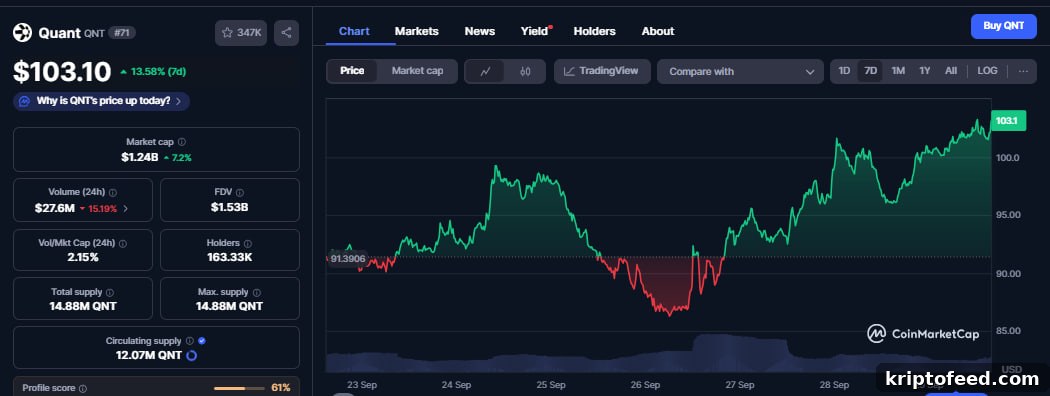
Driven by the latest announcements and a broader market rally, the token rose more than 7% on one-dimensional charts.
Meanwhile, potential use cases for QuantNet and Quant within the UK’s GBTD project could spur meaningful demand for QNT in coming years, especially as banks explore tokenized assets and programmable money.