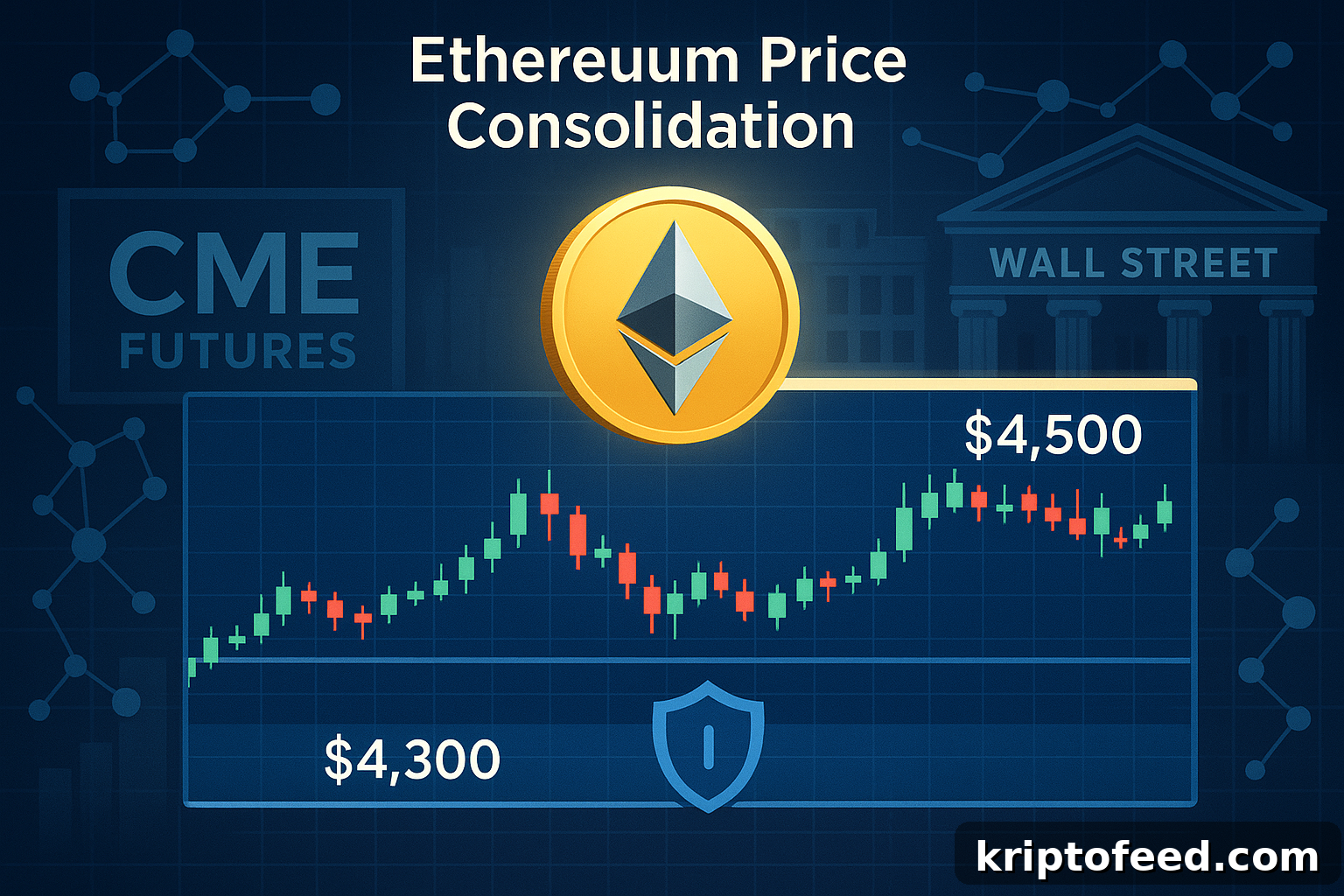
- ETH holds $4.2K–$4.5K range as $7.5B accumulation signals long-term support.
- Institutional open interest hits records, boosting confidence in ETH outlook.
- Key $4.5K resistance may trigger rally, while $4K–$4.1K offers downside support.
Ether (ETH) is trading within a relatively tight band between $4,200 and $4,500 this month, showing signs of fading short-term momentum even as on-chain indicators point to stronger structural demand. Short-term traders remain cautious about potential weakness, but accumulation patterns, exchange flows, and institutional positioning present a more layered view of Ethereum’s near-term trajectory.
Accumulation trends around $4,300–$4,400
Blockchain analytics firm CryptoQuant identifies a major accumulation zone between $4,300 and $4,400. Approximately 1.7 million ETH—valued at roughly $7.5 billion—has been moved into long-term accumulation addresses at these price levels. A substantial portion of that activity originated from withdrawals from centralized exchanges, which suggests an average cost basis in the vicinity of $4,300.
This concentration of buying interest creates a meaningful support area that could act as a cushion if Ether revisits lower prices. Analysts note that ETH’s ability to hold above this cluster may determine whether the current consolidation evolves into a platform for renewed upside or devolves into a deeper corrective phase.
Binance, the world’s largest exchange by volume, has played a central role in this dynamic, recording the largest outflows during the accumulation phase. Addresses that deposited ETH onto Binance show a considerably lower average cost basis—closer to $3,150—highlighting differing strategies among market participants. Longer-term holders appear to be accumulating at higher price points, while some shorter-term traders may have entered earlier and seek to realize profits at lower entry prices.
Institutional participation and derivatives market activity
Institutional flows are increasingly shaping Ether’s outlook. Open interest on the Chicago Mercantile Exchange (CME) has climbed to record highs, concentrated heavily in short-term maturities spanning one to three months. While this concentration can elevate volatility around contract expirations, it also reflects growing institutional engagement with Ether.
At the same time, open interest for longer-term maturities of three to six months is building, which many analysts interpret as a sign of confidence in Ethereum’s broader trajectory. Crypto market analyst Pelin Ay emphasized that rising institutional demand and positioning in derivatives markets could underpin further upside for ETH. Despite elevated liquidation risks, Ay suggested that ETH could target the $6,800 resistance level before year-end if institutional participation continues to expand.
Technical levels and market sentiment
Technically, Ether has been range-bound between $4,200 and $4,500 in September, underperforming peers such as Bitcoin and Solana, which have recently reached higher highs. That relative underperformance suggests a temporary rotation of capital into other major crypto assets.
The $4,500 level stands out as a critical inflection point. A decisive break above that threshold could restore momentum and trigger a more pronounced upside move. Conversely, downside risks remain: traders watch for potential liquidity sweeps with support zones identified around $4,200 and a deeper order block near $4,000–$4,100.
Market sentiment is mixed. Crypto trader Merlijn pointed to monthly indicators improving, noting a MACD flip to green after years of consolidation. According to Merlijn, this technical signal implies Ethereum is “coiled and ready to detonate,” and clearing $4,500 could spark a parabolic rally.
As Ethereum moves toward the final quarter of the year, the balance between weakening short-term momentum and strengthening structural support will likely determine whether the asset breaks higher or retests key demand zones. Traders and investors will be watching accumulation levels, exchange flows, and institutional activity closely for clues about the next directional move.