
- The manipulation of POPCAT caused the Hyperliquid liquidity provider (HLP) to absorb approximately $5 million in losses.
- The Hyperliquid (HYPE) token is trading below key exponential moving averages amid a bearish market backdrop.
- Retail demand for HYPE has weakened and futures open interest fell to $1.56 billion.
The Hyperliquid token came under intense pressure after a sophisticated POPCAT attack left the decentralized derivatives platform reeling from multi‑million dollar losses.
The POPCAT exploit, which targeted Hyperliquid’s liquidity provider system, exposed risk‑management weaknesses at Hyperliquid and raised concerns about retail demand and overall market sentiment for the HYPE token.
POPCAT attack forced HLP to absorb roughly $5 million in losses
The POPCAT manipulation took place on November 12, when a trader executed a coordinated series of trades across multiple wallets to create an artificial buy wall in the POPCAT market.
On‑chain analysts report the trader deployed roughly $3 million in USDC from the OKX exchange, distributing funds across 19 separate addresses.
Those wallets opened nearly $30 million in leveraged long positions, driving POPCAT’s price above $0.21.
Once the buy wall was removed, POPCAT’s price plunged sharply, triggering massive liquidations.
Because market liquidity was thin, Hyperliquid’s market maker system, the Hyperliquid Provider (HLP), had to take on and close out the resulting positions.
In total, HLP incurred losses estimated between $4.9 million and $5 million.
The remaining long positions were passed to the Hyperliquidity Provider (HLP) to liquidate.
HLP appears to have lost $4.95M closing out the positions. pic.twitter.com/Qfq9jcy4Mz
— Arkham (@arkham) November 12, 2025
Pendant the crash, POPCAT’s price fell from $0.21 to $0.13, prompting Hyperliquid to manually close positions to limit further financial damage.
The attack highlighted how coordinated large capital movements across multiple wallets can destabilize decentralized platforms.
Examining the tactics used, analysts noted similarities to previous manipulative behavior observed on tokens such as TST, ZEREBRO, JELLYJELLY and HIFI, although Hyperliquid said deposits and withdrawals were eventually restored and normal trading resumed.
Implications for Hyperliquid markets and DeFi
The POPCAT incident underscores the persistent risks faced by decentralized exchanges that offer leveraged tokens.
While HLP absorbed the losses and protected liquidity providers, the event demonstrates how thin liquidity and concentrated positions can amplify market manipulation impacts.
Some voices on Crypto Twitter have suggested these attacks are not always profit‑driven but may aim to damage the reputation of decentralized platforms.
On‑chain forensic analysis looked into potential links between the wallets used in the manipulation and entities such as BTX Capital, though those claims remain unproven.
Hyperliquid’s response—including a temporary pause on its Arbitrum bridge—helped stabilize the situation.
Still, the incident is likely to weigh on investor sentiment, particularly as retail demand for HYPE remained subdued following a notable decline in futures open interest over the past month.
Futures open interest for HYPE contracted from $2.08 billion at the end of October to $1.56 billion, signaling reduced risk appetite among traders.
HYPE price reaction after the attack
Despite the loss, Hyperliquid’s HYPE token displayed relative resilience in the aftermath.
HYPE rose modestly from $37.77 to $39.39 after the attack was resolved, indicating some continued confidence among retail holders.
At the time of publication, the token had settled around $38.09, suggesting cautious long‑term prospects.
Technical indicators paint a bearish picture: HYPE trades below its 200‑day exponential moving average (EMA) near $39 and remains under the 50‑ and 100‑day EMAs around $43.
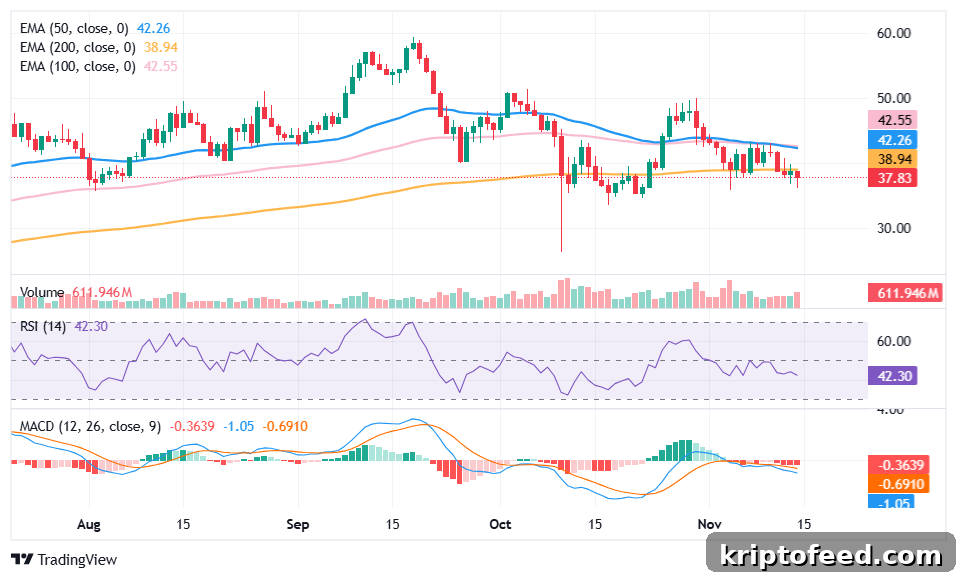 Price chart for Hyperliquid | Source: CoinMarketCap
Momentum indicators, including the MACD and RSI, point to persistent selling pressure. Analysts warn that a decisive break below the $35 support level could accelerate a move toward the $30 area.