
Less than six years ago, Vitalik Buterin began developing Ethereum, a decentralized, open-source platform that enables peer-to-peer smart contracts with blockchain as its underlying architecture. Today Ether — the cryptocurrency that powers this ecosystem — remains the second-largest cryptocurrency by market capitalization. However, ETH suffered a steep decline from which it has yet to fully recover since the 2018 bear market. Forecasting Ethereum for 2020 is therefore challenging given the highly volatile nature of cryptocurrency markets. In this article we analyze technical and fundamental factors and summarize expert opinions to explore where Ethereum might head in 2020.
The Future of Ethereum: Could 2020 Be a Pivotal Year?
Ethereum has dominated the decentralized application development space and has retained its position as the second-largest cryptocurrency by market cap for several years, save for brief periods when other projects briefly overtook it. Nevertheless, Ethereum faces growing competition from other smart-contract platforms that also aim to host decentralized applications (dApps) and tackle scalability—one of Ethereum’s longest-standing challenges.
Despite these pressures, Ethereum’s outlook is far from bleak. In 2020 the network could see meaningful code-level changes. Ethereum 2.0 (Serenity), which introduces proof-of-stake and other core upgrades, may begin to materialize, while recent upgrades such as Istanbul could pave the way for sharding, a scaling solution that partitions the blockchain to increase throughput. If implemented successfully, sharding could raise network capacity substantially, potentially enabling thousands of transactions per second. Watch for network upgrade news throughout the year, as these developments will be critical to ETH’s price prospects.
Key Reasons Ethereum Could Rise in 2020
Below are factors that could support an Ether recovery in 2020. Keep in mind that macroeconomic data, regulatory changes, and other external events can alter these prospects, so staying updated with news and tracking core technical indicators is essential.
- Vitalik Buterin, Ethereum’s cofounder, has framed Ethereum 2.0 as the project’s evolution from an early, somewhat ad hoc effort into a more robust “world computer” powered by proof-of-stake.
- Research and developer resources indicate that initial sharding rollout phases were anticipated for 2020, which would be a fundamental scaling milestone for the network.
- The Bitcoin halving scheduled for the following year has historically coincided with positive price movements in Bitcoin, which can spill over into major altcoins like Ethereum.
- Long-term charts have begun to show some signs of oversold conditions for ETH, suggesting potential for recovery if market sentiment shifts.
Technical Analysis and Scenarios for 2020
The technical observations below were derived from data as of December 27, 2019. They provide possible scenarios and levels of interest, but cannot guarantee exact future movement. Historical price data helps identify potential targets and significant support/resistance levels.
We provide analysis of ETH priced in US dollars (ETH/USD) and ETH priced against Bitcoin (ETH/BTC), since both pairs can present distinct trading opportunities.
ETH / USD: Key Observations and Areas of Interest
Technical analysis ETH vs. USD for December 27, 2019. Data analyzed from Bitfinex using TradingView.
The chart highlights several points to watch closely:
- The analysis uses daily intervals to assess medium-term scenarios.
- A bullish run began when Ethereum gained at the start of 2019 and continued into the first half of the year until the upward trendline was broken in August.
- Fibonacci retracements reveal medium-term levels of interest, and additional intermediate supports and resistances are marked on the chart.
- The area around USD 143 stands out as a significant level, along with USD 160; both could act as support or resistance as needed.
- USD 190 has served as a key resistance level over the past year and will be an important reference for any bullish breakout.
- If bulls prevail, ETH could test successive resistance levels with Fibonacci targets between approximately USD 330–360, where it reached highs in 2019. Clearing those levels would strengthen the bullish case.
- If bulls fail to act, ETH could fall toward about USD 105 and potentially retest 2019 lows near USD 83, a scenario that could produce oversold conditions.
- At the time of the analysis, the Relative Strength Index (RSI) was recovering from oversold territory. While this suggests waning selling pressure, multiple confirmations would be required before declaring a trend reversal. A break of the yellow channel on the chart would be an early bullish sign.
ETH / BTC: Key Observations and Areas of Interest
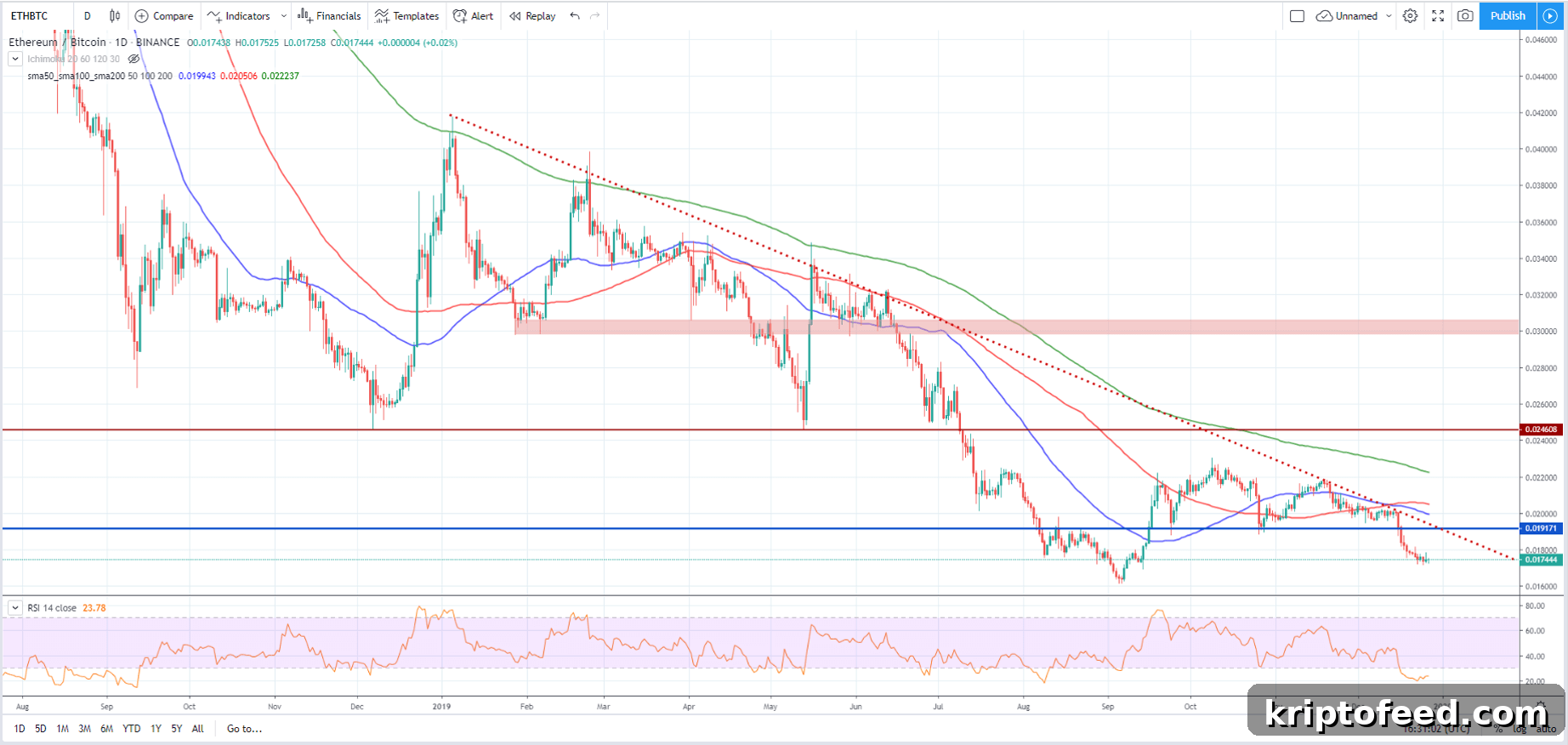
Technical analysis ETH vs. BTC for December 27, 2019. Data analyzed from Binance using TradingView.
ETH/BTC is another pair with opportunities but is typically more volatile and harder to trade, so risk management is essential.
- Using daily intervals, the pair was approaching September lows where ETH/BTC previously bottomed. A rebound from that level is possible if bulls step in or if Bitcoin stops gaining dominant strength.
- A steady decline throughout 2019 is visible via a descending series of highs; a breakout above that downtrend would be a key early indicator for bulls.
- This prolonged decline pushed ETH/BTC into oversold readings on the RSI—the lowest oversold levels since September 2018—suggesting a potential for mean reversion.
- 50-, 100- and 200-day moving averages acted as resistance throughout the year and remain relevant for evaluating upside breakouts.
- A notable support/resistance pivot exists around 0.0246 BTC.
Additional Technical Notes and Projections
- Yearly lows for ETH: Ether fell to roughly USD 82 last December. Its Bitcoin pair hit lows in September 2019 at about 0.016 BTC.
- All-time highs: Ethereum posted an impressive rally in 2017, reaching highs above USD 1,420. The ETH/BTC peak occurred earlier in 2019 when the pair was substantially higher than the recent lows.
Both analyses indicate that Ethereum is approaching critical areas that will influence its near-term future. If bulls are to regain control and reverse the prevailing bearish bias, they must act decisively to shift market expectations.
Ethereum Price Predictions for 2020: Expert and Popular Views
Below are a selection of speculative and expert opinions on Ethereum’s 2020 prospects. These forecasts vary widely and can fuel market enthusiasm, but readers should keep realistic expectations and continuously monitor market trends. Cryptocurrency markets are highly volatile and prices can swing dramatically, so compare these projections against your own analysis before making decisions.
Some outlets projected ETH recovering to roughly USD 200–300 in 2020, while others offered more conservative or more optimistic ranges. One long-term forecasting site placed 2020 targets between USD 77 and USD 124, suggesting downside risk. Another automated forecaster pointed to a possible drop toward about USD 159. Conversely, a bullish automated projection suggested much higher targets for the year, but such extreme estimates should be treated with caution.
A more in-depth study by Satis Group provided a bullish outlook for ETH into mid-2021, estimating prices could reach around USD 788 by August 2021, with long-term stability nearer USD 500. Even so, no single forecast is definitive, and many prediction sources are speculative rather than institutional-grade research.
Conclusions: What These Predictions Mean for Ethereum’s Future
Despite recent corrections, Ethereum remains one of the strongest projects in the crypto space—especially in decentralized application development. If market confidence returns, bullish traders could drive ETH prices higher, and upcoming network upgrades have the potential to improve Ethereum’s fundamental outlook, which would likely be reflected in price action. That said, markets face unpredictable setbacks and external events, so it is essential to follow network developments closely and maintain disciplined technical monitoring when evaluating ETH as an investment.