
The buzz around Ethereum shows no sign of fading as Google Trends data reveal search interest is soaring
Ethereum’s recent strong performance is mirrored by a sharp rise in Google searches, approaching levels not seen since 2018.
Search interest for the cryptocurrency has reached a yearly high in the United States, driven largely by searches from California, New York, and Washington.
The trend is similar in other parts of the world. This substantial growth in November has already exceeded search activity recorded over the past two years. The top cities with the highest concentration of Google searches for Ethereum are San Francisco, Singapore, Toronto, and Vienna.
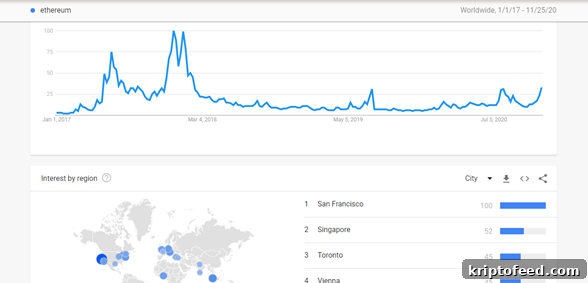 Chart showing the trend of searches for ‘Ethereum’ worldwide. Source: Google Trends
Why interest in Ethereum is rising
Several factors likely contribute to the surge in interest. First, Ethereum’s price has been climbing, which often triggers increased online searches as investors and observers seek information on recent gains and future prospects. ETH has been on a bullish run, moving closer to levels last seen in 2018.
Institutional adoption may also be driving attention. Major companies and financial services are increasingly supporting cryptocurrencies; for example, PayPal confirmed broader support for digital assets, including Ethereum, on its platform, sparking renewed public interest.
Another key driver is the impending launch of Ethereum 2.0. The upgrade has been one of the most-discussed topics in the crypto community and is scheduled to roll out on 1 December. Anticipation around improvements such as energy efficiency and network scalability has amplified discussion and searches.
Does rising interest affect Ethereum’s price?
The critical question is whether increased search interest has a direct impact on ETH’s price or simply occurs alongside price movements.
There is no definitive proof establishing a causal link between search volume and price. However, historical patterns suggest a correlation: periods of rising prices have often coincided with heightened Google searches, and declines have been accompanied by reduced search activity.
At this stage, it remains difficult to determine causality. The surge in attention could be driving buying behavior and contributing to price gains, or it could be a reaction to the price rally and broader market developments. More data and analysis would be needed to clarify the relationship between public interest and market performance.