
- Inflows into Ethereum ETFs and whale accumulation are driving ETH price gains.
- The BPO hard fork raised the blob limit, improving Ethereum’s scalability.
- An overbought RSI signals potential short-term volatility despite strong momentum.
Ethereum continues its price advance, extending a robust weekly rally even as the broader crypto market shows some weakness.
At the time of publication, Ethereum (ETH) was up 1.13% over the past 24 hours, building on a solid seven-day gain of roughly 9.60%.
These gains come despite a modest 0.44% decline across the wider cryptocurrency market, underlining Ethereum’s relative strength.
ETH’s momentum is supported by a mix of institutional demand, improving network scalability, and favorable on-chain dynamics.
However, technical indicators suggest caution may be warranted in the near term, as the RSI currently sits in overbought territory.
ETF inflows strengthen Ethereum’s institutional narrative
One key driver behind Ethereum’s rise has been steady inflows into spot Ethereum ETFs.
Data from Coinglass show spot ETH ETFs attracted about $114.7 million in net inflows on January 6, 2026.
These inflows occurred even as some traditional products registered outflows, indicating fresh institutional capital entering the market.
For investors, ETF demand signals growing confidence in Ethereum as a long-term, regulated asset.
ETFs also help absorb potential selling pressure, providing price stability during periods of heightened market uncertainty.
Market participants increasingly view ETF flows as a barometer of institutional sentiment, much like how macro investors use other on-chain and financial indicators to track broader trends.
Blob Parameter hard fork — a scalability boost for Ethereum
Beyond demand-side factors, Ethereum’s fundamentals improved following recent network upgrades.
The Fusaka upgrade, activated in December 2025, delivered meaningful scalability enhancements.
A central element of that progress was the Blob Parameter — Only Hardfork, commonly referred to as the BPO hard fork.
The BPO hard fork, which went live on Wednesday at 01:01:11 UTC, raised the per-block blob limit, increasing the volume of data the network can efficiently process.
By expanding blob capacity, Ethereum reduced data costs for layer-2 rollups without adding overhead to the base layer.
This change aligns with Ethereum’s long-term roadmap focused on rollups, a vision championed by co-founder Vitalik Buterin.
Lower layer-2 fees have already translated into improved network usage, with daily transactions reaching multi-month highs.
The BPO update also creates better conditions for advanced scaling solutions, including zero-knowledge Ethereum Virtual Machines (zkEVMs).
zkEVMs depend heavily on efficient data availability, so a higher blob limit represents a structural advantage.
Developers view BPO as a step toward further upgrades, including the planned Glamsterdam hard fork expected later in 2026.
Glamsterdam is projected to further increase throughput and computational efficiency across the Ethereum ecosystem.
Taken together, these upgrades strengthen Ethereum’s value as a scalable settlement layer for decentralized applications.
Whale accumulation supports price, but momentum may be overheating
On-chain data add another layer of support to Ethereum’s narrative.
Large holders, often labeled “whales,” accumulated more than 3.62 million ETH over the past month, according to CryptoQuant data.
At the same time, exchange reserves of ETH have fallen to levels not seen in nearly nine years.
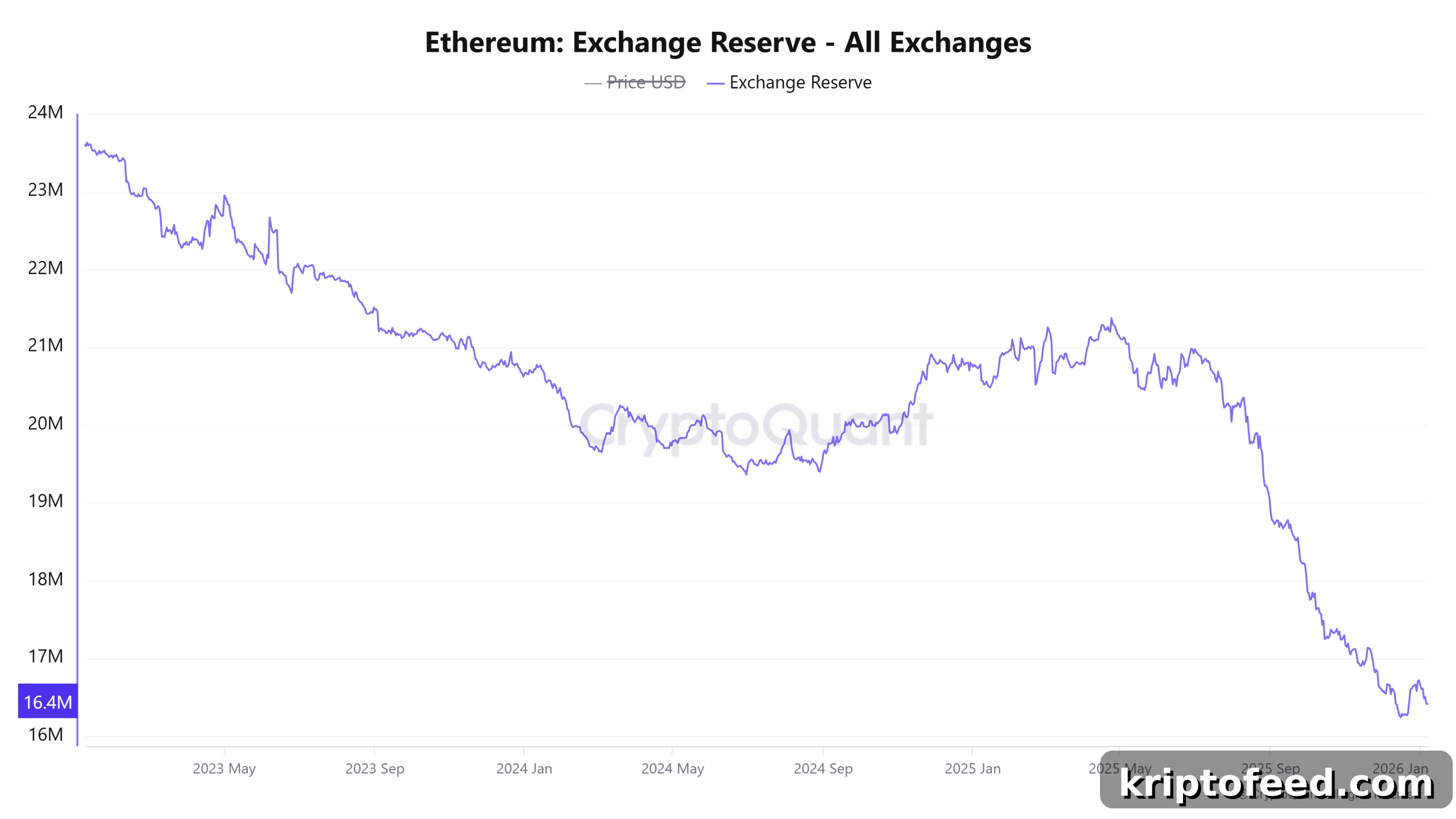
Lower exchange balances typically imply reduced immediate selling pressure.
This pattern suggests long-term holders are betting on higher prices rather than short-term exits.
However, momentum indicators are flashing warning signs.
Ethereum’s Relative Strength Index (RSI) has climbed to around 64, positioning it near overbought territory.
Historically, elevated RSI readings can precede short-term pullbacks or consolidation phases.
Upcoming derivatives events, including near-term options expiries, may amplify volatility.
Ethereum price outlook
The medium- to long-term outlook for Ethereum remains constructive, supported by ETF inflows, improved scalability, and declining liquid supply.
The Blob Parameter hard fork and a higher blob limit bolster the network’s technical foundations and support layer-2 growth.
Further progress toward upgrades such as the Glamsterdam hard fork keeps Ethereum aligned with its long-term roadmap.
Immediate resistance for ETH lies at the 100-day EMA near $3,307; a clear break above this level could open the way toward the 200-day EMA around $3,352.
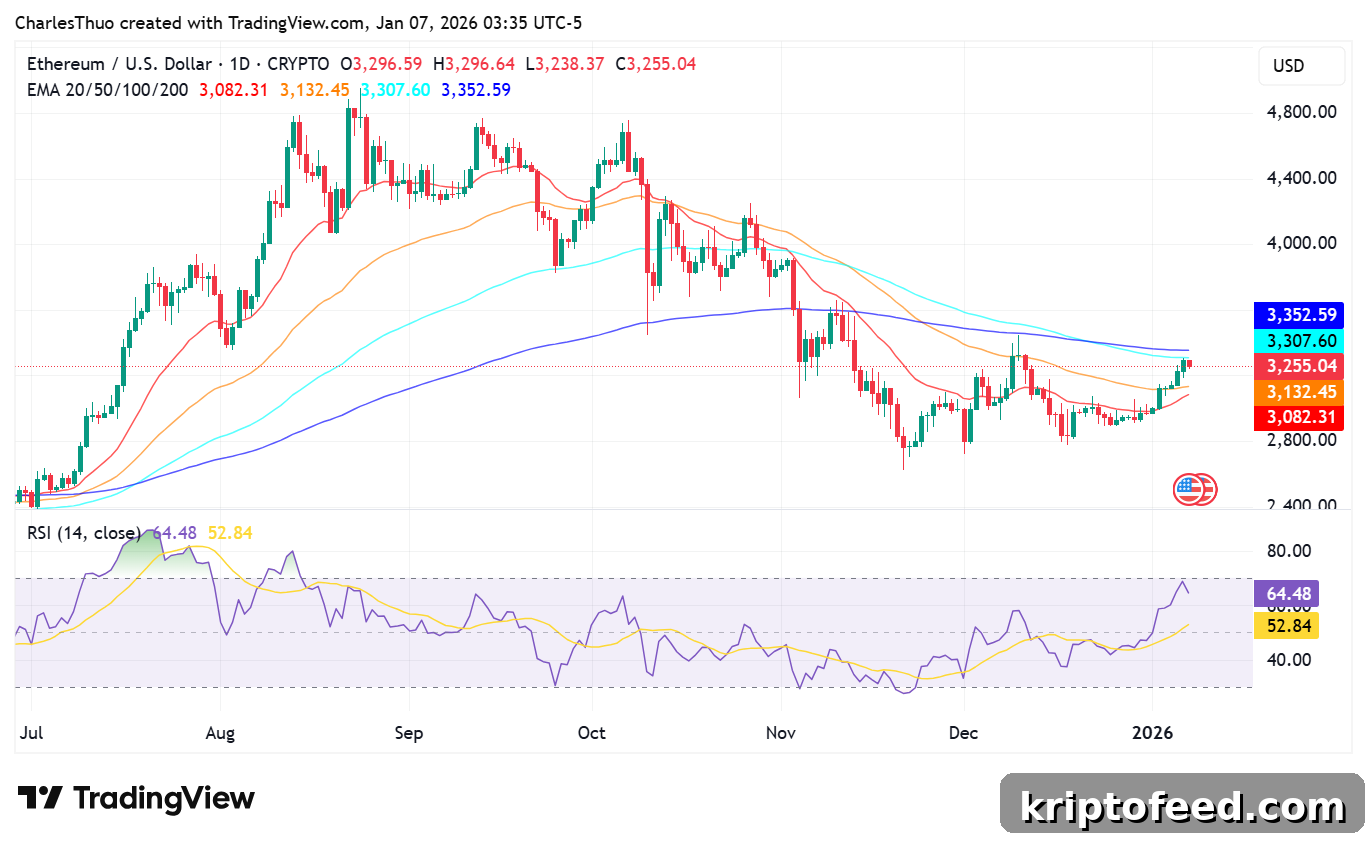
In the short term, the elevated RSI suggests traders should prepare for potential price swings that could push Ethereum down toward support at the 50-day EMA near $3,132.
However, if ETF inflows remain strong and on-chain accumulation continues, any dip may be limited.
Overall, Ethereum appears well positioned for further gains, but investors should exercise caution while momentum remains elevated.