
- Dogecoin price has held above key support with a bullish breakout pattern emerging.
- The DOJE ETF launch was delayed until mid‑next week, but market confidence remains high.
- Analysts expect ETF inflows to fuel a rally that could eventually push DOGE toward $3.
Dogecoin (DOGE) has once again captured market attention, this time driven more by institutional developments than social media hype.
The long‑anticipated first US‑listed Dogecoin exchange‑traded fund (ETF) launch was delayed until next week, yet the excitement around the event has already helped build bullish momentum in the meme coin.
Traders and analysts are closely monitoring price charts, and many see the current setup as one that could propel DOGE toward multi‑dollar futures.
Rex‑Osprey DOJE ETF delay fails to dampen enthusiasm
The Rex‑Osprey DOJE ETF, which plans to hold a large portion of its assets directly in Dogecoin, represents an important milestone for both the memecoin community and the broader crypto industry.
For the first time, a US ETF will be tied to a digital asset that openly lacks traditional utility, making the product notable beyond its headline appeal.
Earlier reports indicated the Dogecoin ETF would launch on Thursday, but Bloomberg’s Eric Balchunas later said trading will officially begin next week rather than today, reflecting a short postponement in the timetable.
Despite the setback, investors appear unfazed. Dogecoin’s price has climbed steadily in recent days, absorbing volatility from US inflation data and holding firmly above key support levels.
Open interest in Dogecoin futures has also surged, rising to more than $4.67 billion from roughly $3.3 billion earlier in the week, according to Coinglass. That increase suggests both retail and institutional participants are positioning ahead of the ETF debut.
Dogecoin price breakout signals a strong bullish trend
From a technical perspective, Dogecoin is showing clear bullish signals.
As highlighted by CryptoJoe on CoinMarketCap, DOGE has broken above a descending trendline, a move many analysts interpret as the start of an impulsive wave‑three rally.
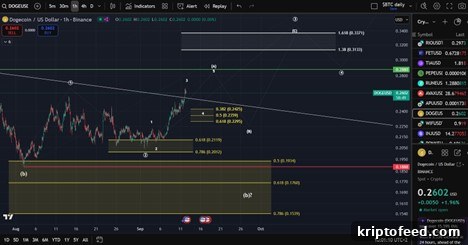
The wave structure implies further upside may be likely, with no immediate signs of a top. Support for the next corrective wave is expected between $0.2425 and $0.2295, which would allow healthy pullbacks before any continuation higher.
Major moving averages continue to back the bullish case: DOGE is trading well above the 50‑day exponential moving average as well as the 100‑ and 200‑day moving averages. Momentum indicators such as the MACD remain positive, and the Relative Strength Index (RSI) is holding near 65, indicating strong buying pressure without extreme overbought readings.
Path toward higher targets
Chart patterns are consistent with an optimistic outlook.
TradingView contributor Mycatdorito noted a symmetrical triangle breakout pointing to a near‑term target of $0.29, while a double bottom formation on the 12‑hour chart suggests a move toward $0.30 is possible.
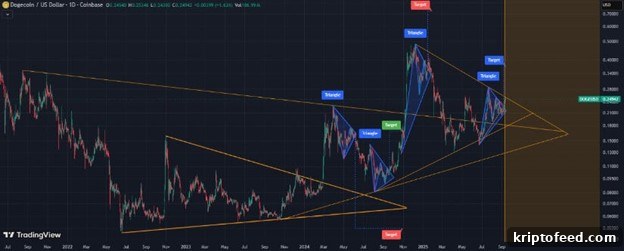
Fibonacci extensions indicate resistance levels could extend as high as $0.37 if momentum accelerates.
The ETF launch adds a new dimension to the story. The DOJE ETF is expected to attract institutional inflows similar to those seen with Bitcoin and Ethereum products, albeit on a smaller scale. Mainstream financial exposure could create incremental demand for Dogecoin and help sustain a longer‑term rally.
Is $3 realistic?
For many investors, the question is not only whether DOGE can hit immediate targets but whether it can eventually break into new territory.
With the coin up more than 150% over the past year, continued momentum beyond current resistance zones could pave the way for a broader rally. If ETF‑driven inflows materialize and market confidence holds, some analysts view a multi‑leg climb toward $3 as a plausible medium‑term objective.
In the near term, $0.25 remains a key resistance level to watch. A decisive breakout above that mark would confirm the bullish structure and clear a path to higher targets. Conversely, traders should monitor $0.22 and $0.20 as critical support zones in the event of a pullback.