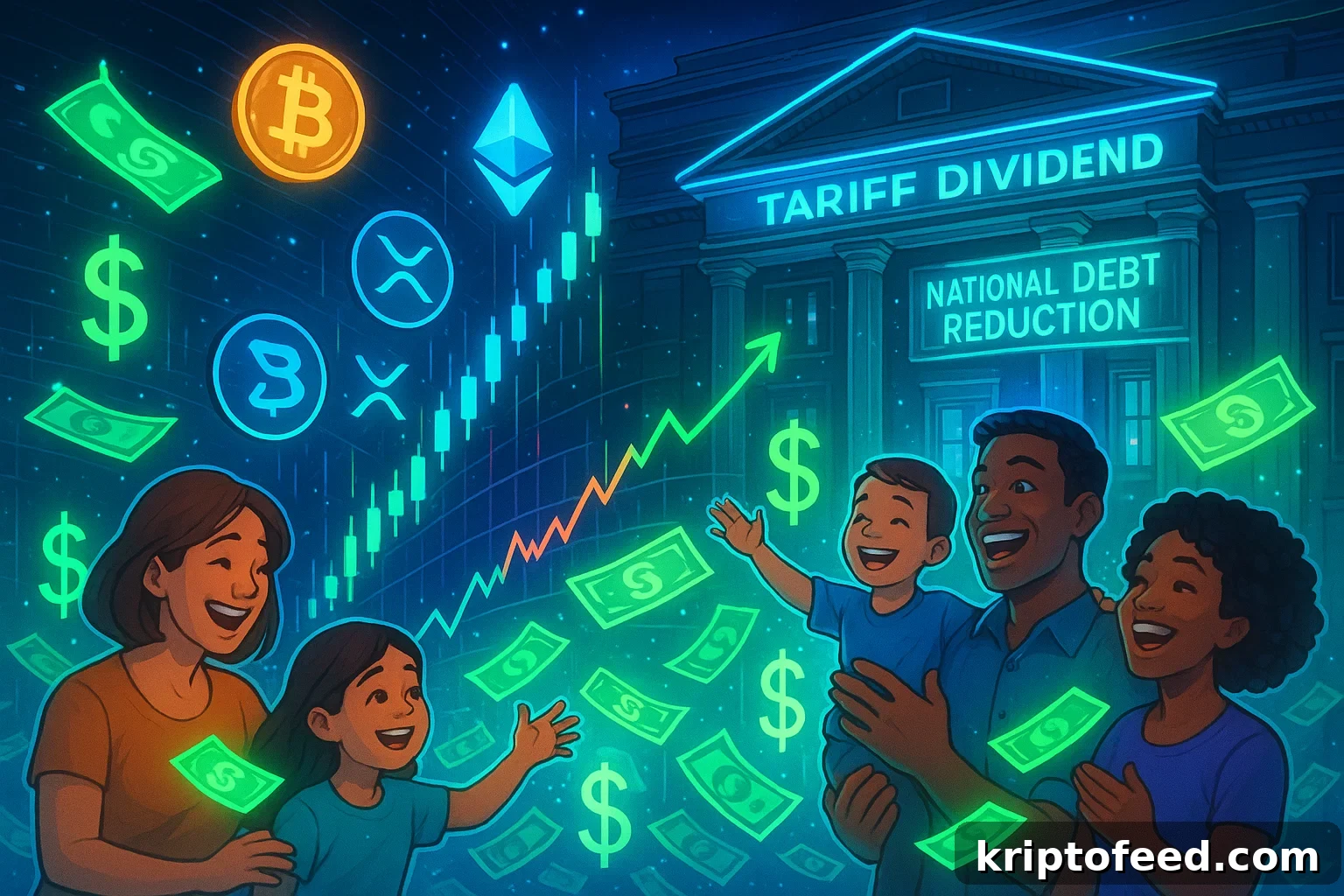
- Trump is reportedly considering tariff rebates of $1,000 to $2,000 for American households.
- The stated goal is to help reduce the $37 trillion national debt, but the plan faces significant legal hurdles.
- Analysts see potential for a targeted rise in altcoins, rather than a broad market rally.
U.S. President Donald Trump is reportedly considering providing American households with tariff rebates in the range of $1,000 to $2,000.
He frames the idea as a kind of “dividend for the people,” and such a move could influence consumer spending and market dynamics.
The primary objective is to help lower the $37 trillion national debt.
However, observers are already speculating that these rebates could trigger renewed interest in altcoins—reminiscent of the 2020–2021 period when pandemic stimulus checks pushed many retail investors toward cryptocurrencies.
Trump’s Tariff Dividend: Political and Legal Challenges
The rebates Trump mentions would be funded from revenues generated by his aggressive tariff policies.
So far in 2025 those tariffs have produced roughly $215 billion, and some projections suggest revenues could approach $300 billion by year’s end.
Trump has emphasized that reducing the national debt remains a top priority, while also suggesting that some of the funds should be distributed directly to Americans, saying something along the lines of, “We’re thinking maybe $1,000 to $2,000—that would be great.”
The administration has even claimed tariffs could eventually produce more than $1 trillion annually, although that outcome remains uncertain.
But here’s the catch: the legality of imposing broad tariffs is under intense judicial scrutiny.
The Supreme Court is scheduled to hear a case in November 2025 to determine whether the president has constitutional authority to impose sweeping tariffs.
Earlier decisions by the U.S. Court of Appeals for the Federal Circuit have already raised questions about that authority.
Treasury Secretary Scott Bessent warned that if courts rule against the administration, the government could be forced to return between $750 billion and $1 trillion in collected or projected revenue.
So while the idea of rebates sounds appealing, the legal uncertainty makes any payout far from guaranteed.
Altcoin Markets: Potential Upside?
Analysts say that if these rebates are actually distributed, they could prompt a surge of investment into altcoins.
A 2023 study by Marc Di Maggio at Harvard found that when households receive extra cash, a notable share of that money sometimes flows into cryptocurrencies—especially among retail investors seeking returns or a hedge against inflation.
That pattern helped fuel the altcoin boom of 2020–2021, when Bitcoin’s dominance fell from 73% to 39% as stimulus funds entered digital assets.
Today the backdrop is different: interest rates are above 4% and total crypto market capitalization has grown to around $4 trillion.
Strategists at firms like Wintermute argue that any new “alt season” would likely be more selective, favoring coins with tangible utility over pure speculation.
Even so, the psychological boost from direct payments combined with possible future rate cuts by the Federal Reserve could re-energize retail investors.
Blockchain platforms focused on innovation—such as Solana and others with clear use cases—could be notable beneficiaries if attention shifts toward utility-driven projects.
In short, while tariff-funded rebates could stimulate consumer spending and stir pockets of crypto demand, legal risks and evolving market conditions mean the effects would likely be targeted and selective rather than a sweeping market rally.