-
Chainlink joins GAKS to support KRW stablecoin standards and deployment.
-
LINK’s price shows modest recovery amid the partnership and whale accumulation.
-
Technically oversold conditions could trigger a short-term rebound in LINK’s price.
Chainlink Labs has officially joined the Global Alliance for KRW Stablecoins (GAKS), a key initiative led by South Korean blockchain and gaming firm WEMADE.
Chainlink Labs has joined the Global Alliance for KRW Stablecoins (GAKS) led by WEMADE, a 600M+ user platform.https://t.co/PdTxmFvSbj
The alliance is advancing stablecoin standards in Korea by leveraging Chainlink’s data, interoperability, compliance, & privacy standards. pic.twitter.com/QPTuTH4mEo
— Chainlink (@chainlink) January 27, 2026
The alliance was launched in November 2025 to promote the adoption and standardization of stablecoins backed by the Korean won.
Its mission is to ensure KRW-backed stablecoins meet local regulatory requirements as well as global technical standards.
GAKS brings together a diverse membership that includes security firms, fintech companies, and blockchain infrastructure developers.
Chainlink Labs’ participation strengthens the alliance’s technical capabilities by adding a major oracle network to the coalition.
Chainlink’s role in developing KRW stablecoin standards
Chainlink’s involvement in GAKS positions the company as a central contributor to global technical standards for KRW-backed stablecoins.
By leveraging its oracle technology, Chainlink connects blockchain networks to real-world data, ensuring that KRW-backed digital assets remain transparent, reliable, and compliant.
The alliance benefits from Chainlink’s expertise in data integrity and verifiable real-time information—capabilities that are critical for institutional adoption.
With this technology, KRW stablecoins can be trusted for tokenized asset projects and other digital finance applications both domestically and internationally.
Chainlink’s membership also increases GAKS’s institutional credibility. Oracle solutions from Chainlink are already used by major international institutions, demonstrating that KRW stablecoins built within this framework can meet high regulatory and security standards.
Supported by Chainlink, GAKS is now well positioned to promote real-world adoption of KRW stablecoins while maintaining transparency, trust, and technical resilience—a model that could influence other regulated stablecoin ecosystems worldwide.
LINK price outlook as Chainlink joins GAKS
The announcement of the Chainlink–GAKS collaboration produced a modest uptick in LINK’s price, which rose by just over 1% in the past 24 hours, slightly outperforming the broader crypto market.
This increase reflects a mix of fundamental, technical, and market dynamics.
The strategic partnership links LINK’s utility directly to South Korea’s regulated stablecoin sector, reinforcing its role as infrastructure for institutional finance and real-world asset tokenization.
By joining GAKS, Chainlink signals to investors that its technology is integral to compliance and growth within a fast-expanding market, which may support longer-term demand for LINK.
On-chain data also shows notable accumulation by large holders who have withdrawn LINK from exchanges, reducing immediate selling pressure.
This trend suggests informed investors view current levels as a value opportunity, creating a base for price stability and potential recovery.
From a technical perspective, LINK approached oversold conditions when the RSI briefly dropped to 38.95 and price tested the $11.38–$11.92 support zone.
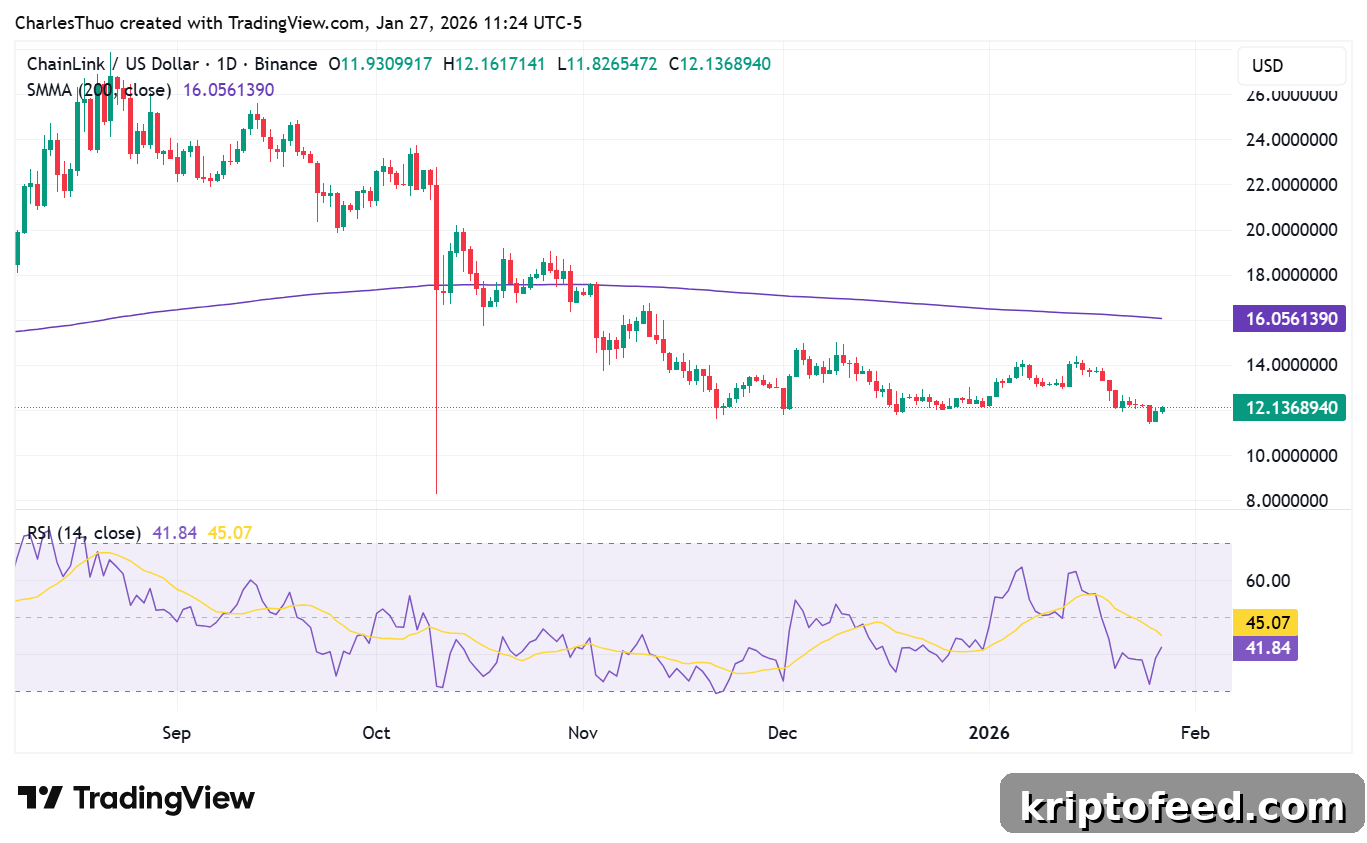
While oversold conditions often precede short-term rallies, broader market indicators remain cautious, and LINK still trades below major moving averages, including the 200-day SMA near $16.06.
A more meaningful trend reversal would likely require a move above $13.40 (the 7-day SMA).
Overall, LINK may see short-term gains driven by the GAKS partnership and technical rebounds, but the broader trend remains downward.
Continued upside will depend on sustained institutional adoption, further technical integrations, or positive shifts in market sentiment.