
- Chainlink and Swift enable tokenized fund workflows via existing banking systems.
- UBS pilots the new Chainlink-Swift system, avoiding costly infrastructure upgrades.
- Global institutions can connect to cryptocurrencies using familiar payment rails.
Chainlink and Swift have expanded their collaboration with a new solution designed to help financial institutions manage tokenized fund processes using their existing infrastructure.
The initiative links Swift’s global messaging network with the Chainlink Runtime Environment (CRE), enabling subscription and redemption workflows for tokenized assets without forcing firms to rebuild their legacy systems.
The first pilot involved UBS Tokenize, the Swiss bank UBS’s tokenization arm, and builds on earlier work under the Monetary Authority of Singapore’s Project Guardian.
This collaboration aims to show how blockchain technology can streamline traditional financial processes, paving the way for broader adoption of tokenized assets.
We’re excited to announce a landmark technical solution enabling financial institutions worldwide to manage digital asset workflows directly from their existing systems using Swift (@swiftcommunity) messaging and Chainlink in collaboration with @UBS.https://t.co/W1fq1guro4… pic.twitter.com/0uBUl2K4tk
— Chainlink (@chainlink) September 30, 2025
Plug-and-play infrastructure for tokenization
The new solution leverages Swift’s ISO 20022-compliant messaging standards and Chainlink’s commercial-grade infrastructure along with its technical DTA (Digital Transfer Agent) standard.
Institutions can trigger smart contract events directly via Swift messages, reducing the need for entirely new identity or key management systems.
Commenting on this milestone, Chainlink co-founder Sergey Nazarov said:
I’m very excited about this historic innovation we achieved by leveraging Swift standards and UBS’s tokenized asset design, because we’re showing how smart contracts and new technical standards can enable transfer agents and other entities to manage tokenized asset workflows on-chain.
Markets reacted positively as observers watched a potential financial transformation unfold in real time.
The UBS trial confirmed that institutions like banks can integrate cryptocurrencies into their existing operations without painful learning curves, launching new platforms, or major system overhauls.
These developments follow months of prior work.
In 2024, UBS, Chainlink and Swift explored how tokenized funds might operate under Singapore’s Project Guardian.
The latest experiment advances that work, demonstrating blockchain compatibility with legacy systems.
Chainlink emphasized:
With Swift messages and the Chainlink Runtime Environment (CRE), banks and institutions can seamlessly access blockchains using the same Swift infrastructure they have relied on for decades.
Overview
Integrating blockchain into traditional finance has often felt like merging two incompatible worlds.
The Chainlink–Swift model aims to change that narrative.
Rather than asking banks to adopt entirely new technologies, this approach lets them leverage cryptocurrencies through familiar systems — Swift messaging.
It’s a simple gesture with far-reaching implications.
If successful, the approach could usher in a new era in which blockchain becomes part of everyday global finance.
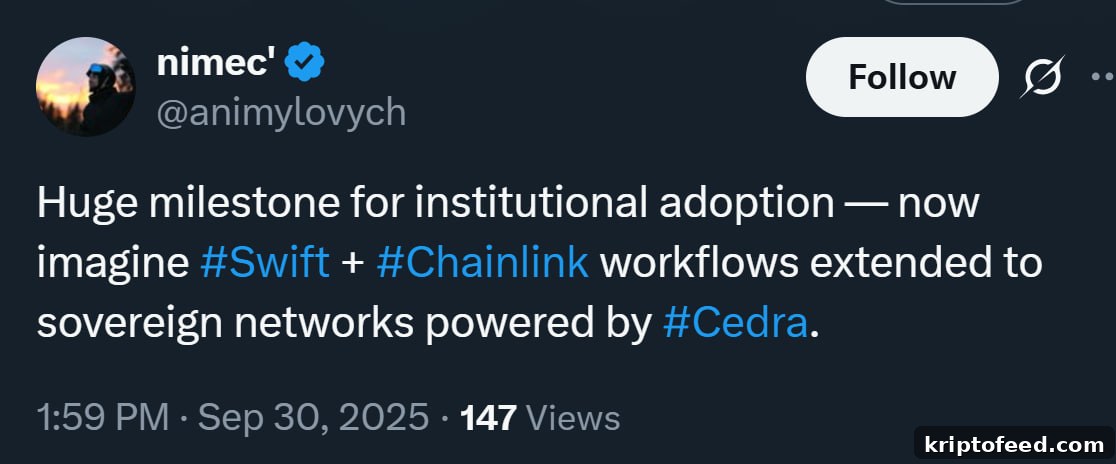
For institutions seeking the resilience and capabilities of blockchain, the new system offers more opportunities with reduced operational risk.
LINK price outlook
The Chainlink token has remained relatively muted amid the news, trading up about 1% on the daily chart at $21.
However, a 35% increase in 24-hour trading volume indicates renewed activity.
It consolidated over the past week and appears positioned to lead October breakouts.
Popular analyst Ali highlighted the $20 level as a launchpad for a potential move to $47 for LINK.
If Chainlink $LINK defends $20 support, the next target could be $47. pic.twitter.com/GUTAuMdJyH
— Ali (@ali_charts) September 30, 2025
If that scenario plays out, it would represent a roughly 124% increase from LINK’s current market price.