
- Bitcoin (BTC) has slipped to around $73,000 amid ETF outflows and rising geopolitical tensions.
- More than $2 billion in ETF redemptions and roughly $900 million in liquidations intensified selling pressure.
- Key support sits near $72,650, with the 14-day RSI approaching oversold levels at 34.82.
Bitcoin fell below the $73,000 mark as a combination of geopolitical escalation, heavy institutional redemptions from spot ETFs, and concentrated leveraged selling weighed on the market.
At the time of reporting, BTC was trading near $73,235 after hitting an intraday low of $72,604 from an earlier high of $74,490.
The move extends a multi-week decline that has erased more than 8% over the past 14 days and nearly 33% over the last year.
Geopolitical shock and forced liquidations accelerate the downtrend
The sharpest leg of the selloff followed renewed US military strikes on Iran, which triggered a broad risk-off reaction across global markets. Crypto assets, which often carry higher leverage exposure, were particularly vulnerable.
Market data show that more than $900 million in crypto positions were liquidated during the session, concentrated in over-leveraged long positions. Forced liquidation cascaded selling into already weakened order books, pushing Bitcoin briefly below $73,000 and accelerating downside momentum before intra-day stabilization.
During the same period, Bitcoin’s correlation to the Nasdaq Composite rose to about 0.96, one of the highest readings seen in recent months, highlighting increasing synchronicity with traditional risk assets.
Bitcoin ETF outflows deepen institutional selling pressure
Institutional flows added further downward pressure. Spot Bitcoin ETFs recorded eight consecutive days of net outflows, among the longest negative streaks since their launch. On May 27 alone, outflows reached roughly $733 million, contributing to total withdrawals exceeding $2 billion since mid-May.
These redemptions indicate sustained selling from institutional investors reducing exposure amid the downturn. The session’s largest move was tied to a reported institutional block trade valued at about $1.3 billion—approximately 29.2 million shares of BlackRock’s iShares Bitcoin Trust (IBIT)—executed at an estimated $43.16 per share and routed through private market channels.
Following that transaction, Bitcoin fell roughly 1.4%–1.5% within minutes, demonstrating that liquidity conditions were thin enough for large orders to influence short-term pricing and compound existing ETF-driven selling momentum.
Bitcoin price outlook
Over the past month Bitcoin has declined roughly 4.7%, and the 14-day drop of 8.4% reflects an emerging short-term downtrend. The asset remains far below its highs, trading about 42% under the $126,080 peak recorded in October 2025.
Despite the pullback, market activity remains elevated — daily trading volume is running above $44 billion — indicating both institutional and retail participants are actively repositioning rather than fully exiting the market. That sustained activity suggests the move is driven more by flow shifts and deleveraging than by a collapse in participation.
Technically, BTC has slipped below its 20-day, 50-day, and 100-day moving averages, reinforcing a bearish short-term structure.
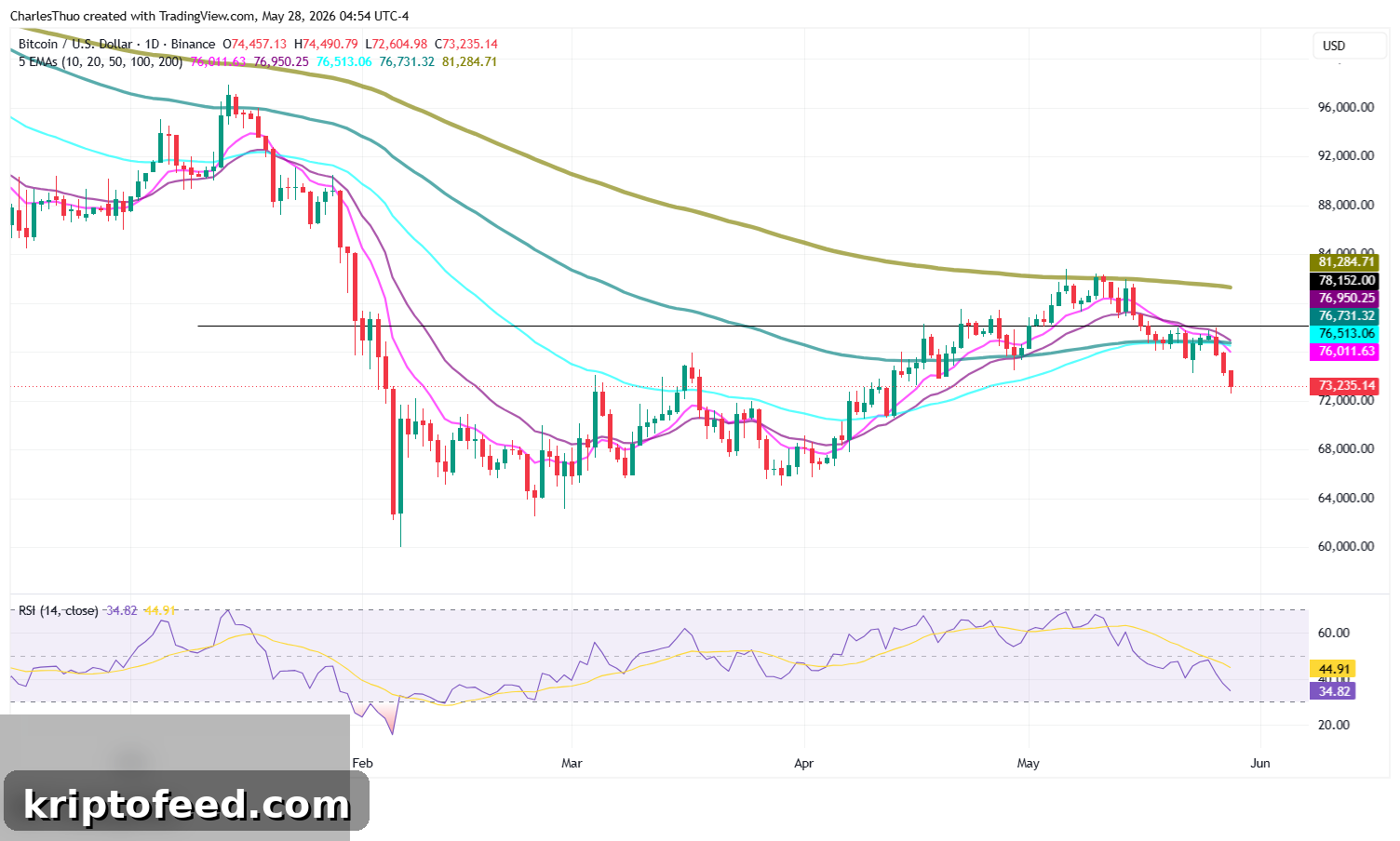
Immediate attention centers on the $72,650 support level, the most recent swing low and the key boundary between consolidation and deeper downside risk. On the upside, the 50% Fibonacci retracement at $74,332 now serves as the first meaningful resistance for any recovery attempt.
If ETF outflows persist or geopolitical tensions remain elevated, a decisive break below $72,650 could expose Bitcoin to a move toward the $70,000 area, where liquidity and buyer interest could be tested more aggressively. Conversely, momentum indicators show early signs of downside exhaustion: the 14-day RSI sits around 34.82, placing BTC near oversold territory and increasing the probability of short-term relief bounces within the broader downtrend.