
- The $54 support level is critical for the Hyperliquid price.
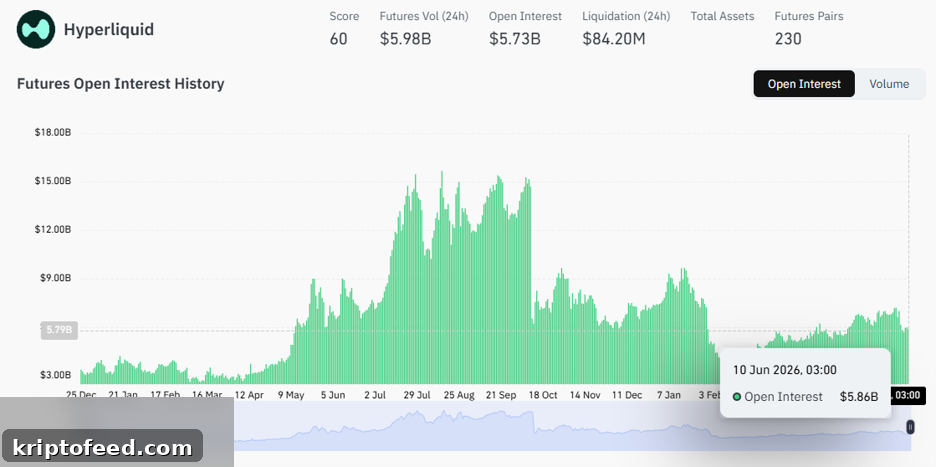
- HYPE futures open interest has fallen to $5.86B, triggering a leveraged unwind.
- Crypto Fear and Greed Index hit 15 as Bitcoin ETF outflows drove risk-off selling.
The Hyperliquid price plunged 11% in 24 hours to $55.35, making it one of the worst-performing assets on a broadly weak day for crypto markets.
While the wider crypto market retreated—Bitcoin sliding about 3.1% toward the $62,000 area—HYPE’s losses were roughly four times larger. This behaviour is typical for high-beta assets that get caught in a rapid deleveraging wave.
Over seven days, the picture is starker: HYPE has dropped 23.7% and has surrendered more than a quarter of its value from the all-time high of $75.48 reached on June 2.
Why is the Hyperliquid price declining?
The most direct explanation for the steep move comes from derivatives activity.
Open interest in Hyperliquid futures fell to $5.86 billion, indicating that leveraged long positions were being closed rather than fresh shorts being initiated.
At the same time, spot trading volume rose 12.5%, which points to genuine selling pressure in the cash market rather than a mere reshuffle of funding rates.
Traders who had built leveraged positions during HYPE’s rally were exiting, and liquidations compounded selling pressure. Importantly, the drop was not prompted by any reported exploit, outage, or change in Hyperliquid’s on-chain fundamentals—daily buybacks continued as usual. In short, this was a speculative unwind rather than a protocol failure.
That unwind, however, occurred amid a challenging macro backdrop that amplified the move.
The broader market continues to struggle
The Crypto Fear and Greed Index fell to 15—deep in “extreme fear”—down from 47 a month ago. Total crypto market capitalization slipped about 2.24% over 24 hours to roughly $2.13 trillion.
Market participants pulled back ahead of the Federal Reserve’s June 16–17 meeting, with CME FedWatch showing a 98.2% probability that rates would remain unchanged. Geopolitical tensions also weighed on sentiment after reports of an incident involving an alleged Iranian strike on a US Apache helicopter near the Strait of Hormuz.
On the regulatory and industry front, the Hyperliquid Policy Centre (HPC) filed a joint comment letter with Paradigm on June 9 opposing a proposed April rule from FinCEN and OFAC tied to the GENIUS Act. That proposed rule would impose anti-money-laundering and sanctions-related requirements on stablecoin issuers, extending obligations into secondary-market activity.
HPC and Paradigm argue that in permissionless blockchain environments issuers cannot reliably identify the real-world parties behind transactions, and holding issuers strictly liable for secondary-market transfers would be impractical. They propose concentrating stronger compliance requirements on primary-market interactions—where issuers have direct customer relationships—and adopting narrower rules for secondary markets, applying the Travel Rule only when operators have a direct relationship with transacting parties.
Their submission also suggested recognizing smart contract–level compliance tools (like address blocklists and transfer restrictions) as valid mitigation measures, and urged that anti-money-laundering obligations should not be extended to protocol developers or infrastructure participants. Their concern is that overly broad liability could push regulated stablecoins out of decentralized finance, leaving space for unregulated offshore alternatives.
What to watch next for HYPE
The immediate technical focal point is the $54 support area. Market observers note that if HYPE holds above $54 it could consolidate in a range roughly between $54 and $65. A decisive break below $54, however, would open the $44–$54 gap and signal a materially larger drawdown from current levels.
On derivatives metrics, a stabilization or rebound in futures open interest—which had fallen markedly—would suggest that forced unwinding is losing steam. Conversely, continuing declines in open interest alongside price weakness would imply further deleveraging remains in progress.
Potential catalysts to monitor include any increased activity tied to the SpaceX IPO listing, which could bring more volume to Hyperliquid markets; however, higher platform activity does not guarantee price support for HYPE specifically. A return of Bitcoin above $63,000 would also improve the broader altcoin environment and could help limit downside risk.
For now, absent a shift in macro sentiment or a recovery in derivatives positioning, Hyperliquid remains exposed to further declines as traders stay cautious ahead of the Fed meeting and in light of elevated market fear levels.