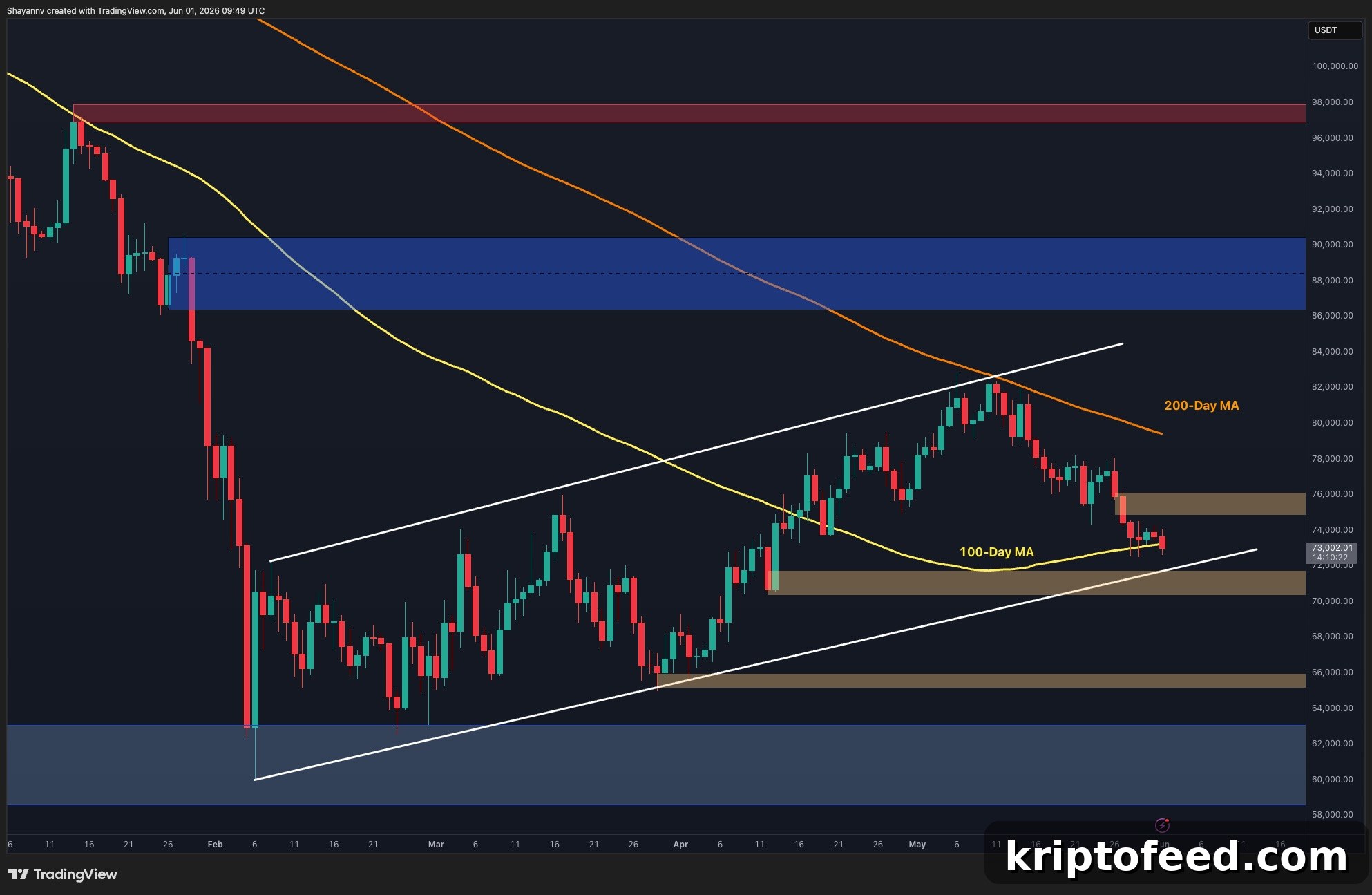
Bitcoin remains under bearish pressure after recently consolidating around the 100-day moving average near $73,000. Price has dipped slightly below that line, and upcoming action will determine whether this pullback deepens or forms a base for recovery.
Bitcoin Price Analysis: The Daily Chart
On the daily chart, BTC continues to trade inside a large ascending channel that has guided price since the February lows. The 200-day moving average, currently near $80,000, has acted as dynamic resistance during the recent decline.
The 100-day moving average sits around $73,000 and is being tested as immediate support. Bitcoin is trading around this level, making it a pivotal zone for the medium-term trend.
If daily price fails to hold above the 100-day MA, the lower boundary of the ascending channel and the major demand zone around $70,000–$71,000 would be exposed. That region also aligns with a previously established order block, adding technical significance to the area.
On the upside, any recovery attempt is likely to encounter resistance between $75,000 and $76,000, where a supply zone recently produced a strong rejection. Beyond that, the 200-day MA near $80,000 remains the critical barrier. Reclaiming that level would improve the medium-term structure and open a path toward the $87,000–$90,000 resistance region.
BTC/USDT 4-Hour Chart
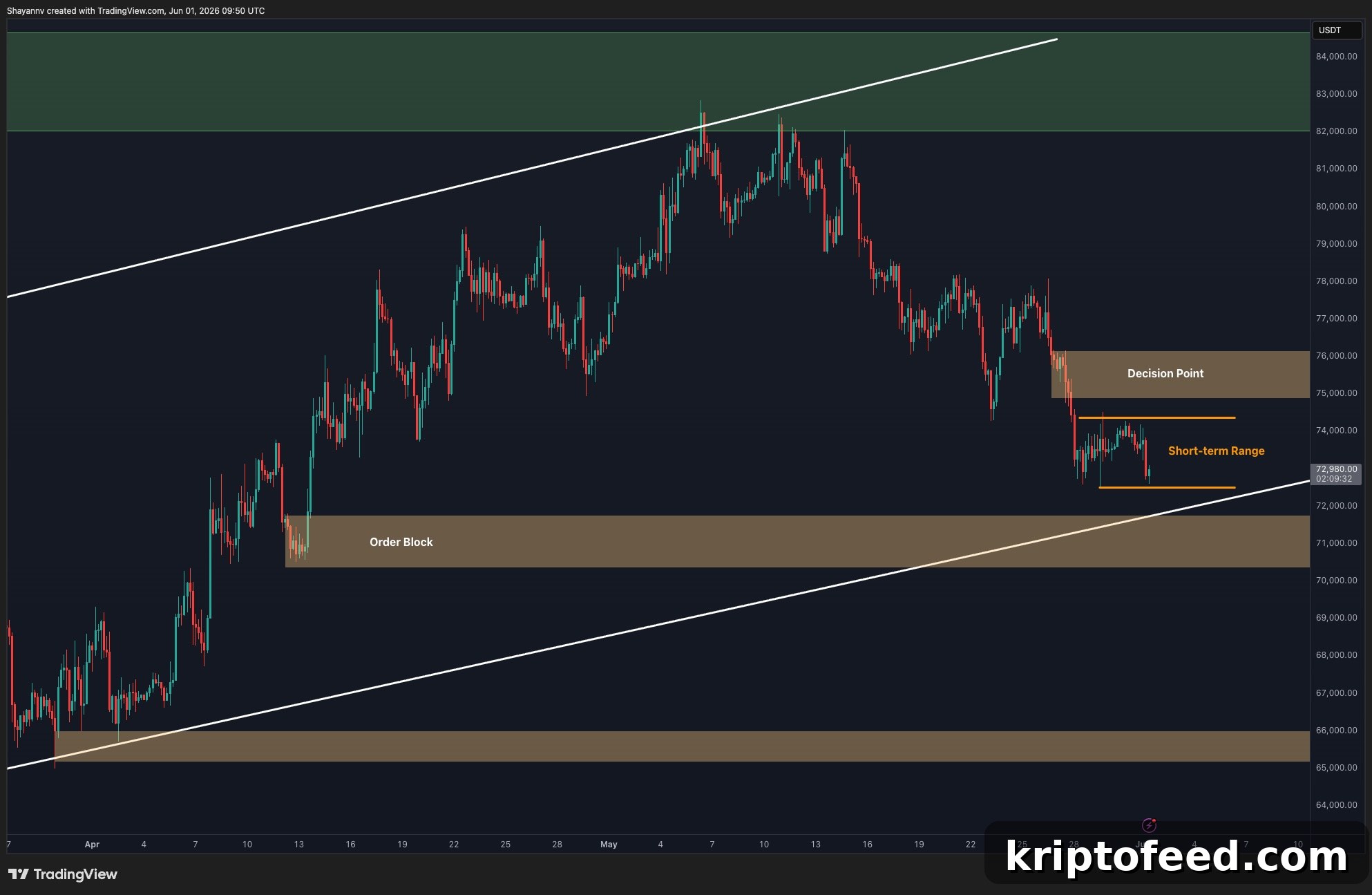
The 4-hour chart highlights a clearer loss of bullish momentum. BTC has formed a series of lower highs and lower lows after failing to sustain a breakout above $82,000.
Price is currently consolidating in a narrow range roughly between $72,800 and $74,500. This range sits just above the rising lower trendline of the broader channel, creating a crucial decision point for traders.
Short-term structure remains neutral to bearish while BTC trades below the $75,000–$76,000 supply zone. A breakout above that area could spark a relief rally toward $78,000 and potentially back to $82,000, where a major liquidity cluster is located.
Conversely, if sellers push price below the current range and the ascending trendline, the market could rotate quickly toward the higher-timeframe order block at $70,000–$71,000. There is limited support between these levels, so a move into that zone could be swift.
For now, BTC appears trapped between near-term support and overhead supply, with increased volatility likely as market participants choose direction.
On-chain Analysis
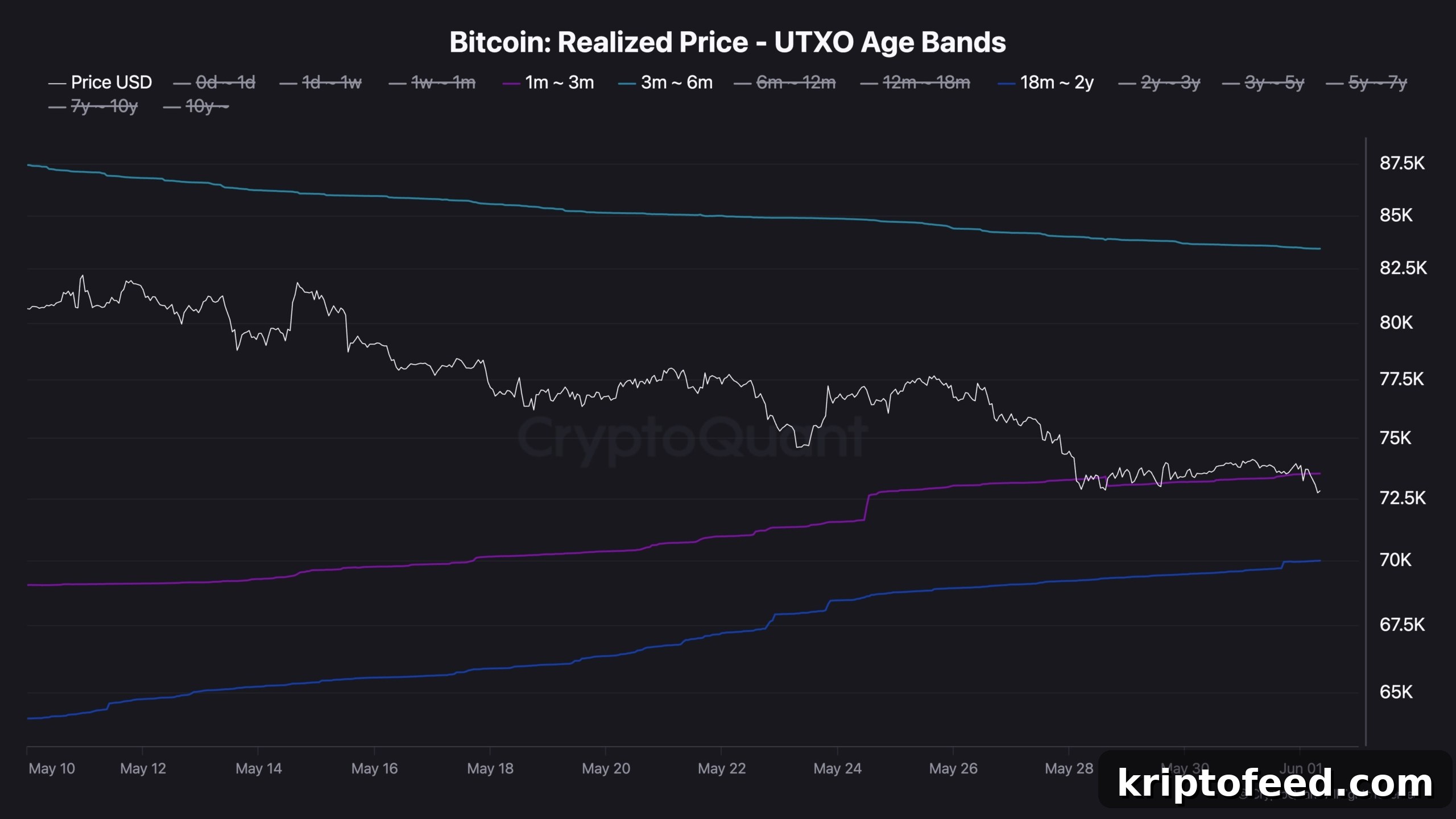
On-chain UTXO realized price age bands show an important development among short-term holders. Bitcoin is trading below the realized price of the 1–3 month cohort, which has climbed to about $73,000–$74,000.
Historically, that cohort acts as a useful sentiment gauge: when price remains above the realized cost of recent buyers, selling pressure tends to be lower as holders remain profitable. Sustained trading below that level, however, raises the odds of capitulation among weaker hands.
At the same time, the realized price for the 18-month to 2-year cohort continues to rise and currently sits near $70,000. This level aligns with the major daily support zone and reinforces the $70,000–$71,000 area as a possible accumulation region.
The older 3–6 month cohort remains materially higher around $83,000–$84,000, reflecting the average cost basis of holders who accumulated during the prior advance. That band now represents significant overhead resistance and corresponds with the upper portion of the present trading range.
Combined, the on-chain data suggests Bitcoin is testing a short-term holder cost basis around $73,000–$74,000 while stronger, longer-term support builds near $70,000. As long as the $70,000 zone holds, the broader market structure remains constructive despite the ongoing correction.