
The hashrate securing the Bitcoin network has continued to surge, surpassing 40 EH/s in June 2018 despite months of downward pressure on Bitcoin prices. That figure is more than double the 2017 peak of roughly 13 EH/s, representing an increase of over 100% in just four months. Such rapid growth is impressive but also creates challenges for mining companies, which must continually reinvest to remain competitive and maintain profitability over the medium term.
The strong rise in Bitcoin prices in late 2017 raised mining profitability, and historically price appreciation is followed by new deployments of hashrate. However, bringing new ASIC miners online is relatively inelastic and often delayed: building facilities, securing extremely low-cost electricity contracts and installing hardware can take considerable time. Mining profitability typically depends on access to rock-bottom power rates available only in certain locations, which further slows and concentrates deployment.
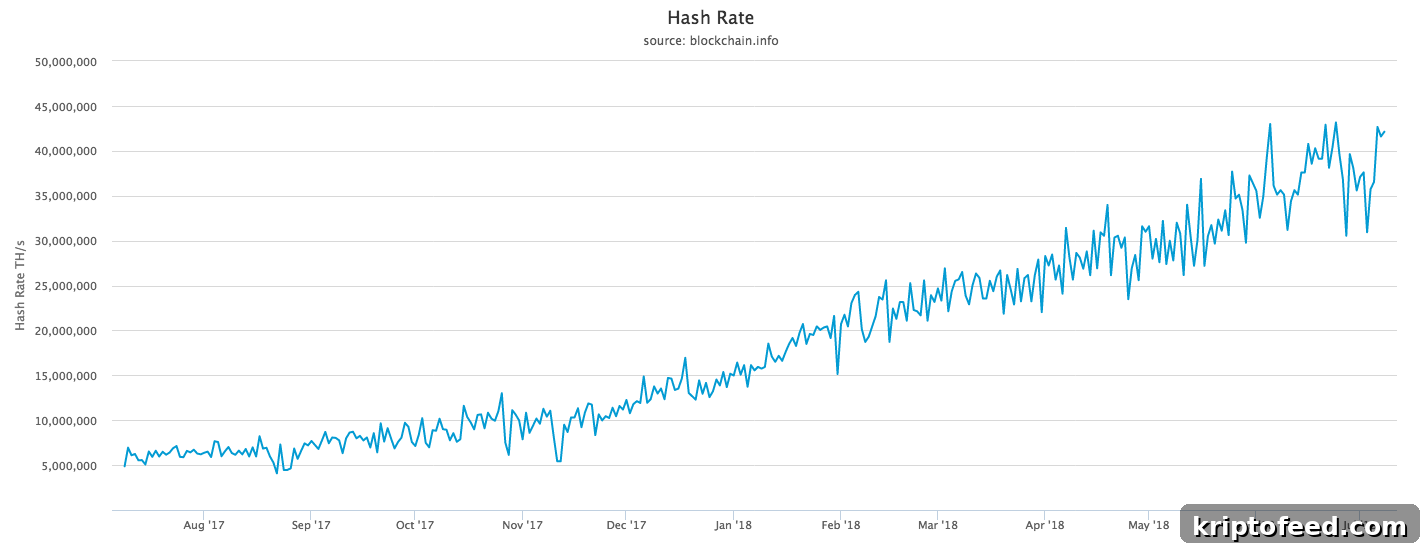 To appreciate the scale of this growth, the additional hash power added since the end of 2017 is roughly equivalent to about 2 million top-tier SHA-256 ASIC units — a number that exceeds many prior estimates of units in circulation. With such units listed online for around $1,800 each, even generous bulk discounts still imply more than $4 billion worth of new mining equipment securing the network. This simple calculation does not account for alternative sources of hashpower such as Bitfury’s BlockBox container units, which use proprietary ASICs and claim around 8 PH/s (8,000 TH/s) per container. At a rumored price of $1 million each, these containers are affordable only to the best-capitalized operations.
Earlier this year Bitfury CEO Valery Vavilov estimated the company’s share of the mining market at 10–12%, implying a significant number of BlockBox containers in operation. For example, Hut 8 Mining deployed 33 BlockBox units in Alberta, Canada, delivering an operating hashrate near 255.5 PH/s, with additional equipment scheduled to come online by September 2018.
The rapid rise in hashrate is part of a longer-term trend. CoinShares’ mining whitepaper released in May shows that hashrate has effectively tripled annually over the last four and a half years alongside steady efficiency gains in mining hardware. Production costs are central to mining economics: CoinShares estimated a market-average marginal cost of producing one bitcoin at about $6,400 as of May. This marginal cost is largely driven by the price of electricity at mining facilities, making access to cheap power the dominant factor in profitability. As a result, miners often locate near power producers that can supply low-cost bulk electricity.
Research from BitMEX examined China’s dominance in Bitcoin mining and noted that excess energy capacity built for the aluminium industry has helped create favorable conditions for mining. Much of the surplus hydro-power capacity in China comes from smaller plants in rural areas. Because high-voltage long-distance transmission infrastructure is limited, that power is often available locally at very low cost to miners who set up nearby.
Concerns about Bitcoin mining’s power consumption and dependence on fossil fuels may be overstated. CoinShares’ paper emphasizes that the cheapest electricity frequently comes from stranded hydro resources, and miners actively seek out the lowest-cost sources wherever they are. While coal remains an important source for some large operations, such as certain Bitmain facilities, evidence suggests a growing share of mining uses hydro and other low-carbon sources. As the paper puts it: “The cheapest electricity in the world is in many cases stranded hydro power and Bitcoin miners have shown a strong will and ability to seek out the cheapest possible sources, wherever they may be. While much of the industry has been confined to China in the last few years, we are now observing a large number of mines constructed across a much wider geographical spread.”
Hashrate distribution is indeed becoming more global. Countries like Canada, Norway and the U.S. state of Washington now host significant mining operations thanks to affordable electricity and cooler climates, which reduce cooling costs. But expansion into new jurisdictions is not always straightforward. Quebec, for instance, initially appeared welcoming to miners but has since reconsidered as inquiries swelled: Hydro-Québec received requests totalling more than 17,000 MW, prompting calls to cap power allocations for cryptocurrency mining at around 500 MW.
It is also important to note that accurately calculating hashrate is inherently imprecise. Most estimates rely on block times, network difficulty and the observed time to mine new blocks, which require assumptions and approximations. Many of these assumptions and their implications are discussed in detail in the appendices to the CoinShares whitepaper.
In summary, the Bitcoin mining sector appears to be in robust health, with increasingly well-capitalized operations expanding wherever low-cost energy is available. Growing competition among hardware manufacturers should benefit miners by driving down equipment margins and improving efficiency, while the geographic spread of mining continues to broaden the sources of network hashpower.