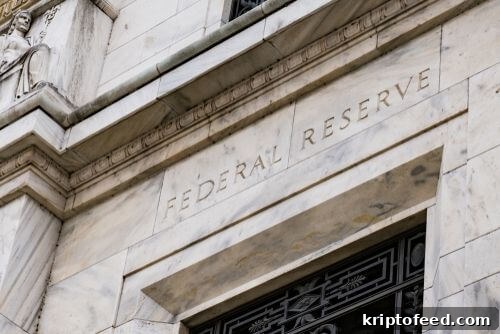
The Federal Reserve’s recent actions have many Bitcoin proponents warning that the next financial crisis could be arriving sooner. Over the past month alone, the U.S. has increased the money supply by an amount greater than Bitcoin’s entire market capitalization.
With roughly $210 billion injected into the economy recently, the Fed is attempting to sustain current economic momentum. This strategy—known as quantitative easing (QE)—involves purchasing government bonds to lower interest rates and stimulate economic activity.
Quantitative easing runs counter to Bitcoin’s core principles. The creation of additional fiat money was explicitly referenced in Bitcoin’s earliest messaging, highlighting a fundamental contrast between inflationary central-bank policies and Bitcoin’s capped supply.
An expanding Federal Reserve balance sheet implies greater instability for the U.S. dollar. The Fed’s balance sheet sits near $3.77 trillion today, and some projections place it rising above $4.5 trillion within the next five years—an approach that many critics say only delays an inevitable adjustment.
Preserving the Status Quo
By propping up markets and financial institutions, central-bank interventions can actually deepen underlying problems. For many investors, assets like gold, Bitcoin, and other cryptocurrencies are attractive as hedges against fiat currency because they aren’t inherently inflationary and don’t require constant monetary expansion to retain value.
As former Bank of England governor Mervyn King warned:
“By sticking to the new orthodoxy of monetary policy and pretending that we have made the banking system safe, we are sleepwalking towards that crisis.”
That contrast becomes particularly stark as Bitcoin mining approaches a notable milestone. This week, the cryptocurrency will reach a point where only three million tokens remain to be mined. The fixed or predictable supply of Bitcoin emphasizes its difference from fiat systems where supply can be increased, highlighting competition to acquire a scarce digital asset.
Using Derivatives to Pop the Market
Another narrative concerns the role of derivatives in cooling Bitcoin’s rapid rise at the end of 2017. Some observers claim that the introduction of Bitcoin futures and other derivative instruments enabled short positions that helped deflate the speculative excesses of that period. Former CFTC Chairman Christopher Giancarlo has suggested that these tools allowed market participants to take positions opposite to outright believers, bringing more balance to price discovery.
In an interview discussing the period, he noted:
“One of the untold stories of the past few years is that the CFTC, the Treasury, the SEC and the [National Economic Council] director at the time, Gary Cohn, believed that the launch of bitcoin futures would have the impact of popping the bitcoin bubble. And it worked.”
Using derivatives to reduce speculative bubbles can be viewed as interventionist, yet proponents argue it prevents more catastrophic collapses by introducing corrections and liquidity. The Federal Reserve’s expansive policy, by contrast, can sustain bubbles in fiat assets for longer while potentially increasing systemic risk. That contrast raises a broader question: why do policymakers and the public often scrutinize bubbles in Bitcoin more heavily than comparable excesses in fiat markets?
Ultimately, the debate highlights divergent responses to financial instability: one favors controlled market mechanisms and tools like derivatives to allow correction, while the other relies on central-bank support to maintain stability—sometimes at the cost of deferring larger issues. As monetary policy and digital assets evolve, the tension between these approaches will continue to shape investor behavior and economic outcomes.