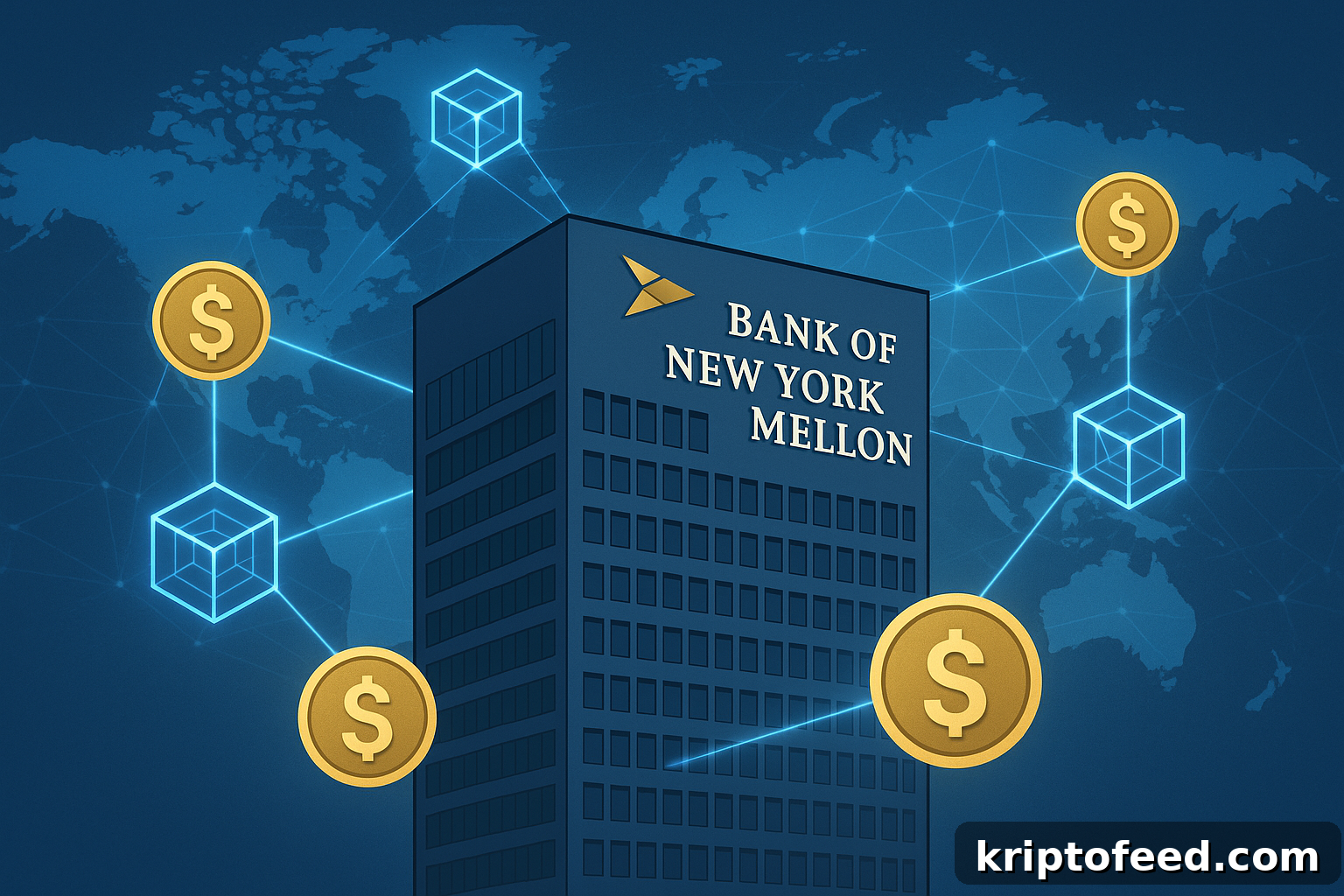
- BNY Mellon is exploring blockchain-based tokenized deposits as part of efforts to modernize payment infrastructure.
- JPMorgan and HSBC have launched tokenized deposit pilots to enable faster, cheaper cross-border transfers.
- As new regulations boost confidence in digital-asset innovation, banks worldwide are adopting blockchain technology.
BNY Mellon is evaluating the use of tokenized deposits as part of an ongoing initiative to modernize payment infrastructure. The effort aims to enable clients to make payments using blockchain technology and reflects a broader industry shift as financial institutions worldwide adopt digital asset frameworks.
Carl Slabicki, Platform Owner for Financial Services at BNY Mellon, says the project aligns with the bank’s push to enhance real-time, instantaneous, and cross-border payments. He explained that tokenized deposits could help the bank “overcome the constraints of legacy technology” and simplify the movement of deposits and payments within its ecosystem and, as industry standards develop, across the wider financial market.
BNY Mellon’s financial services business processes roughly $2.5 trillion in payments daily, underscoring the potential scale and impact of this innovation. The bank views blockchain as a tool to make transactions faster, more efficient, and more secure — a vision shared by several leading institutions across the global banking sector.
Banks move toward blockchain-based payments
Tokenized deposits are essentially digital representations of customer deposits that serve as claims on commercial banks. Unlike traditional transfers that can take days to settle, transactions using tokenized deposits are processed on blockchain rails and can settle instantly. Proponents say this model can reduce costs and enable 24/7 transaction processing.
BNY Mellon’s initiative follows similar experiments at other major institutions. In June, JPMorgan Chase launched a pilot for JPMD, a token representing the bank’s U.S. dollar deposits. In September, HSBC rolled out a tokenized deposit service allowing corporate clients to send currency across borders more efficiently and securely.
In Europe, momentum has extended to collaborative efforts among banks. A consortium of nine financial institutions, including UniCredit, ING Group, and DekaBank, announced plans to jointly develop a stablecoin: a blockchain-based token pegged to fiat currency and backed by liquid assets such as government bonds.
Industry momentum and regulatory clarity
The renewed interest in blockchain within the banking sector has coincided with clearer rules around digital assets. The United States has recently implemented regulations for stablecoins, while the European Union’s Markets in Crypto-Assets (MiCA) framework is now in force. These regulatory developments have increased incumbent banks’ confidence to experiment with blockchain-based payment solutions.
BNY Mellon, one of the world’s largest custodians that holds or manages approximately $55.8 trillion in assets, has consistently participated in blockchain initiatives. In July, the bank announced a partnership with Goldman Sachs to use blockchain to record ownership of money market funds. It is also among more than 30 global financial institutions working with SWIFT to develop a blockchain-based shared ledger for real-time cross-border payments.
Exploring tokenized deposits marks a new step in BNY Mellon’s broader digital transformation strategy. As the financial system gradually evolves toward tokenized, blockchain-enabled assets, BNY Mellon’s work illustrates how legacy institutions are adapting to a decentralized future in which increased efficiency, transparency, and interoperability could reshape global finance.