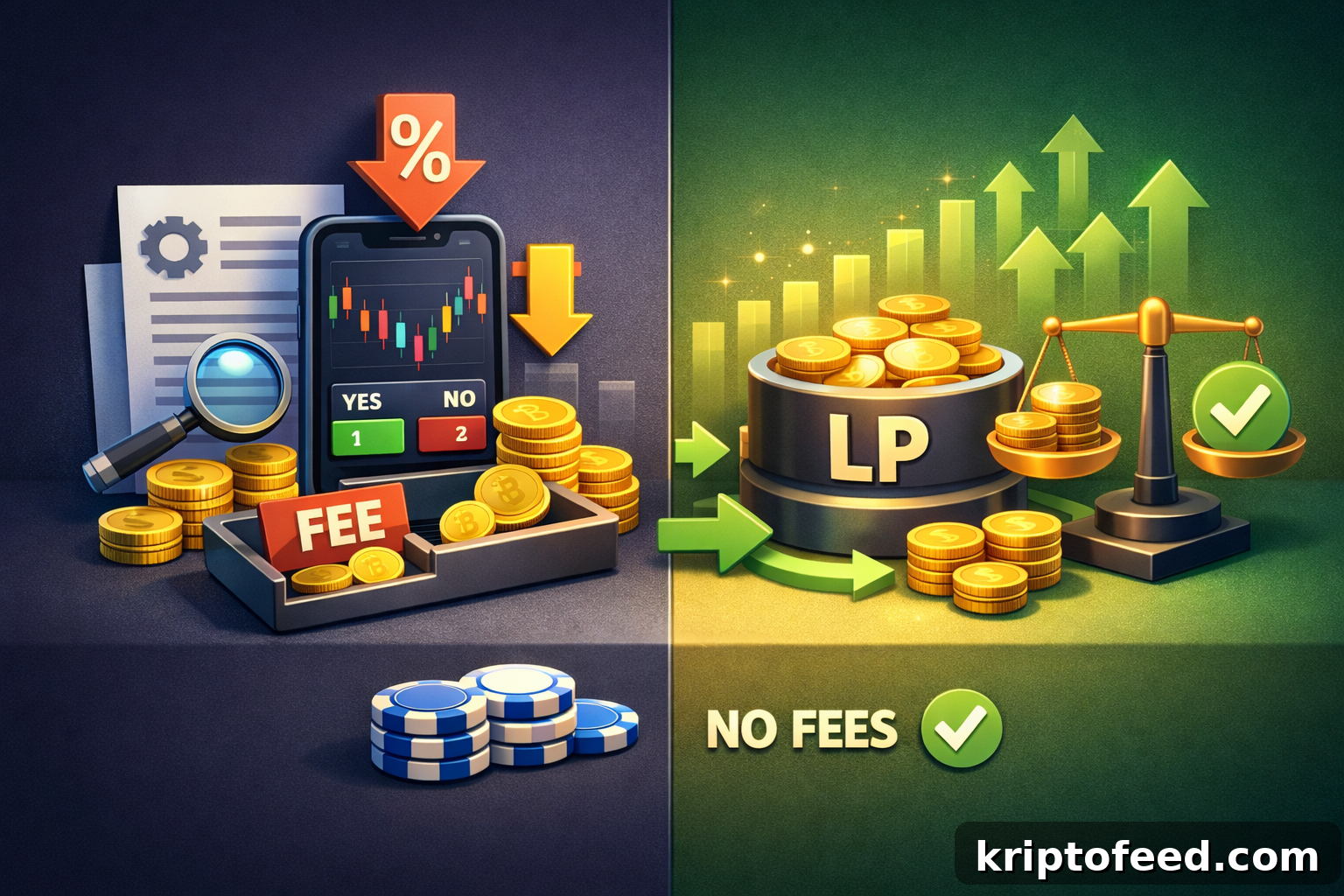
- Fees charged to takers are redistributed daily to liquidity providers in USDC.
- The highest fees apply when market odds are near 50% and decline toward zero in extreme cases.
- Long-term crypto, political, and non-crypto markets remain fee-free.
Prediction market platform Polymarket has quietly made a targeted but meaningful change to how some of its crypto markets operate.
Updated documentation now shows that 15-minute crypto up- and down-markets have introduced taker fees, marking a departure from the platform’s long-standing zero-fee trading model for this segment.
The update arrived without a formal announcement and applies only to a narrow subset of markets.
Most Polymarket markets remain fee-free, suggesting this is a focused structural adjustment rather than a platform-wide policy shift.
The change was discovered through revisions to Polymarket’s fee documentation and the Maker Rebates Program materials.
Those sections now explain that fees charged to takers are being applied to short-term crypto markets to help fund liquidity incentives.
Archived versions of the documentation indicate this language is new, implying the fee model was introduced recently and without broad public notice.
Documentation reveals new fee structure
The updated materials state that taker fees apply only to 15-minute crypto markets.
These are short-term contracts designed for swift price moves, where liquidity conditions can shift rapidly.
The platform explains that fees collected from takers are redistributed daily to liquidity providers in the USDC stablecoin rather than retained by Polymarket itself.
This redistribution frames the fee as a funding mechanism for market makers, not as a revenue stream for the platform.
Other markets — including long-term crypto forecasts, political markets, and non-crypto event markets — continue to operate without fees.
Fees tied to market odds
The documentation outlines a variable fee model based on market odds.
Fees peak when prices are near 50%, a range typically associated with the highest uncertainty and trading activity. As odds move toward 0% or 100%, fees decrease sharply toward zero.
Examples in the documentation show how this works in practice.
A taker trade of 100 shares priced at $0.50 would incur a fee of roughly $1.56, slightly over 3% of the trade’s notional value at the curve’s midpoint.
Smaller trades and those placed near extreme probability levels face lower fees, with very small fees rounded down.
Social media frames the rollout
The quiet rollout prompted discussion on X (formerly Twitter), where several users characterized the move as a market-structure adjustment rather than a conventional fee hike.
One user, 0x_opus, argued the change increases protection against wash trading and noted that the platform is not taking the fees for itself since they are redirected to liquidity providers.
Another trader, kiruwaaaaaaa, suggested the measure targets high-frequency bots, with fee-funded rebates potentially encouraging tighter spreads and more stable liquidity.
A third user, Tawer955, offered a more detailed take, calling the headline reaction “scary, but not as bad as it sounds.” He said the structure creates a sustainable cash flow for liquidity providers while reducing incentives for bots that previously exploited free liquidity.
Impact limited to selected markets
For most Polymarket users, the change is likely to have limited impact. Only 15-minute crypto markets are affected, while the rest of the platform remains fee-free.
Even within affected markets, the fee design lowers costs for directional trades and those placed near clear probability outcomes.
By concentrating fees around the most competitive price ranges and redistributing them to liquidity providers, Polymarket appears to be fine-tuning incentives in its fastest markets without altering the broader user experience.