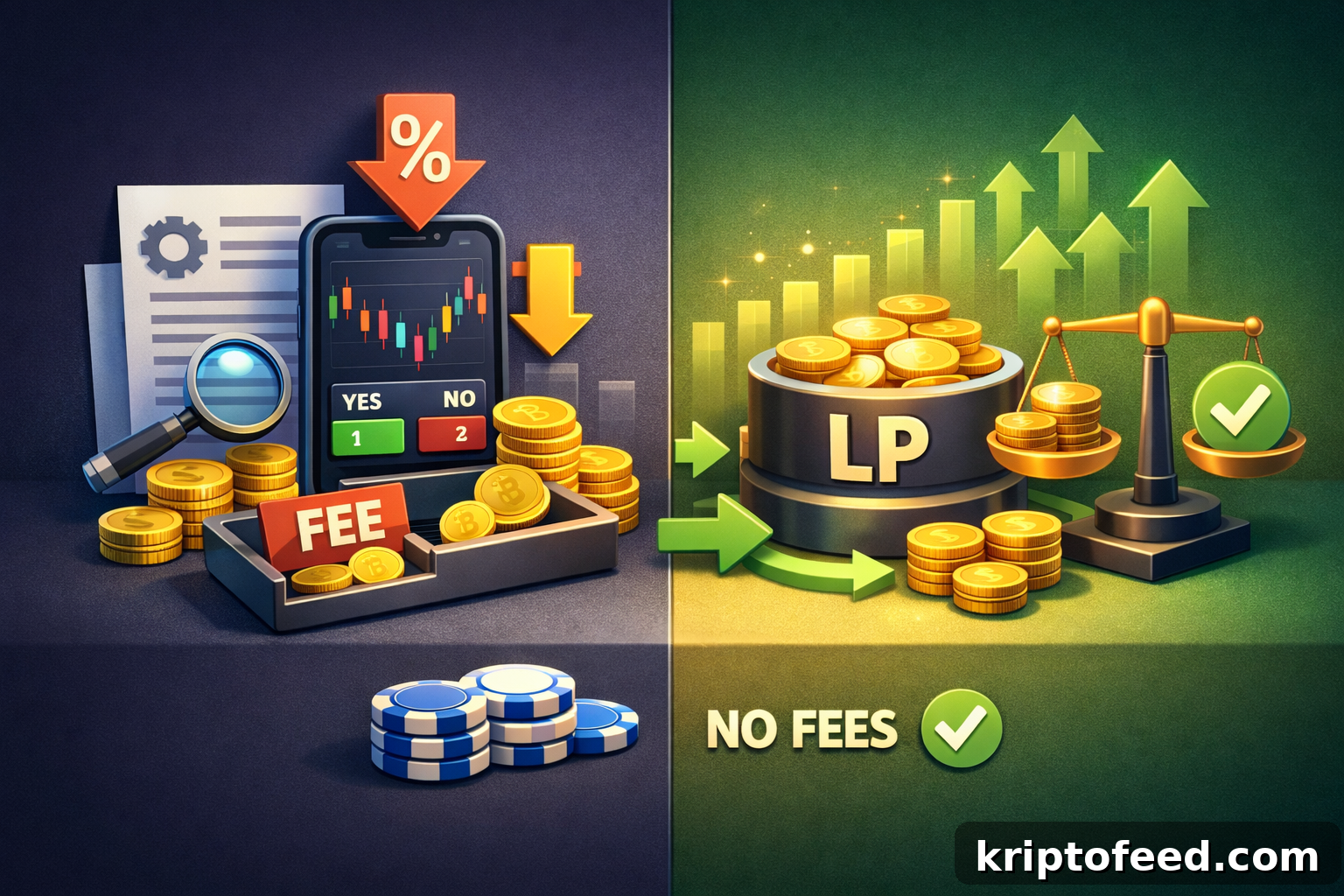
- Fees collected from takers are redistributed daily to liquidity providers in USDC.
- Fees peak when market probabilities are near 50% and fall toward zero at extreme probabilities.
- Longer-term crypto, political, and non-crypto markets remain fee-free.
The prediction market platform Polymarket has made a subtle but meaningful adjustment to how some of its crypto markets operate.
Updated documentation on the site shows that the 15-minute crypto Up/Down markets now carry taker fees — a break from the platform’s long-standing zero-fee trading model.
The update appeared without a formal announcement and applies only to a narrow subset of markets.
Most Polymarket markets remain fee-free, indicating a targeted structural tweak rather than a platform-wide policy shift.
The change was discovered through revisions to Polymarket’s Trading Fees and Maker Rebates Program documentation.
Those sections now explain that taker-only fees have been introduced on short-duration crypto markets to help fund liquidity incentives.
Archived versions of the documentation suggest this wording is new, implying the fee model was implemented recently and without public fanfare.
Documentation reveals new fee structure
According to the updated material, the taker fees apply exclusively to 15-minute crypto markets.
These are short-term contracts designed for rapid price moves, where liquidity conditions can shift quickly.
The platform states that fees collected from takers are redistributed daily to liquidity providers in the USDC stablecoin, rather than being retained by Polymarket itself.
This redistribution mechanism frames the fee as a funding tool for market makers rather than a revenue stream for the platform.
Other markets, including longer-term crypto forecasts, political markets, and non-crypto events, continue to operate without fees.
Fees tied to market probabilities
The documentation outlines a variable fee model based on market probabilities.
Fees are highest when prices are near 50%, a range typically associated with the greatest uncertainty and trading activity. As probabilities approach 0% or 100%, the fee declines sharply toward zero.
Examples included in the documentation demonstrate how this works in practice.
A taker trade of 100 shares at a price of $0.50 would incur a fee of roughly $1.56, which is just over 3% of the trade value at the peak point of the curve.
Smaller trades and those placed near the extreme probability outcomes face lower fees, with very small fees rounded down.
Social media reaction and intent
The quiet rollout sparked discussion on X, where several users framed the move as a market-structure adjustment rather than a conventional fee increase.
User 0x_opus said the change would help guard against wash trading and argued that the platform was not charging users in the traditional sense because the fees are redirected to liquidity providers.
Another trader, kiruwaaaaaa, described the measure as targeting high-frequency bots and suggested fee-funded rebates could foster tighter spreads and more consistent liquidity.
A third user, Tawer955, offered a more detailed analysis, calling the headline impact “scary, but not as bad as it sounds.”
He said the structure creates a sustainable cash flow for liquidity providers while reducing incentives for bots that previously exploited free liquidity.
Impact limited to select markets
For the majority of Polymarket users, the change is likely to have limited impact. Only 15-minute crypto markets are affected, while the rest of the platform remains fee-free.
Even within the affected markets, the fee design lowers costs for directional trades and for bets placed near clear probability outcomes.
By concentrating fees on the most competitive price bands and redistributing them to liquidity providers, Polymarket appears to be fine-tuning incentives in its fastest markets without altering the broader user experience.