
- Outflows from Bitcoin ETFs and falling liquidity intensified the recent BTC price decline.
- Margin liquidations accelerated the sell-off as key support levels were broken.
- Correlation with tech stocks increased pressure amid a broader risk-off mood.
The price of Bitcoin has come under heavy pressure in recent weeks, experiencing a sharp pullback driven by reduced demand, large ETF outflows, and a wave of forced liquidations.
The decline has wiped out months of gains and prompted traders to debate whether the recent drop is a temporary setback or the start of a deeper cycle reset.
ETF outflows fuel the sell-off
Bitcoin’s fall has been steep and persistent since its early October peak above $126,000.
Since that peak, the cryptocurrency has lost nearly $800 billion in market value and has fallen back to levels last seen in the spring.
ETFs, which had acted as a stabilizing force for Bitcoin (BTC), are now adding to the weakness.
BlackRock’s IBIT ETF, once a buyer that absorbed selling, recorded its largest monthly redemption on record, with $520 million leaving the fund.
This shift marks a change in institutional sentiment and has become a significant source of downward pressure.
A recent NYDIG study highlights how ETF outflows, shrinking stablecoin balances, and changing corporate treasury strategies have eroded the demand engine that supported Bitcoin earlier this year.
NYDIG’s Greg Cipolaro describes the current cycle as a “negative feedback loop,” where forces that previously boosted the market now accelerate the decline.
The change has placed Bitcoin under sustained selling pressure at a time when broader risk appetite is also weakening.
One notable sign of that shift appears in the stablecoin market, where assets have dropped for the first time in months and some tokens lost substantial value following liquidation events.
Digital asset treasuries, which had been active Bitcoin buyers, are also pulling back as they pare liabilities by selling assets or repurchasing shares.
These actions have contributed to a steady outflow of liquidity across the crypto sector.
Bitcoin price outlook
From a technical standpoint, Bitcoin has moved into oversold territory and printed a hammer candle, which can hint at a potential short-term bottom.
Attention is now focused on $88,500, a level that capped rallies earlier this year and briefly halted last week’s sell-off.
A sustained break above that level could set the stage for a short-term recovery toward the $94,000–$95,000 area.
However, that scenario faces strong resistance from broader market sentiment.
Bitcoin’s tight relationship with risk assets adds another layer of complexity.
The correlation between Bitcoin and Nasdaq 100 futures has climbed to unusually high levels, approaching 0.96.
When tech stocks decline, Bitcoin tends to follow, and recent turbulence tied to concerns about an AI-driven bubble has weighed on both markets.
Bitcoin dominance has also fallen to multi-month lows, signaling that capital is rotating away from BTC into either safer assets or other high-risk alternatives.
The market is also seeing heightened volatility from margin liquidations.
Leveraged positions, particularly in perpetual futures, amplified recent moves.
When Bitcoin dipped below $87,000, more than $900 million in positions were wiped out, with long positions bearing the brunt of losses.
Liquidation cascades have become a recurring theme, deepening each leg down.
Oscillators, including the Relative Strength Index (RSI) and Moving Average Convergence Divergence (MACD), remain negative, suggesting that previous bounces were quickly sold into.
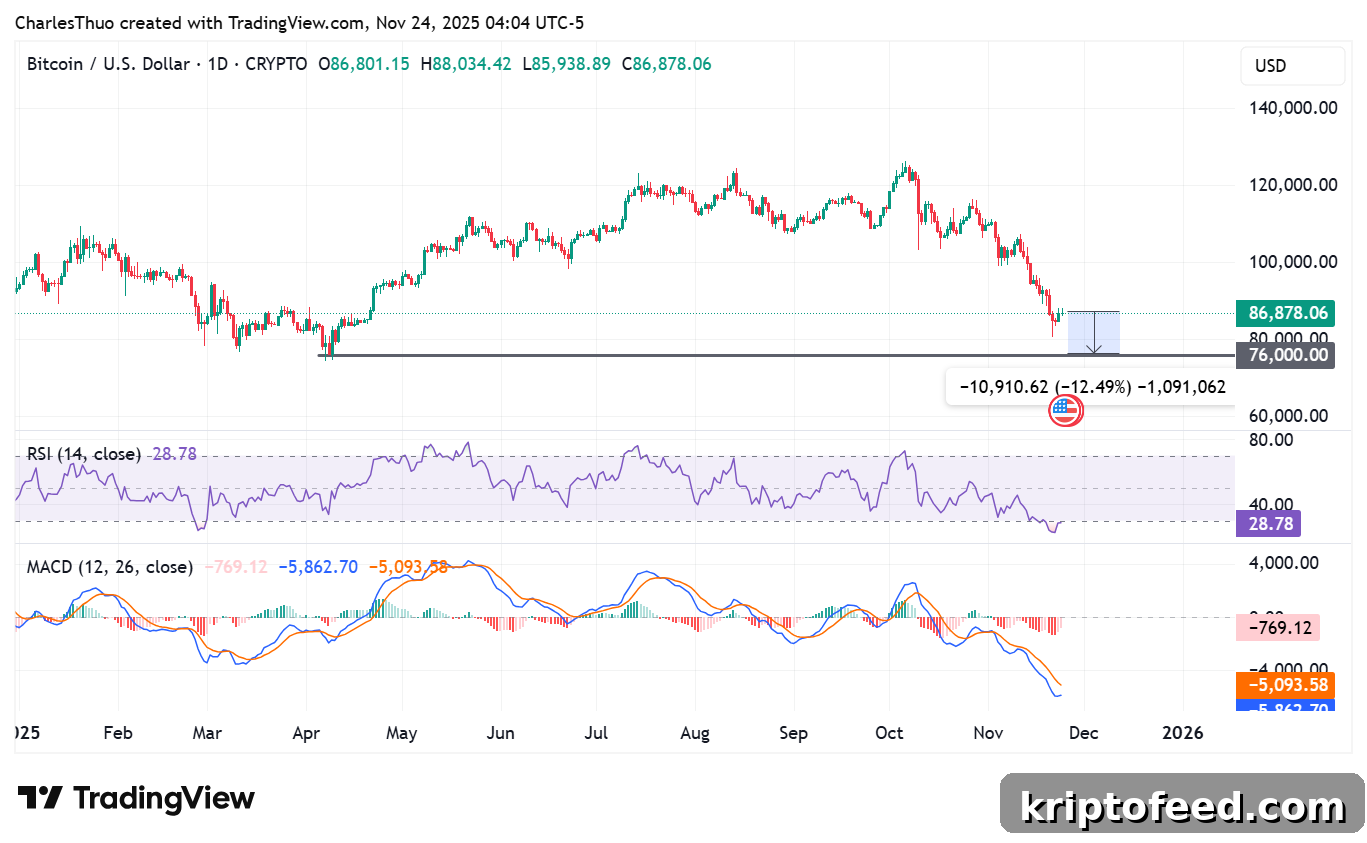
A break below recent lows could open the door for a fresh test of the $76,000 area, where Bitcoin previously found stability during an earlier market shock tied to regulatory fears.