
- ASTER price is currently trading near $1 amid strong selling pressure.
- A short squeeze above $1.39 could trigger a sharp rebound.
- Solana’s Percolator DEX threatens Aster’s market dominance.
The price of ASTER is under pressure as new competition prepares to enter the decentralized perpetual exchange market.
Solana co‑founder Anatoly Yakovenko has unveiled “Percolator,” a new L1‑native perpetual DEX designed to run directly on the Solana blockchain.
This development introduces a potent contender into an already competitive space dominated by Aster and Hyperliquid.
Once celebrated for its on‑chain derivatives dominance, Aster now faces a critical inflection point.
The timing of Solana’s move is especially disruptive: Aster is struggling with a steep price decline and falling user activity.
Solana Percolator shakes up the market
Yakovenko’s Percolator is still in early development but has already drawn significant attention.
Built directly on Solana, it promises fast, low‑cost perpetual trading without relying on external layer‑2 networks.
Initial GitHub entries indicate that key modules for funding rates, account verification, and position management are already in place, with stress testing expected soon.
Solana’s reputation for high throughput and low fees gives Percolator a strong foundation to challenge existing players.
If it delivers on performance, the DEX could siphon liquidity and traders away from Aster and Hyperliquid.
That potential shift increases pressure on Aster, which is already fighting to retain users amid falling volumes and outflows.
ASTER price fights to hold above $1
At the time of writing, Aster is clinging just above the psychological support level of $1 after two days of decline.
Technical indicators suggest the token is on shaky ground.
MACD has crossed below its signal line, signaling weakening momentum, while RSI sits near 31 — close to oversold territory.
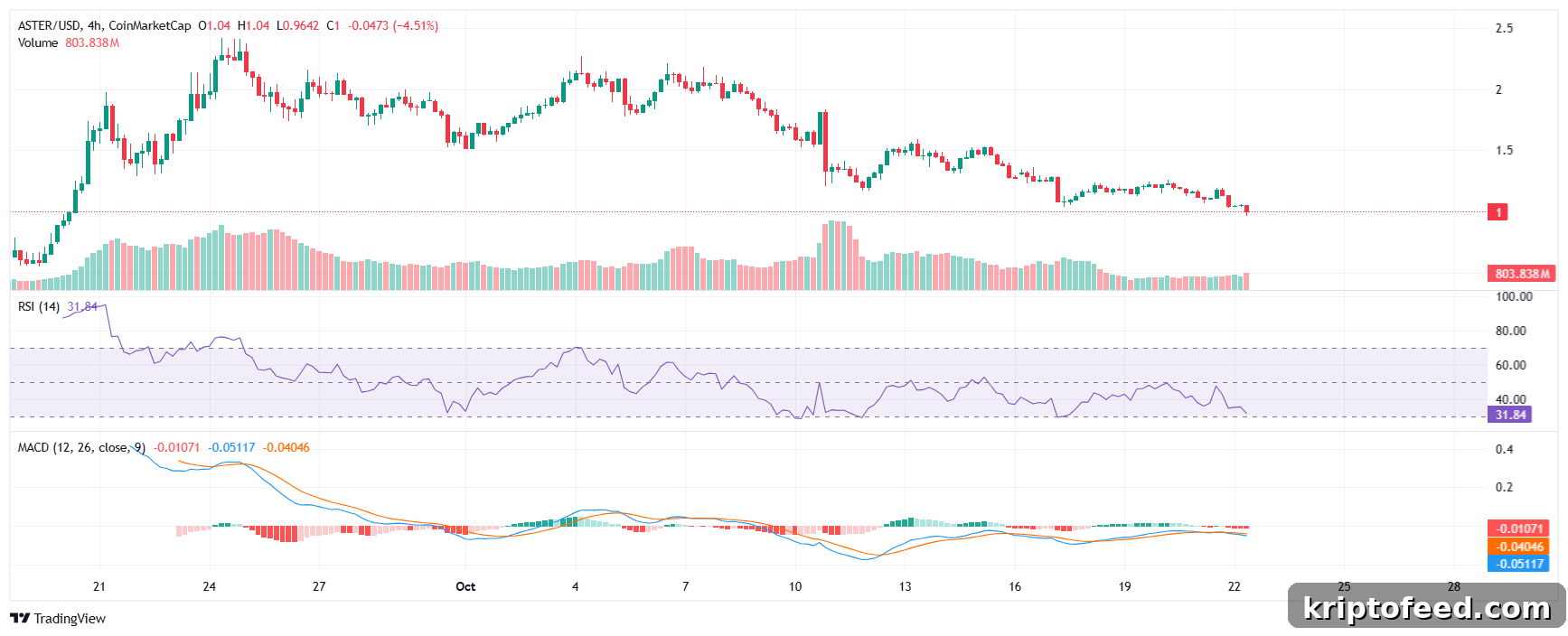
A drop below $1 could push the token toward the next key support at $0.94, while a rebound could retest $1.27.
Market data for Aster paints a concerning picture.
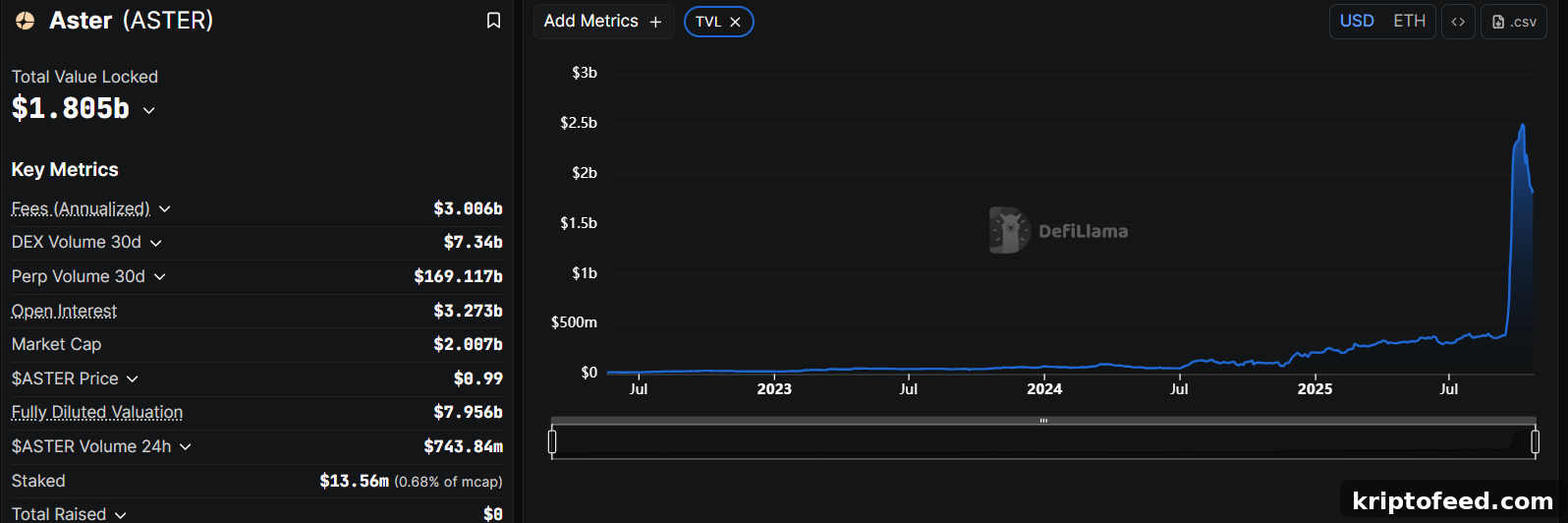
The token trades around $1.01, down more than 34% over the past month. Its market capitalization has fallen to roughly $2 billion, with a 24‑hour trading volume of $805 million.
Aster’s total value locked (TVL) has also declined to about $1.805 billion at press time, reflecting waning engagement from traders and liquidity providers.
Sentiment deteriorates as usage unravels
Over the past week, Aster experienced a TVL outflow of $326 million and a dramatic collapse in daily trading volume to just $78 million.
That contrasts poorly with competitors like Lighter and Hyperliquid, which continue to handle more than $10 billion in daily trades.
The decline in activity has raised concerns that traders are fleeing the protocol amid doubts about the sustainability of its incentive‑driven growth.
Technical momentum remains bearish, with a potential MACD death cross and Aroon Down near 93% reinforcing downward bias.
Aster is now trading in a weak demand zone between $1.03 and $1.14 — an area that historically offers limited support.
If selling continues, analysts warn the token could slide toward $0.70 or even $0.50.
Could a short squeeze save ASTER’s price?
Despite the gloom, some traders see a potential bounce forming.
The Money Flow Index (MFI) plunged from 80 to 38, indicating retail investors have been exiting.
Derivatives data, however, shows about 80% of positions remain short.
If ASTER’s price climbs above $1.39, roughly $34 million in shorts on Binance alone could be liquidated, potentially triggering a short squeeze.
A bullish RSI divergence supports this scenario and suggests sellers may be losing control.
If momentum shifts, a break above $1.39 could drive prices toward $1.88 and $2.22.
Conversely, a drop below $1.05 or $0.92 would likely invalidate recovery prospects and deepen the bearish trend.
Investors are watching to see whether Aster can stabilize and regain momentum before Percolator reaches full deployment.
If Solana’s new DEX meets expectations, it could redefine competitive dynamics across decentralized derivatives and influence where ASTER’s price heads next.