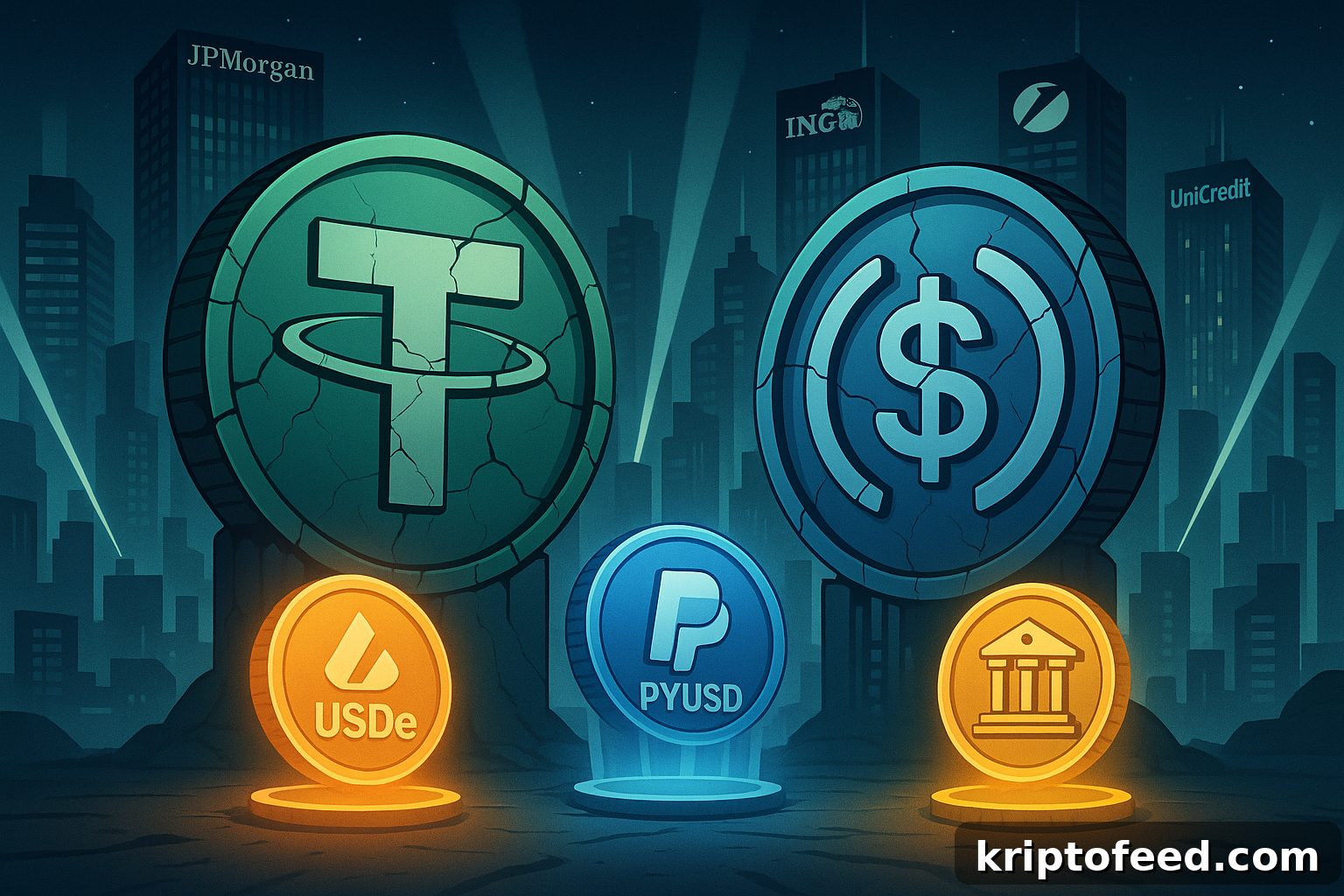
- USDT and USDC fall to an 83.6% market share as rivals such as USDe, PYUSD and bank-backed coins gain ground.
- Ethena’s USDe rises to $14.7 billion, driving a wave of yield-bearing stablecoins that reshape the market.
- ING, UniCredit, JPMorgan and Citi push into stablecoins, challenging the dominance of Tether and Circle.
Tether’s USDT and Circle’s USDC, the two largest stablecoins by market capitalization, are showing signs of losing their long-held dominance in the digital asset sector.
Although both tokens have grown in absolute market value, their combined share of the stablecoin market has fallen by more than 5% over the past year, signaling a shifting landscape for stablecoins.
Data from DeFiLlama and CoinGecko show that USDT and USDC’s share of the stablecoin market dropped from 89% a year ago to 83.6% by October 2025.
Industry analysts say this may mark the start of a new phase in which alternative issuers — including startups and banks — position themselves to challenge the duopoly.
USDT and USDC lose market share
The combined dominance of USDT and USDC peaked in March 2024, when the stablecoin market was valued at roughly $140 billion.
At that time, Tether had about $99 billion in circulation and Circle’s USDC accounted for about $29 billion, together representing roughly 91.6% of the market.
Since then, their dominance has steadily declined.
By October 2024, USDT and USDC represented 89% of the sector, and as of October 2025 they hold just 83.6%.
That represents a 5.4% drop over the past year and a 3.4% decline since January.
Nic Carter, a partner at Castle Island Ventures, highlighted the trend in a post on X titled “The stablecoin duopoly is ending.”
He attributed the decline to three main factors: competition from new intermediaries, an intensified race to attract users with yield-bearing stablecoins, and a shifting regulatory dynamic following the introduction of the U.S. GENIUS Act.
New stablecoin challengers emerge
Carter noted that several new players gained traction over the past year, reshaping the stablecoin landscape.
Among them are Sky’s USDS, Ethena’s USDe, PayPal’s PYUSD and World Liberty’s USD1.
Ethena’s USDe was especially notable, growing to a supply of $14.7 billion by offering holders yields derived from crypto basis transactions. Carter called USDe “the year’s biggest success story.”
Other issuers, including Ondo with USDY, Paxos with USDG and Agora with AUSD, have also entered the market with similar yield-bearing structures.
Even as regulatory scrutiny has intensified under the GENIUS Act — particularly around yield products — Carter believes the trend of offering yields to stablecoin holders will continue.
Meanwhile, Circle is exploring ways to introduce yield features for USDC in partnership with Coinbase, indicating that established issuers may adapt to competitive pressure.
Banks enter the stablecoin arena
In addition to fintech startups, traditional banks and financial institutions are moving into the sector.
Carter suggested that bank-led stablecoin consortia have the strongest potential to rival Tether, since no single bank has the reach to scale a stablecoin on its own.
Recent developments support that view.
In September, Dutch bank ING announced a joint venture with Italy’s UniCredit and seven other European lenders to build a euro-denominated stablecoin.
The project, designed to comply with the European Markets in Crypto-Assets (MiCA) framework, is expected to launch in the second half of 2026.
A U.S. initiative involving JPMorgan and Citigroup has also been reported, and Carter predicts that such collaborations could fundamentally shift market power.
As competition accelerates, USDT and USDC may retain leadership but will face an increasingly fragmented environment.
This shift marks a critical phase for the industry, where regulatory oversight, yield innovation and institutional adoption are set to redefine the global stablecoin market.