
- The company has begun testing RLUSD on leading Ethereum Layer-2 platforms.
- The rollout reflects growing demand for regulated stablecoins.
- RLUSD will go live on L2s pending approval from New York regulators.
The cryptocurrency industry is gradually moving toward a more multi-chain future where no single platform dominates.
Rather than being tied to one blockchain, users, institutions and developers increasingly prefer cross-chain transfers that follow demand and opportunity.
Stablecoins remain central to these transactions, serving as the entry point for newcomers and institutions navigating the on-chain economy.
Ripple appears to recognize this reality.
In a statement on December 15, the blockchain company confirmed it has begun testing its stablecoin RLUSD across several Ethereum Layer-2 platforms.
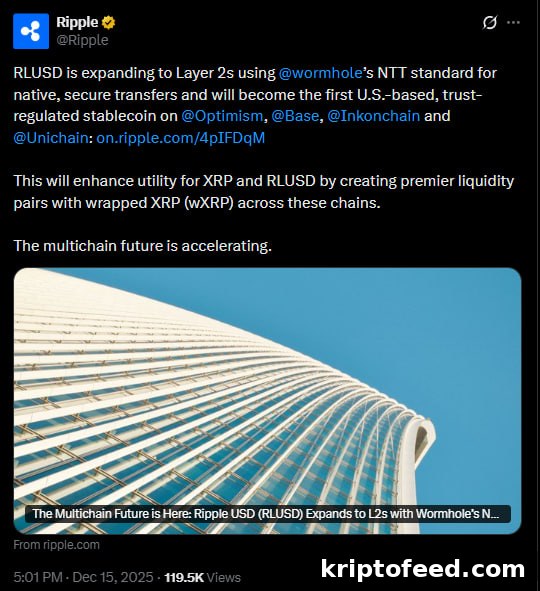
The experiment marks a key step toward the asset’s public debut, scheduled for 2026 pending regulatory approval.
The current testing phase will run across Base, Unichain and Ink, leveraging Wormhole’s interoperable infrastructure to enable smooth movement between networks.
Ripple’s Senior Vice President of Stablecoins, Jack McDonald, acknowledged the central role stablecoins play in driving decentralized finance and institutional adoption.
He added:
RLUSD is built from the ground up to be the reliable, liquid medium required for users to seamlessly enter, interact with and exit the broader digital asset economy. By launching RLUSD—the first U.S. trust-regulated stablecoin—on these L2 networks, we’re not only expanding utility; we’re setting the definitive standard where compliance and on-chain efficiency meet.
Why Layer-2 platforms matter
Layer-2 networks have become some of the busiest areas of the crypto sector.
They offer faster, cheaper and more practical transactions for everyday use than the main Ethereum network, which still faces congestion and high fees.
As a result, L2s are an attractive home for decentralized applications, on-chain services and digital payments.
Deploying RLUSD on these platforms allows Ripple to tap into environments with real user activity.
Notably, Optimism will serve as the initial deployment, with access connected to platforms such as Unichain, Ink and Base.
This approach enables Ripple’s stablecoin to grow alongside meaningful user adoption.
Meanwhile, Ripple is collaborating with Wormhole and its NTT (Native Token Transfers) standard.
With this setup, RLUSD can move across chains while remaining a single, consistent token.
Ripple retains issuance control of the stablecoin while users gain flexibility across multiple platforms.
The company’s announcement noted:
By utilizing Wormhole’s Native Token Transfers (NTT) standard, Ripple can maintain native issuance and control over RLUSD while delivering the security and flexibility of on-chain liquidity movement across these emerging ecosystems.
Bolstering the XRP ecosystem
RLUSD’s strategic expansion also strengthens the broader XRP ecosystem.
Stablecoins play a vital role in trading, digital payments and liquidity, and Ripple is deploying its stablecoin where demand already exists.
At the time of the announcement, XRP traded at $1.93 after a 3% decline in the last 24 hours.
Its performance reflects wider market sentiment.
The broader cryptocurrency market remains under pressure, with Bitcoin struggling below $90,000 and trading around $87,700.