- POPCAT manipulation caused Hyperliquid’s HLP to absorb roughly $5 million in losses.
- The Hyperliquid token is currently trading below key EMAs amid downward momentum.
- Retail demand for HYPE has weakened and futures open interest has fallen to $1.56 billion.
The value of Hyperliquid plunged under pressure after a sophisticated POPCAT attack forced the decentralized derivatives platform to incur multi-million dollar losses.
The POPCAT exploit targeted Hyperliquid’s liquidity provider system, exposing weaknesses in the platform’s risk management and raising concerns about retail demand and overall market sentiment for the HYPE token.
POPCAT attack resulted in about $5M HLP loss
The POPCAT manipulation unfolded on November 12, when a trader executed a sequence of spoofing trades on POPCAT markets, using multiple wallets to create an artificial buy wall.
On-chain analysts say the trader moved about $3 million in USDC from the OKX exchange and distributed it across 19 different addresses.
Those wallets then opened nearly $30 million in leveraged long positions, pushing POPCAT’s price above $0.21.
Once the buy wall was removed, POPCAT’s price collapsed sharply, triggering mass liquidations.
Due to thin liquidity, Hyperliquid’s market-making system, the Hyperliquid Provider (HLP), had to absorb the remaining positions.
Overall, HLP appears to have suffered losses in the range of $4.9–5 million while closing out the positions.
The remaining long positions were passed to the Hyperliquidity Provider (HLP) to liquidate.
HLP appears to have lost $4.95M closing out the positions. pic.twitter.com/Qfq9jcy4Mz
— Arkham (@arkham) November 12, 2025
During the crash, POPCAT fell from $0.21 to $0.13 and Hyperliquid manually closed positions to prevent further damage.
The incident highlighted how coordinated capital movements across multiple wallets can destabilize decentralized platforms.
Investigators noted similarities to previous manipulation patterns observed in tokens such as TST, ZEREBRO, JELLYJELLY and HIFI, although Hyperliquid stated that deposits and withdrawals were ultimately restored and normal trading resumed.
Impact on Hyperliquid and DeFi markets
The POPCAT event underscores ongoing risks for decentralized exchanges that handle leveraged tokens.
Although HLP absorbed the losses and protected liquidity providers to a degree, the episode demonstrates how thin liquidity and concentrated positions can amplify the effects of market manipulation.
Some commentators on crypto social media suggested these attacks may not always be profit-driven but could aim to damage the reputation of decentralized platforms.
On-chain forensic investigations have explored links between the wallets used in the manipulation and entities such as BTX Capital, though those connections have not been proven.
Hyperliquid’s response—including a temporary pause of the Arbitrum bridge—helped limit further instability.
Nevertheless, the episode is likely to weigh on investor sentiment, especially as retail demand for HYPE has remained subdued and futures open interest declined significantly over the last month.
HYPE futures open interest has contracted from $2.08 billion at the end of October to $1.56 billion, a sign of reduced risk appetite among traders.
HYPE price reaction to the attack
Despite the loss, Hyperliquid’s HYPE token showed some short-term resilience after the incident.
HYPE ticked up modestly from $37.77 to $39.39 following the attack’s resolution, indicating that broader retail confidence in the token held to some extent.
Since then, the token has pulled back to about $38.09 at the time of writing, reflecting cautious longer-term sentiment.
Technically, indicators paint a bearish picture: HYPE is trading below its 200-day exponential moving average (EMA) just under $39 and remains beneath the 50- and 100-day EMAs near $43.
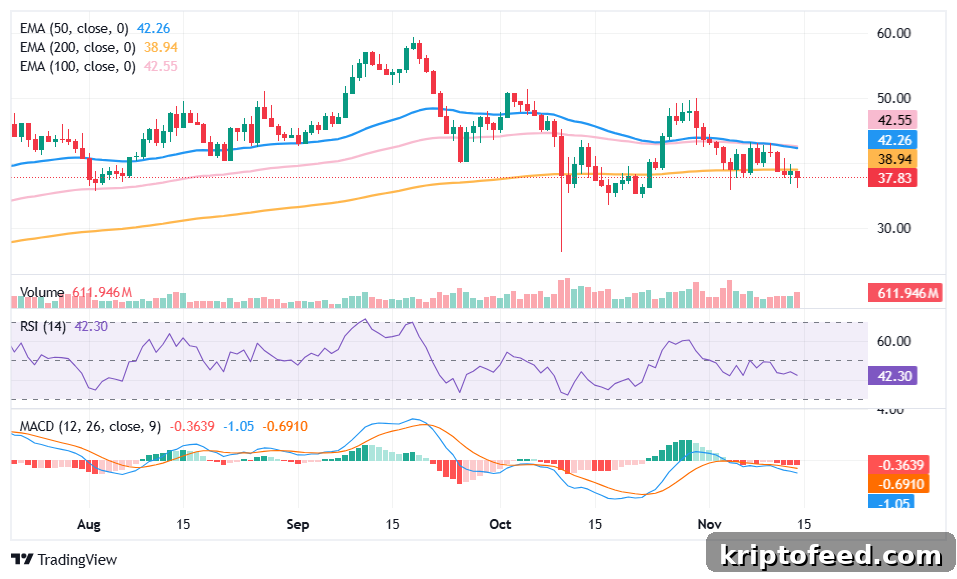
Momentum indicators, including MACD and RSI, signal ongoing selling pressure, and analysts warn that a decisive break below the $35 support could accelerate a drop toward the $30 level.