-
- Ethereum is the world’s second-largest cryptocurrency by market capitalization.
- The next major Ethereum upgrade, Pectra, will go live on May 7.
- Vitalik Buterin has proposed replacing the Ethereum Virtual Machine (EVM) bytecode with RISC-V.
Ethereum is once again in the spotlight as traders prepare for what could be a decisive year.
With the Pectra upgrade scheduled for May 7, which combines two long-planned improvements—Praga and Electra—the Ethereum blockchain is undergoing significant changes.
At the same time, increased staking activity, improved scalability through Layer-2 solutions, and proposals to revise the Ethereum virtual machine are shaping long-term expectations.
These upgrades, along with lower gas fees and growing developer activity, have fueled renewed forecasts that push ETH’s 2025 peak targets toward nearly $6,000.
Ethereum’s position as the second-largest cryptocurrency by market capitalization continues to draw institutional attention despite ongoing volatility.
Its ability to support decentralized applications and token ecosystems makes it a central pillar in the future of crypto.
As activity migrates to cheaper sidechains, the base layer is evolving with a focus on efficiency.
Early signals show ETH building momentum
Ethereum has shown early signs of recovery after months of price stagnation.
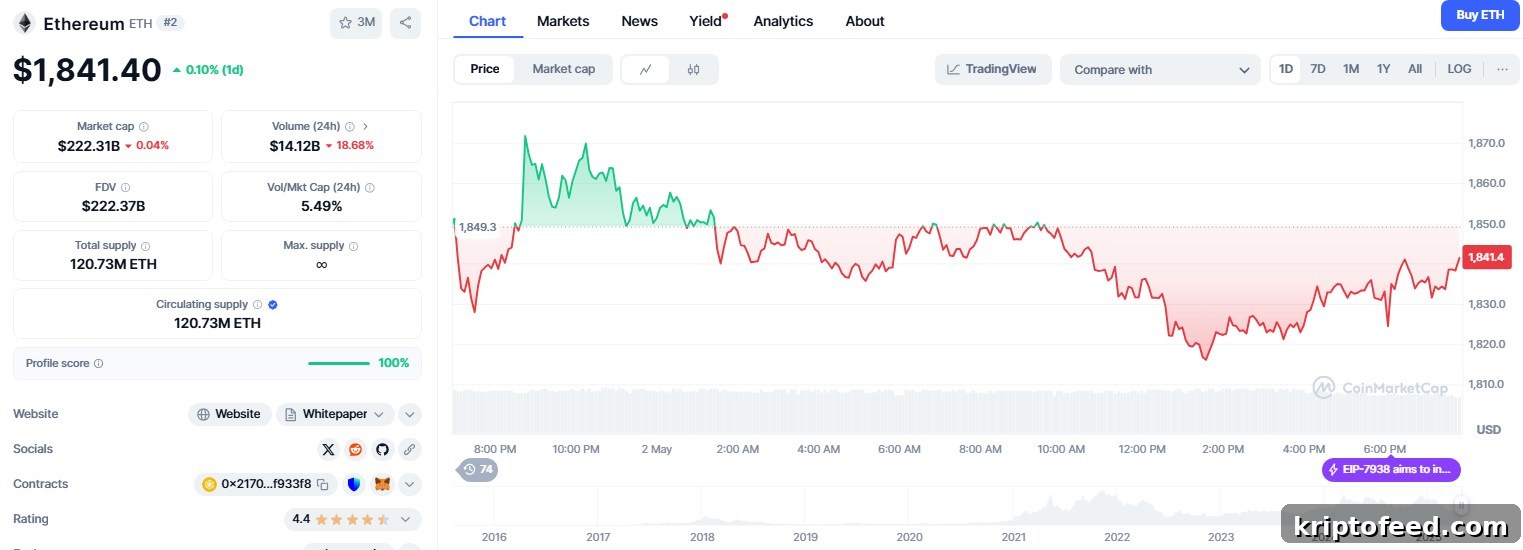
ETH is currently trading around $1,841, above the 9-day simple moving average, with a relative strength index near 58.3, indicating rising momentum.
Source: CoinMarketCap
Analysts note the price has consolidated in a range between $1,600 and $1,900, forming a potential rounding bottom pattern.
If ETH clears $1,900, the next resistance could emerge near $2,200.
Although gas fee revenue fell to 3.18 ETH in April and average gas prices hit a four-year low of $0.16, lower network costs make Ethereum more accessible to users.
The sharp drop in base-layer activity has raised sustainability concerns but also reflects a shift of transactions to Layer-2 networks such as Arbitrum and Base.
Pectra and staking add long-term value
The upcoming Pectra upgrade goes live on May 7 and is expected to introduce a set of technical improvements.
By combining the Praga and Electra upgrades, Pectra aims to streamline validation operations and reduce latency.
Additionally, co-founder Vitalik Buterin has proposed replacing the EVM bytecode with RISC-V, an open-source instruction set architecture widely used in traditional computing.
If implemented, this change could help align Ethereum more closely with conventional computing infrastructure and improve future compatibility.
Staking interest has also risen, with Ethereum 2.0 attracting growing attention from long-term holders.
Coupled with Layer-2 scaling solutions and lower transaction costs, these developments strengthen Ethereum’s fundamentals as a platform for decentralized applications.
ETH outlook shows a wide range
Price outlooks for Ethereum from 2025 to 2030 vary widely depending on market sentiment, adoption rates, and global macroeconomic factors.
In the short term, ETH could test resistance near $2,400 by the end of 2025 if the broader crypto market trends upward.
However, growth may be capped around $2,500 unless sustained momentum is built.
Some forecasts suggest more optimistic scenarios: certain analyses indicate ETH could reach a new 2025 high near $5,925 under favorable conditions, with a projected 2025 range between $2,917 and $5,925 and an average near $4,392.
Projections extending to 2026 and beyond show higher potential upper ranges, with long-term models predicting substantial gains by 2030 and later decades, though such long-range forecasts carry significant uncertainty.
Different firms provide varied estimates: some expect ETH around $4,012 in 2025 and much higher by 2030, while others offer more conservative mid-term targets around $3,500 to $6,500. These divergent views underscore how Ethereum’s value is linked to both network upgrades and broader market adoption.
Ultimately, Ethereum’s future trajectory will depend on continued technical innovation, staking incentives, and the growth of decentralized finance use cases. Investors should weigh both upside scenarios and downside risks when considering Ethereum exposure.