
Key takeaways
- ETH is down 1.5% in the past 24 hours and is currently trading above $3,500 per coin.
- The recent strength is supported by increased buying activity from large holders (whales).
Whales accumulate Ethereum
Ether, the second-largest cryptocurrency by market capitalization, is trading above $3,500 after bouncing off the $3,300 area on Wednesday. Although ETH is down about 1.5% over the last 24 hours, market dynamics suggest the token could push higher in the near term.
Data from on-chain intelligence indicates a major Ethereum whale has added roughly $1.38 billion worth of ETH to its wallet over the past ten days. Arkham Intelligence reports this entity purchased an additional one million dollars in Ether and borrowed approximately $270 million from the decentralized lending protocol Aave, potentially to further increase its ETH exposure.
The whale’s current holdings include 228.39K ETH held in loaned positions, valued at about $818.6 million, and 157.32K ETH in direct spot holdings, worth roughly $563.8 million. Other on-chain indicators also show growing bullish sentiment among large Ethereum holders, reinforcing the picture of concentrated accumulation.
Ether targets $3,900 amid choppy trading
On the 4-hour ETH/USD chart, short-term momentum has been bearish, consistent with the 1.5% drop in the last day. Over the previous 48 hours, the market recorded more than $153 million in liquidations, with long positions accounting for about $122.8 million of that total.
The recent pullback followed a rejection at the 200-day Exponential Moving Average (EMA) just below the $3,660 resistance level. After that rejection, Ether fell toward the $3,470 support but has since recovered above $3,500.
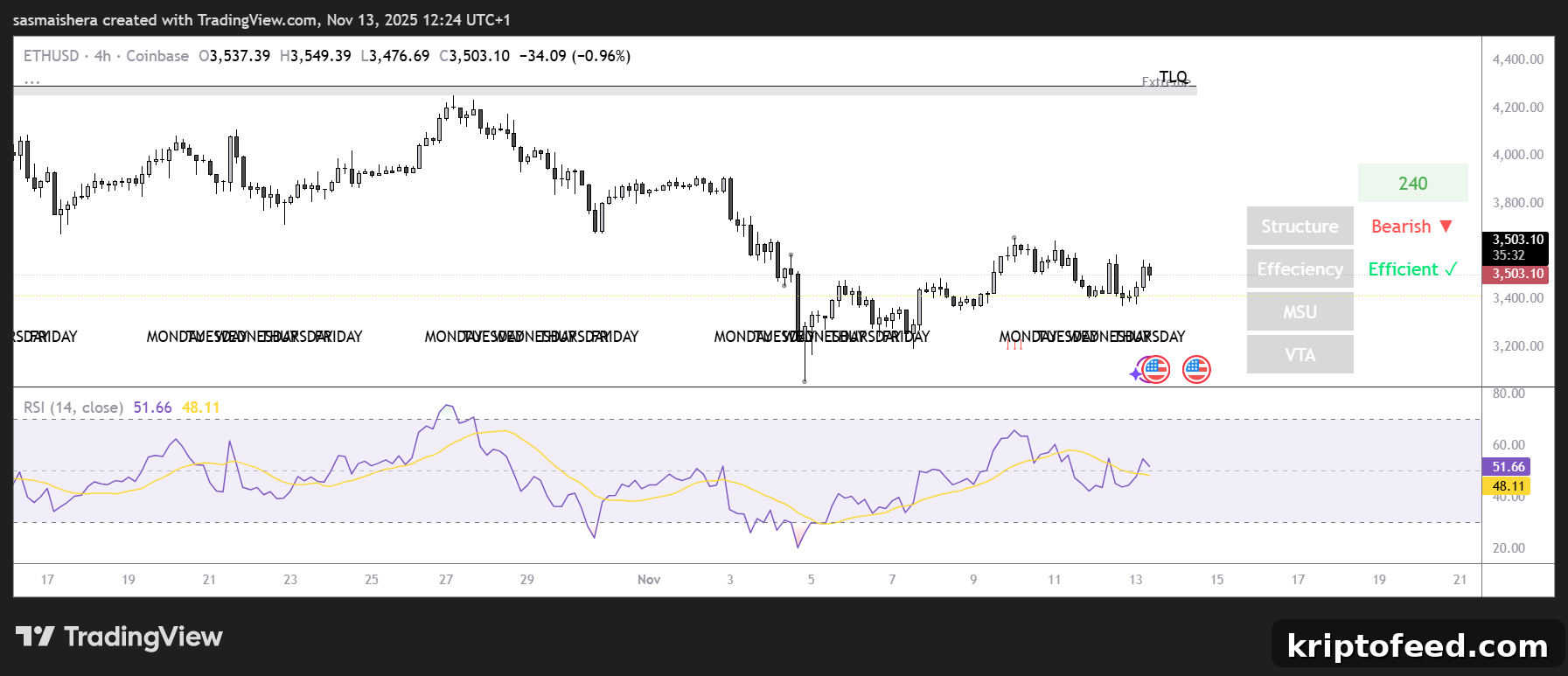
If ETH can maintain a recovery above $3,470, the path toward $3,900 becomes more plausible, though the $3,660 zone presents a near-term hurdle. Failure to clear that resistance could lead to a retest of $3,470, and a deeper decline might push prices toward the next support near $3,100.
Momentum indicators show the Relative Strength Index (RSI) at about 51, reflecting a neutral-to-fading bearish bias. The MACD remains below the neutral line but could cross into bullish territory if buying pressure continues and the recovery strengthens.