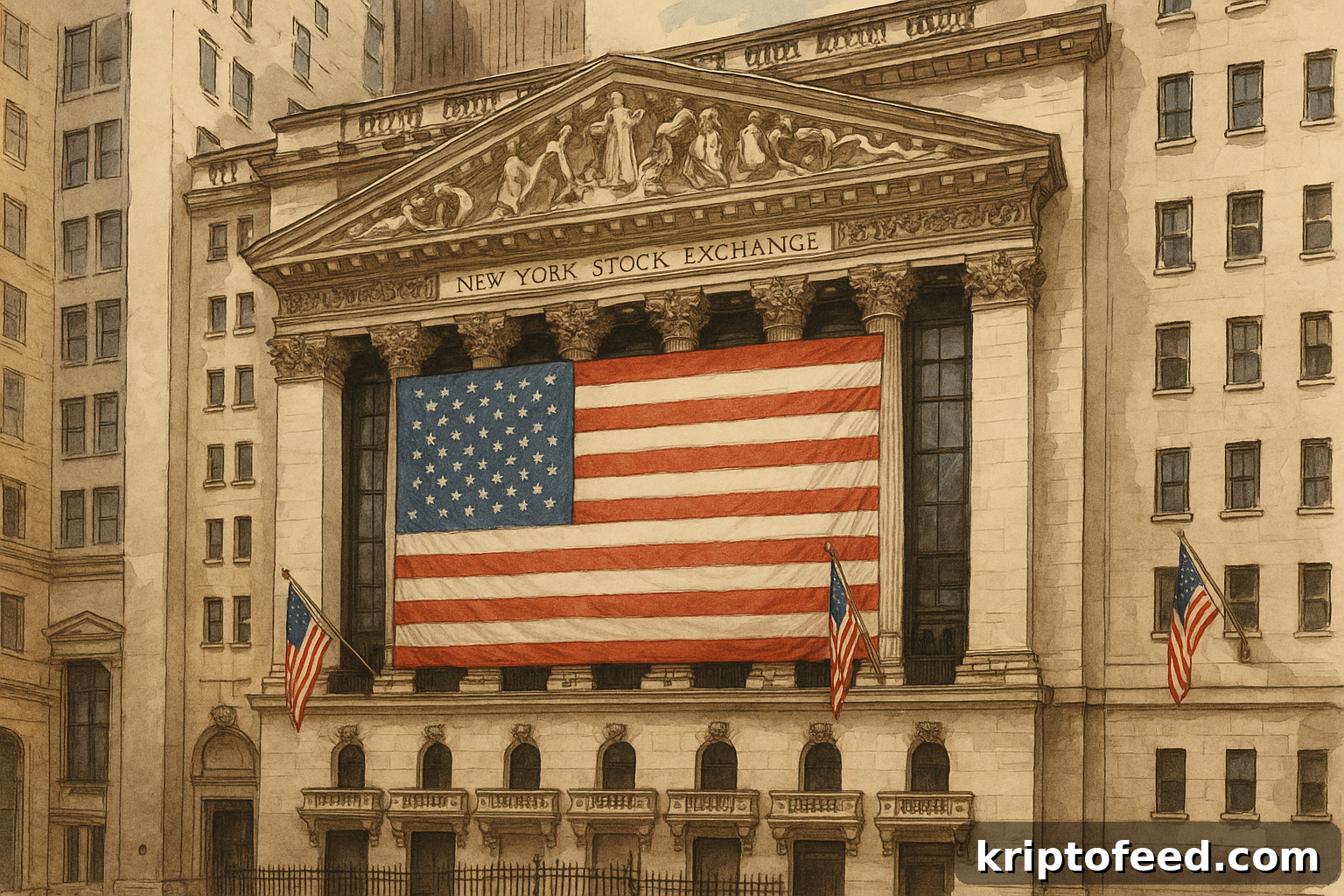
- Satoshi Nakamoto statue arrives at NYSE, marking crypto’s growing Wall Street acceptance.
- Artwork joins global series as Bitcoin’s history and mainstream adoption gain symbolic recognition.
- Institutional embrace of Bitcoin accelerates as public entities hold over 3.7M BTC.
The New York Stock Exchange has become the latest location for Valentina Picozzi’s “disappearing” Satoshi Nakamoto statue, a sign of how far digital assets have come since the era when crypto was unwelcome on Wall Street.
The piece’s arrival was announced on X on Wednesday, positioning the NYSE as common ground between traditional finance and emerging decentralized systems.
The installation coincides with the anniversary of the Bitcoin mailing list, launched on December 10, 2008, adding symbolic resonance to a moment that underscores Bitcoin’s shift from a niche idea to a mainstream fixture.
NYSE installation
The statue was brought to the NYSE by Twenty One Capital, a Bitcoin company that began trading this week.
The artwork is by Valentina Picozzi, who has developed a “disappearing” Satoshi series under her Satoshigallery name.
The New York installation is the sixth piece in a global project she plans to expand to 21 locations.
Picozzi described placing the sculpture at such a prominent financial center as a milestone for the ongoing series.
The display at the NYSE stands in stark contrast to the period when crypto was widely considered taboo across Wall Street.
Bitcoin’s long path
The statue’s arrival aligns with a key date in Bitcoin’s history, near the anniversary of the mailing list that Satoshi Nakamoto launched on December 10, 2008.
Nakamoto mined the genesis block on January 3, 2009, creating the first 50 Bitcoins and laying the foundation for the industry that followed.
On May 22, 2010, Laszlo Hanyecz made the first documented Bitcoin purchase, spending 10,000 Bitcoin to buy two pizzas—a milestone often cited to illustrate Bitcoin’s early beginnings and later rise in value.
In the years after those early events, Bitcoin faced significant resistance: institutions and banks largely kept their distance, and governments attempted to restrict crypto activity through policies many described as Operation Chokepoint 2.0. Even high-profile skeptics in global finance initially dismissed the technology before revising their positions.
Institutional shift
The landscape began to change as major financial figures and institutions moved from skepticism toward active engagement. Leaders such as BlackRock’s Larry Fink signaled renewed interest, and Wall Street participation increased through exchange-traded funds and direct Bitcoin purchases by corporate treasuries.
Public companies, private firms, countries, and ETFs together now hold more than 3.7 million Bitcoin, a collective position that Bitbo estimates is worth in excess of $336 billion. Those figures illustrate how deeply Bitcoin has been integrated into mainstream portfolios and institutional strategies.
Against this backdrop, the NYSE installation acts as a visible marker of crypto’s integration into financial culture rather than its continued status as an outsider technology.
Global statue project
Picozzi’s work has already taken the Nakamoto figure to locations including Switzerland, El Salvador, Japan, Vietnam, and Miami, Florida. The collection is intended to reach 21 statues worldwide, a symbolic nod to Bitcoin’s capped supply of 21 million tokens.
The design emphasizes disappearance: the figure appears to be fading into its surroundings. The sculpture depicts Nakamoto as a hacker in a familiar seated pose, laptop open, representing both the anonymity of Bitcoin’s creator and the programmers who built the broader ecosystem.
The NYSE installation is the latest step in Picozzi’s effort to map Bitcoin’s cultural footprint through public art, linking major global locations to the technology’s origins and ongoing evolution.