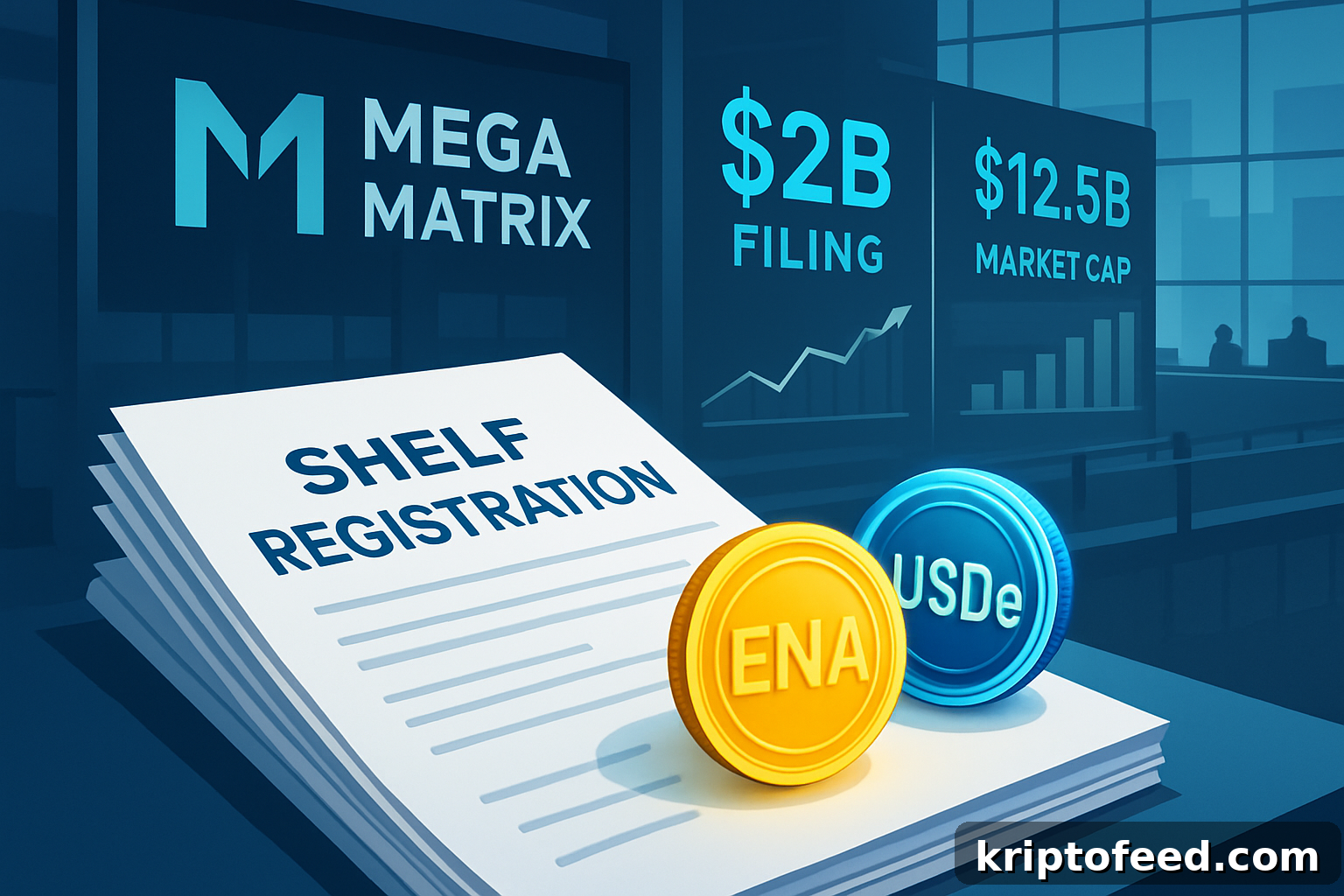
- Mega Matrix files a $2 billion shelf registration to acquire Ethena’s ENA tokens, betting on the growth of yield-bearing stablecoins.
- The USDe stablecoin’s market cap has risen to $12.5 billion, and accelerated adoption could drive revenues to $500 million.
- Analysts warn that yield-bearing digital assets carry risks, comparing them to the CDO products tied to the 2008 crisis.
Mega Matrix, a publicly traded holding company rooted in short-form streaming media, is making a bold pivot toward digital asset fund management.
The company has filed a $2 billion shelf registration with the U.S. Securities and Exchange Commission (SEC) to support a strategy centered on the Ethena stablecoin ecosystem—one of the largest filings of its kind by a company of this size.
This move reflects a growing trend of smaller firms diversifying into digital assets as an asset‑allocation strategy, despite ongoing questions about stability and risk in the sector.
Building exposure to Ethena’s ENA governance token
Mega Matrix says proceeds from the shelf registration will be dedicated to accumulating ENA, the governance token of the Ethena protocol.
Ethena operates USDe, a synthetic stablecoin designed to maintain its dollar peg using collateral hedged with perpetual futures contracts.
Unlike fiat-backed stablecoins such as USD Coin (USDC) or Tether (USDT), USDe generates yield from funding rates in the derivatives market.
Once Ethena’s “fee conversion” mechanism is activated, ENA holders are expected to receive a portion of protocol revenues, allowing investors to indirectly capture yields produced by USDe.
By concentrating on ENA, Mega Matrix aims to gain governance influence over Ethena while participating in the protocol’s revenue model.
The company cites the rapid rise of Circle—the issuer of USDC—and the expanding role of digital assets as treasury holdings as key drivers behind its decision.
Mega Matrix also notes that proposed U.S. legislation, such as the so-called GENIUS Act, which would bar issuers from paying yields directly to stablecoin holders, has increased demand for synthetic yield alternatives like USDe.
Rapid growth of Ethena in the stablecoin market
Ethena Labs, the developer behind USDe, has seen fast expansion despite the relative novelty of its model.
In August, the firm reported cumulative interest revenues exceeding $500 million.
According to CoinMarketCap data, USDe’s market capitalization has grown to $12.5 billion, making it the third-largest stablecoin globally by that measure.
While Ethena remains much smaller than fully collateralized competitors like USDT and USDC, its unique structure and yield-generating capability position it as an emerging contender in the stablecoin landscape.
Investors are watching its growth closely, seeking alternatives to traditional fiat-backed stablecoin models.
Risks and industry context
Mega Matrix’s $2 billion shelf registration is notable given the company’s relatively modest market capitalization of $113 million.
The company reported $7.74 million in revenue for the most recent quarter and a net loss of $2.48 million, with its core business still tied to its short-form streaming platform, FlexTV.
Earlier this year, Mega Matrix also purchased $1.27 million worth of Bitcoin as part of its gradual shift into digital assets.
It is not alone: other firms such as ETHZilla, BitMine Immersion Technologies, SharpLink Gaming, and Bit Digital have similarly reoriented their financial strategies to emphasize cryptocurrencies.
Analysts caution that this approach comes with significant risk.
Josip Rupena, CEO of lender Milo, compared engineered yield-bearing digital assets to collateralized debt obligations (CDOs), which played a central role in the 2008 financial crisis.
He warned that investors may not always fully understand the exposures they are taking on.
As Mega Matrix begins deploying its Ethena-focused plan, the strategy highlights both the appeal and the hazards of using digital assets as corporate treasury tools.
Its success may hinge on continued growth of USDe and the broader stability of the cryptocurrency ecosystem.