
- X’s API ban deleted Yaps and removed most of KAITO’s real token utility.
- Insider wallet transfers before the shutdown intensified selling pressure.
- KAITO’s price has fallen below key support, leaving the token trading near a historic low.
Kaito has officially begun winding down its Yaps product after losing access to X’s API, marking a pivotal turning point for the project and its token economy.
The decision follows a recent policy change from X (formerly Twitter) that banned applications which reward users for posting content on the platform.
X cited an increase in AI-generated spam and low-quality engagement as the primary reason for revoking API access for so-called “reward-for-posting” or InfoFi apps.
Why X’s move forced Kaito to shut down Yaps
Yaps was Kaito’s flagship product and the core driver of user engagement across the ecosystem.
The program rewarded users with KAITO tokens for creating and interacting with crypto-related posts on X.
For many participants, Yaps was the main reason to hold and use the KAITO token.
Industry estimates suggested Yaps represented roughly 70% of KAITO’s practical token utility.
As a result, the shutdown triggered an immediate and severe demand shock for the token.
Kaito confirmed that Yaps’ incentive program and its associated leaderboards would be discontinued rather than adapted.
The company said the product could not operate under X’s new API restrictions.
This forced exit highlighted the risks of building token-driven engagement models on centralized social platforms.
Thousands of users were affected by the change almost overnight.
Data shared by market trackers shows approximately 157,000 Yaps-related accounts were suspended or deactivated after the policy enforcement.
The sudden loss of users accelerated selling pressure as participants exited positions tied to the shuttered program.
Market reaction and insider trading concerns
The market reaction to Yaps’ closure was swift and decisive.
KAITO fell 19.5% in 24 hours, significantly underperforming the broader crypto market, which declined only about 1.05% over the same period.
The token dropped to roughly $0.5449 and slid close to its December low of $0.4717.
Trading volume surged above $153 million in 24 hours, exceeding the project’s daily market cap turnover.
That spike in volume suggested conviction-driven selling rather than a temporary volatility event.
Sentiment worsened after allegations of insider selling began circulating within the crypto community.
On-chain analysts flagged a wallet associated with the Kaito team that deposited 5 million KAITO tokens—worth about $2.7 million at the time—to Binance.
The transfer occurred roughly seven days before the public announcement of Yaps’ shutdown.
The deposit represented nearly 2% of circulating supply and was the largest exchange inflow for KAITO in the past 90 days.
While no wrongdoing has been proven, the timing raised concerns about information asymmetry.
Retail holders interpreted the move as a potential loss of confidence from insiders.
That erosion of trust amplified the downward pressure already created by the loss of token utility.
At the same time, Kaito is attempting to reposition its business model.
The company announced a shift toward Kaito Studio, a product focused on connecting brands with approved creators.
Unlike Yaps, the new model emphasizes quality-driven marketing and analytics over mass token incentives.
This transition reduces reliance on retail participation but creates uncertainty about KAITO’s future role.
It remains unclear whether brands will be required to use KAITO as a payment or settlement token.
Without a clearly defined demand loop, justifying token value appreciation in the short term becomes more difficult.
KAITO price analysis and ecosystem transition
Technically, KAITO confirmed a bearish breakdown.
The price fell below the critical support at $0.60, which had functioned as both a psychological and structural floor.
Momentum indicators turned decisively negative after the breakdown.
The MACD histogram moved into bearish territory while the RSI hovered near 44, implying further downside remained possible.
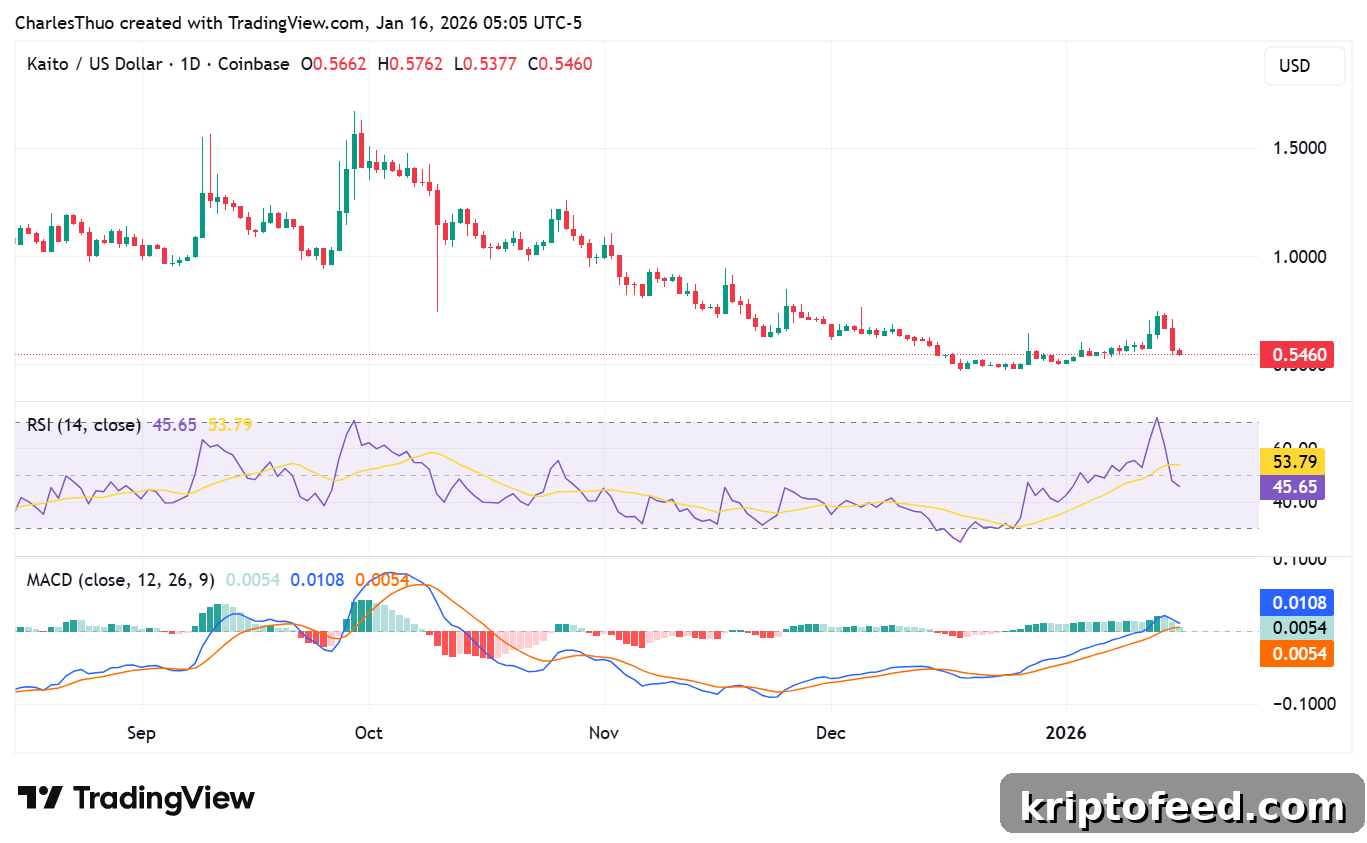
Algorithmic trading systems also appeared to accelerate selling after the $0.60 support was lost.
With limited historical support below current levels, the next major technical target sits near $0.47.
Kaito price outlook
KAITO is currently trading around $0.5449 with a market capitalization near $131 million and a fully diluted valuation of about $540 million.
The large gap between circulating and total supply highlights the risk of ongoing dilution.
In the short term, price action remains fragile while KAITO trades below the $0.60 resistance zone.
If it fails to hold above $0.50, the door opens for a revisit of the $0.47 low.
Any relief rallies are likely to encounter heavy selling from locked holders near former support levels.
A sustained bullish reversal would require reclaiming $0.60 with declining sell volume.
Fundamentally, clarity around insider wallet activity and transparent communication from the team will be critical.
Long-term upside depends on whether Kaito Studio can create genuine demand that directly incorporates the KAITO token.
Until that narrative is proven, KAITO will likely remain volatile and sentiment-driven.
For now, the market appears to be pricing in caution rather than confidence.