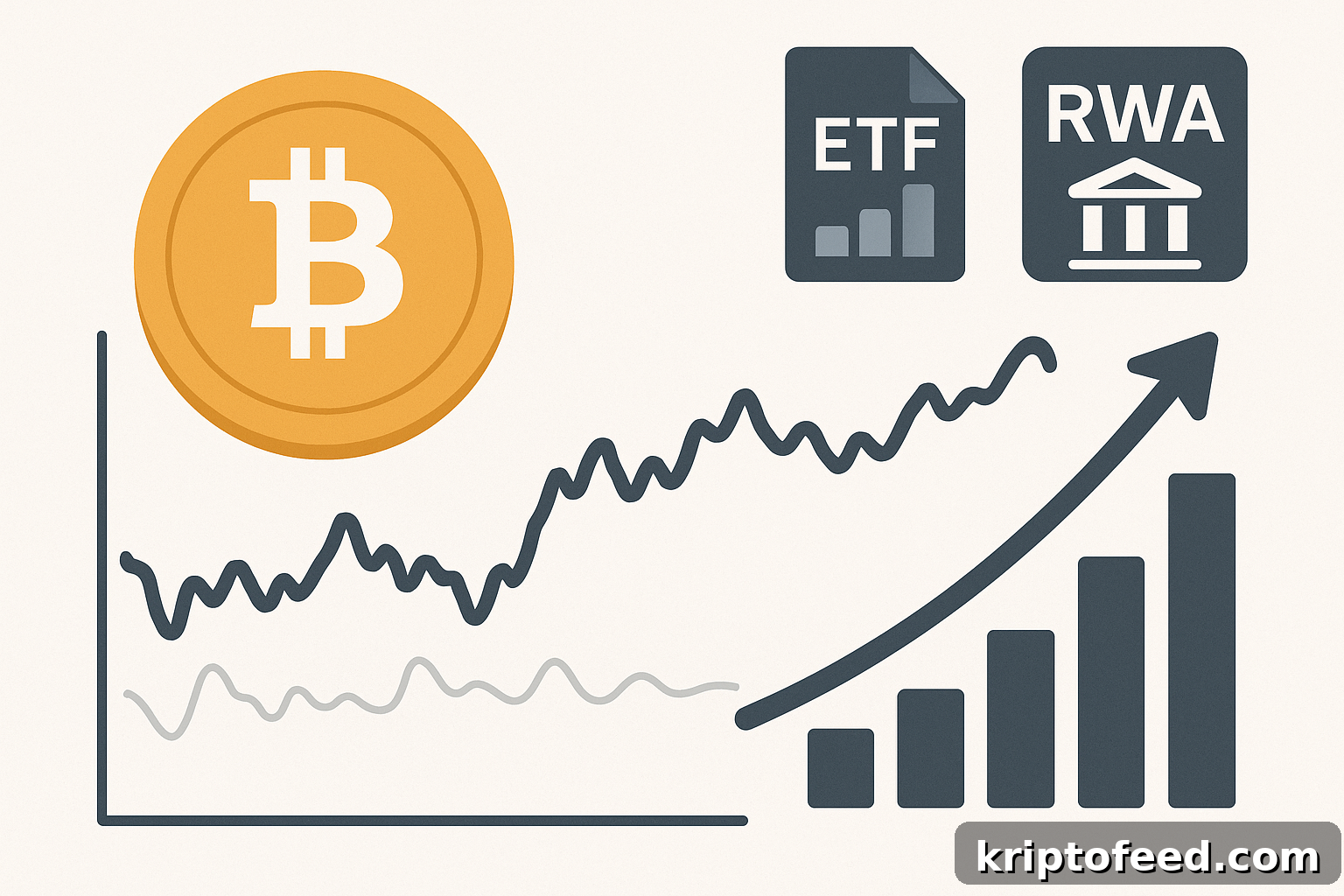
- In the 2025 Bitcoin cycle, institutional flows increase, volatility falls, and market liquidity deepens.
- Tokenized real-world assets grow to $24 billion, accelerating institutional adoption and on-chain activity.
- ETFs reshape Bitcoin liquidity while stablecoins remain central rails in a more mature digital-asset market.
The latest Bitcoin cycle is unfolding within a markedly different market structure. Data from Glassnode and Fasanara Capital point to deeper institutional participation, rapid expansion of tokenized real-world assets, and a notable decline in volatility.
Their Q4 Digital Assets Report highlights how Bitcoin’s behavior has shifted as regulated investment channels expand and liquidity stabilizes across spot, derivatives, and on-chain markets.
The findings show how ETF flows, improved settlement mechanisms, and broader adoption of tokenized instruments are steering the digital-asset ecosystem into a more mature phase.
These structural changes will shape how capital moves through Bitcoin in 2025.
Institutional flows reshaping the cycle
According to the report, Bitcoin has attracted roughly $732 billion of new capital during this cycle.
That influx has coincided with a clear drop in one-year realized volatility—nearly halving compared with previous levels.
Glassnode connects this trend to greater market depth and a larger share of trading driven by institutional strategies.
The report also notes that Bitcoin has facilitated about $6.9 trillion in payments over the past 90 days, putting its payment throughput on a scale comparable to networks such as Visa and Mastercard.
Even as trading increasingly shifts toward ETFs and brokerage channels, the report emphasizes that Bitcoin and stablecoins still dominate value transfer on public blockchains.
ETF channels deepen liquidity
Demand tied to ETFs has changed how investments enter and exit Bitcoin.
Rather than relying primarily on on-chain transfers or centralized exchanges, a larger portion of flows now runs through regulated investment vehicles.
The report finds this shift has supported smoother liquidity conditions and fewer abrupt price moves in spot markets.
Traditional market makers and arbitrage firms have increased their presence thanks to ETF participation.
Their activity has narrowed spreads and helped reduce disruption during selling pressure.
This development reflects a closer alignment between digital-asset markets and established financial infrastructure.
Tokenized RWAs accelerate
Tokenized real-world assets have surged from $7 billion to $24 billion over the year.
Glassnode attributes this rise to stronger institutional demand—from pension funds and hedge funds to corporations—seeking on-chain exposure to familiar financial instruments.
Tokenized funds have gained momentum as asset managers experiment with new distribution models and investors seek streamlined access to traditional assets.
Platforms for tokenized RWAs have strengthened custody, settlement, and compliance capabilities.
That foundation has encouraged steady inflows throughout 2025, supporting a growing market segment that links traditional assets to blockchain settlement rails.
The evolving role of stablecoins
Glassnode describes the market structure as larger and more stable than in previous cycles.
Data shows deeper liquidity across spot, derivatives, and on-chain channels, helping to foster a more measured trading environment.
Lower volatility has become a defining feature of this cycle, influenced by institutional trading strategies that often rely on steady allocation models.
Stablecoins continue to serve as key connectors between traditional and digital financial systems.
The report notes that settlement demand for stablecoins remains significant on both centralized and decentralized platforms.
Glassnode characterizes a dual-rail system—stablecoins alongside traditional infrastructure—as a persistent part of the ecosystem, supporting both institutional flows and retail activity.
Analysts cited in the report expect institutional participation to broaden further as tokenized funds gain wider acceptance.
Glassnode frames this phase as a turning point defined by heavier institutional flows, growing tokenization, and reduced volatility.
Together, these factors suggest that Bitcoin and the broader digital-asset sector are transitioning into a structurally more mature environment in 2025.