- Cronos EVM v1.5.0 officially launched today, October 30
- This upgrade introduces new EVM opcodes, smart accounts, and improved interoperability
- “Smarturn” targets a more flexible, faster, and developer-friendly blockchain
The Cronos blockchain has announced the rollout of the long-anticipated Smarturn upgrade, marking a new phase in the network’s evolution.
This update brings significant improvements to Cronos’ Ethereum Virtual Machine (EVM), including enhanced interoperability, ecosystem performance gains, and smoother wallet functionality.
According to the announcement:
This mainnet upgrade represents a major step forward for Cronos — unlocking smart accounts, introducing new EVM features, and delivering better performance for both developers and end users.
🚀 Cronos EVM upgrade complete — “Smarturn” is here!
This mainnet upgrade marks a major leap in Cronos’ evolution — unlocking smart accounts, new EVM features, and improved performance for developers and users alike.
Here’s what’s new 👇 pic.twitter.com/6Vi4K8BUbL
— Cronos (@cronos_chain) October 30, 2025
The network paused briefly for about 60 minutes to integrate the new components.
Services have been gradually restoring as the Cronos ecosystem adopts the upgrade.
Smarturn aims to reshape Cronos by delivering faster processing and greater compatibility through targeted innovations.
Smarter accounts arrive on Cronos
At the core of this upgrade is support for advanced smart accounts via EIP-7702. With this feature, ordinary wallets — externally owned accounts (EOAs) — can behave like smart contract wallets.
That unlocks capabilities that previously required separate contract-based accounts. As the official blog explains:
EIP-7702 closes the gap by allowing EOAs to act like smart contracts. Preset contract logic remains available until the account revokes authorization, and can be applied to a single chain or across multiple chains simultaneously.
Users can now perform actions without changing account types, including flexible gas payment methods, delegated permissions, batching many transactions, and programming wallet behavior.
By adopting EIP-7702, Cronos joins a small set of EVM-compatible platforms offering this account abstraction, combining automated control with straightforward usage.
This functionality is expected to improve DeFi platforms and decentralized applications (dApps) on Cronos by boosting usability and operational efficiency.
Significant performance gains
Cronos also upgraded its EVM runtime to run on go-ethereum v1.15.11, aligning with Ethereum’s Prague and Cancun enhancements.
The update aims to make contract execution and transactions cheaper and faster.
It also introduces broad client improvements and new EVM opcodes on Cronos to boost performance, developer experience, and debugging. The team noted:
These opcodes make contract execution more efficient for complex DeFi protocols, gaming contracts that handle many operations per transaction, and other applications requiring heavy computation.
Overall, these upgrades make the Cronos EVM runtime faster, lighter, and more developer-focused.
Improved interoperability and developer tools
Smarturn enhances infrastructure for cross-chain builders and developers.
For example, a new RPC data endpoint enables fetching an entire block’s data in a single query — a win for dApp backends, analytics dashboards, and blockchain explorers.
Additionally, the mempool now supports canceling or speeding pending transactions, improving responsiveness during heavy network load.
Cronos also implemented IBC v2 via ibc-go v10.1.1 to strengthen cross-chain communication.
CRO price trend
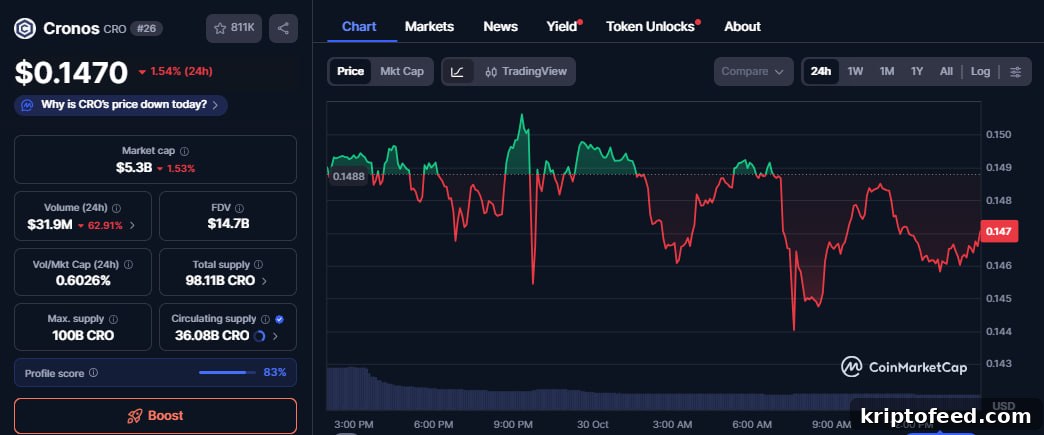
CRO was trading at $0.1470 after a roughly 1.5% decline over the past 24 hours.
Daily trading volume fell by more than 60%, signaling reduced market enthusiasm.
That said, CRO largely reflects broader market sentiment.
Bitcoin was trading below $110,000 after a near 3% drop in the preceding 24 hours.
The market lost momentum following cautious comments from Fed Chair Jerome Powell about the prospect of rate cuts in December.