[PRESS RELEASE – Zug, Switzerland, May 12th, 2026]
Nine protocol initiatives targeting EVM compatibility, gasless transactions, compliant security tokens, transaction privacy, AI agent micropayments, and quantum-safe cryptography
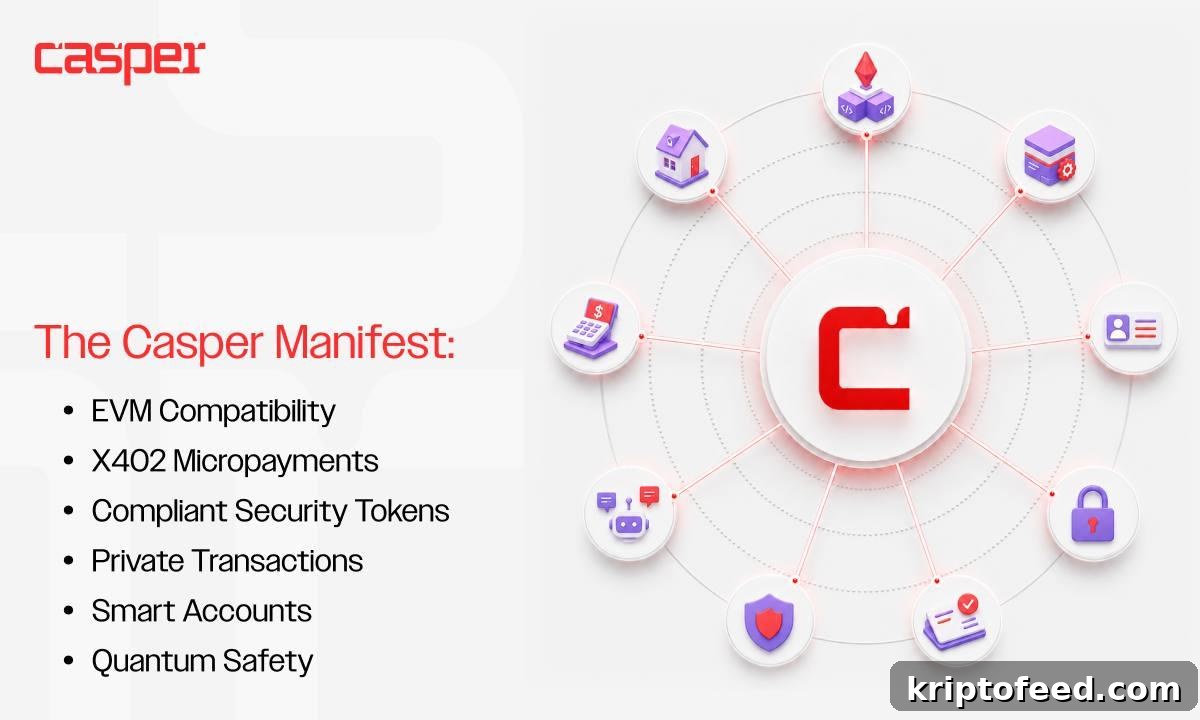
The Casper Association today published the Casper Manifest, a multi-year technical roadmap to position Casper Network as the infrastructure layer for regulated real-world asset tokenization and the emerging machine-to-machine economy.
The Manifest was presented by Casper Association President & CTO Michael Steuer at the Digital Finance Forum in Bermuda before an audience of leaders from Web3, traditional finance, and institutional finance.
Building on major protocol releases delivered since mid-2025, including Casper 2.0 with deterministic finality and a multi-VM execution layer, the Manifest outlines nine coordinated initiatives with a single objective: make blockchain frictionless for users, trusted by institutions, and native for machines. The roadmap brings Ethereum Virtual Machine (EVM) compatibility to Casper’s WebAssembly foundation, advances gasless transactions and smart accounts for simpler user experiences, and expands the compliance, privacy, micropayment, native token, and quantum-safe infrastructure needed for real-world assets and autonomous systems to operate with greater predictability and less friction.
Building the infrastructure for regulated assets and autonomous systems
The nine core initiatives in the Casper Manifest are organized around these areas:
Access for every developer. The largest blockchain developer ecosystem is built on Ethereum tooling—Solidity, MetaMask, and thousands of audited smart contract libraries. Casper is adding full EVM compatibility alongside its existing WebAssembly execution engines so developers can bring contracts, tools, and wallets to Casper without modification. A native token registry will provide equal access to tokens from either environment. One chain, two execution environments, zero fragmentation.
Blockchain that’s frictionless for users. Someone else pays your transaction fees. Multiple steps collapse into a single action. You sign in with your fingerprint instead of managing cryptographic keys. The Casper Manifest implements gasless transactions, batch operations, and smart accounts that support biometric authentication—so interacting with blockchain applications feels like using any other app.
Compliance and privacy as one system. Casper aims to be the first Layer 1 where regulatory compliance and transaction privacy are designed to work together. The network will support compliant security tokens with on-chain identity verification, transfer restrictions, and jurisdictional controls aligned with the ERC-3643 standard that already governs billions in tokenized assets. As a member of the ERC-3643 Association, the Casper Association contributes to expanding the standard. Alongside compliance, a multi-phase privacy roadmap will deliver confidential transactions with fixed, predictable costs and built-in tools for auditors and regulators to verify compliance without exposing transaction details publicly. Privacy and compliance are treated as two sides of the same system, designed for the large and growing real-world asset tokenization market.
Native infrastructure for the machine economy. AI agents need to pay for services programmatically—per API call, per data query, per computation—without subscriptions, invoices, or human intermediaries. As a member of the X402 Foundation, Casper is implementing the X402 open payment standard, enabling machines to pay each other over HTTP in stablecoins and other fungible tokens. Casper expects to become the first WebAssembly-native Layer 1 with production X402 support. The same smart accounts and gasless infrastructure built for human users will give AI agents scoped spending permissions and autonomous operation out of the box, providing strong controls and compliance for machine-driven payments.
Tokens as first-class citizens. On many blockchains, user-created tokens are implemented as smart contracts that incur higher operational costs than native currency transfers. Casper’s Native Token Registry elevates tokens to protocol-level status with the same fixed, predictable costs as native transfers. A single pricing model will apply to all tokens and a single infrastructure layer will be shared across WebAssembly, EVM, and future execution environments on Casper Network. This registry provides the backbone for use cases ranging from DeFi to compliant security tokens and private, confidential transfers.
Quantum-safe from the start. No major smart contract platform has shipped post-quantum transaction signing in production. Casper plans to deliver hybrid accounts that contain both classical and quantum-resistant keys during a transition period. For institutions evaluating blockchain platforms for decade-long deployments, Casper aims to offer production-ready solutions to address the risks posed by future quantum computers rather than leaving those concerns to research papers.
“Much of the industry is focused on either maximizing hype, or iterating on concepts that service the same existing, crypto-native use cases. Few are building the infrastructure that will onboard the next billion users, the next trillion dollars in tokenized assets, or the first billion machines,” said Michael Steuer, President and CTO of the Casper Association. “Executing the Casper Manifest means developers can bring their entire EVM stack. For users, blockchain should be invisible—one tap, done. For institutions, Casper’s roadmap provides on-chain compliance, transaction privacy, and quantum safety. And machines need payment rails that don’t require a human, while being bound to spending limits set by their owners on smart accounts. That’s the future-proof infrastructure Casper is building.”
Timeline
The nine initiatives will roll out over time rather than all at once. The first initiative, X402 micropayments, is expected to ship in the coming weeks. Later in 2026, Casper will deliver EVM compatibility, networking hardening, and compliant security token features. These releases will be followed by the Native Token Registry, gasless transactions, batch operations, and smart accounts. Transaction privacy and quantum safety initiatives will build on the earlier releases through 2027. Formal protocol enhancement proposals for each initiative will be published.
Explore a detailed overview of the Casper Manifest at the Casper Network news page.
About Casper Network
Casper Network (CSPR) is a Layer 1 Proof-of-Stake blockchain engineered for regulated real-world assets and the machine economy. With deterministic transaction finality, a multi-VM execution layer supporting WebAssembly and soon EVM smart contracts, and fixed-cost operations enforced at the protocol level, Casper provides infrastructure for compliant asset tokenization, frictionless consumer experiences, and autonomous machine-to-machine commerce. The Casper Manifest advances nine coordinated protocol initiatives spanning developer access, user experience, institutional compliance, privacy, micropayments, and quantum safety. The Casper Association, a non-profit based in Zug, Switzerland, oversees protocol development and ecosystem growth.
Full Casper Manifest: https://casper.network/news/manifest