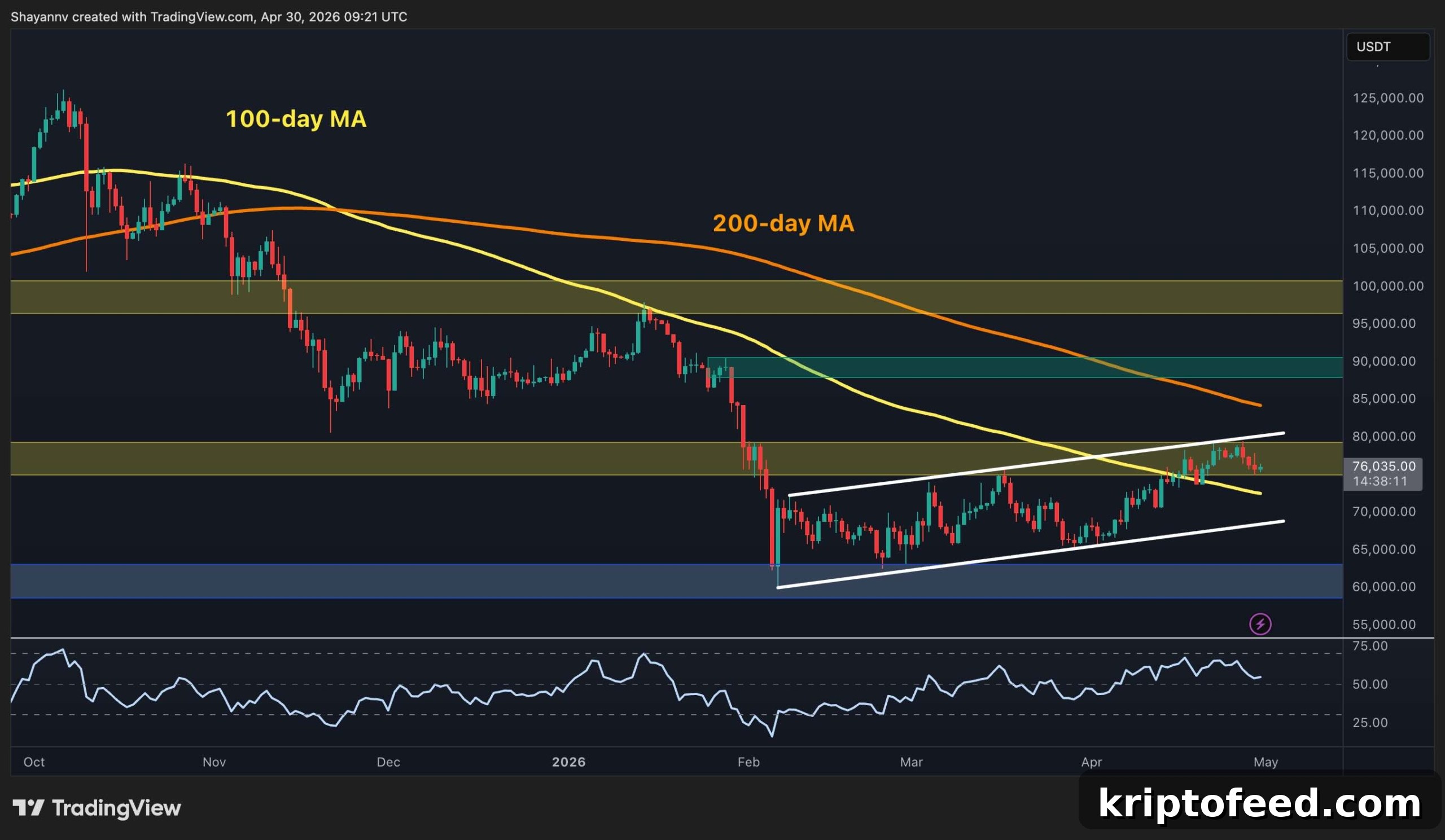
Bitcoin closes out April around $76,000, finishing the month at a level that aligns with the key technical battleground. The recovery from February’s low near $60,000 has been steady rather than explosive. After a late attempt to push toward $80,000 failed to hold, BTC pulled back to retest important structural levels as markets head into May. Beneath the price action, futures order flow is revealing additional nuance that the chart alone does not fully convey.
Bitcoin Price Analysis: The Daily Chart
Since the February low, Bitcoin has formed a clear ascending channel, with the lower boundary currently providing support near $70,000. Following the rejection at the channel’s upper boundary and the $80,000 resistance area, the price is likely to test the declining 100-day moving average around $72,000. The daily RSI sits in the 50–55 range, down slightly from its mid-April peak, which reflects a consolidating market rather than a decisive trend reversal.
The ascending channel remains intact as long as $75,000 holds on a daily close. A bounce from these levels that reclaims $80,000 would keep the recovery scenario intact and set the stage for a test of the 200-day moving average around $85,000 and potentially the $90,000 supply zone. Conversely, a sustained close below the channel floor would represent significant structural damage and refocus attention on the $60,000 demand zone near February’s low.
BTC/USDT 4-Hour Chart
On the 4-hour timeframe, the steeper trendline that propelled the sharpest leg of April’s rally has been broken, and price has retreated from the $80,000 upper channel boundary to sit just above the $76,000 support zone. The 4-hour RSI has fallen to around 40—the weakest reading seen over the past week—indicating short-term momentum has cooled and that buyers should not take this support for granted.
The broader ascending channel that began in early April remains intact, with its lower boundary near $68,000—well below the current price—so the larger structure has not been threatened. What has changed is the character of the move: losing the inner trendline suggests the easier, low-resistance portion of April’s rally is behind us.
If the $74,000–$75,000 support zone holds cleanly and price bounces from there, it would indicate the pullback is corrective and that a new leg toward $80,000 is forming. Failure to protect $74,000, however, would likely open the mid-channel area near $72,000 as the next logical support, followed by the channel’s lower boundary around $68,000.
Sentiment Analysis
During the corrective period from late 2025 through March 2026, Bitcoin’s futures market was dominated largely by retail-sized orders, with smaller positions visible across a wide price range from $110,000 down to $62,000. That pattern reflects a correction mostly driven and sustained by smaller participants capitulating in a downtrend. The first notable shift occurred near the February low, when clusters of large whale futures orders appeared—marking the first institutional-scale futures activity in months.
April has amplified that signal. A new cluster of large whale futures orders is forming around the $75,000 zone and has been densifying over the past two weeks as price consolidates. Unlike earlier spot accumulation during the cycle, these are leveraged futures positions. Whales are not only accumulating spot exposure; they are increasingly expressing directional conviction through futures.
That distinction is important. Leveraged futures positions suggest higher conviction on potential upside from current levels, or they can reflect hedging to protect spot holdings against downside risk. Therefore, if $75,000 holds as a reliable floor, the futures order flow increases the probability that the next significant move will be upward toward $80,000 and beyond rather than a resumption of the correction.