- A Venus Protocol user suffered massive losses after authorizing a malicious transaction.
- The attacker took just seconds to drain vUSDT, BTCB, vETH, vXRP, and vUSDC from the victim’s wallet.
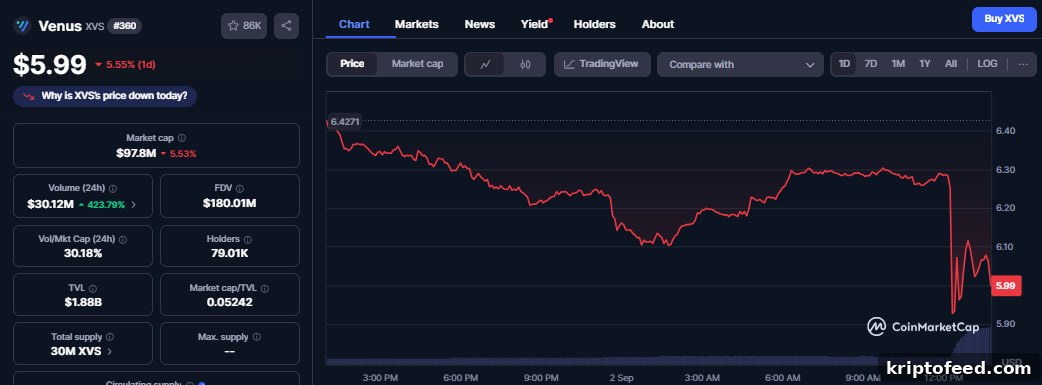
- Venus Protocol’s native token fell sharply after the incident became public.
While the broader crypto market showed relative stability on Tuesday, the daily chart for XVS turned red after reports emerged that a Venus Protocol user fell for a sophisticated phishing scam and lost roughly $27 million in digital assets.
What drew attention was how the theft unfolded: it was not the result of a protocol vulnerability but a simple user error.
On-chain investigator PeckShield reported that the victim approved a malicious transaction, unknowingly granting token transfer approval to the attacker’s address (0x7fd8…202a). Once approval was granted, the attacker’s burner wallet immediately transferred the assets away.
The entire drain happened in seconds, wiping out what the victim likely accumulated over years. Incidents like this highlight the harsh reality of DeFi, where a single mistaken approval can lead to catastrophic financial loss.
The breakdown of the stolen assets is as follows:
- $19.8 million in vUSDT
- $7.15 million in vUSDC
- $146,000 in vXRP
- $22,000 in vETH
- 285 BTCB (Bitcoin on BNB Chain)
Those figures represent what many would consider generational wealth, now gone due to social engineering rather than any technical breach of Venus Protocol itself.
Venus Protocol remains secure
A key question for the community was whether Venus Protocol had been compromised. The answer is no. The BNB Chain-based lending and borrowing protocol remained secure and fully operational. The $27 million loss did not stem from a coding flaw, systemic exploit, or smart contract bug.
Instead, this attack fits a broader pattern of social engineering scams in DeFi where attackers trick users into granting token approvals. Earlier examples include a June case where a scammer used social engineering to steal more than $4 million from a Coinbase user, and a much larger incident last August that saw over $240 million taken from a single victim.
The weak link in these scenarios is the wallet holder, not the protocol. Despite the victim’s loss, Venus Protocol continued functioning normally—an outcome that may add to the victim’s frustration but underscores the decentralised nature of custody and responsibility in crypto.
Risks tied to DeFi’s permissionless nature
Decentralized finance thrives on permissionless infrastructure, which enables open and efficient interactions. That same openness carries risks. Token approvals simplify interactions between wallets and decentralized applications (dApps), but granting unlimited approvals effectively hands control to another address.
If that address belongs to a fraudster, the consequences can be devastating. The Venus Protocol case is a stark example: a single approval allowed the attacker to empty the wallet. Unlike traditional finance, DeFi generally offers no refunds or customer support that can reverse such mistakes—errors are often irreversible, and the $27 million is likely unrecoverable.
XVS price outlook
News of the scam weighed on Venus Protocol’s native token. XVS dropped more than 6% on the daily chart following the disclosure and was trading around $5.99 amid heavy selling pressure. A reported 400% spike in 24-hour trading volume indicates heightened activity, likely from holders exiting positions to limit losses.
With bears dominating the price action, XVS may face further downside before it finds a stable support level.